Pakistan, UAE mull expanding cooperation in aviation sector

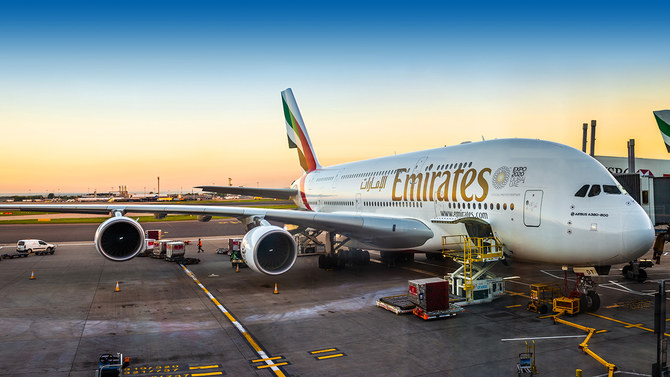
The Emirates A380 touched down in Islamabad on July 08, 2019. This was the first time ever that the iconic double- decker aircraft has landed in Pakistan. (Shutterstock)
Updated 16 July 2019
Follow

Pakistan, UAE mull expanding cooperation in aviation sector

  • UAE airlines seek to start flight operations to new destinations in Pakistan
  • Pakistan-UAE’s aviation strategy a plus for expats, minister says

ISLAMABAD: Sound bilateral relations between Islamabad and Abu Dhabi, particularly in the aviation sector, have helped a large number of Pakistani expatriates residing in the UAE, the country’s aviation minister told Arab News on Tuesday.
In talks with the UAE Ambassador to Pakistan, Hamad Obaid Ibrahim Salim Al-Zaabi on Monday, Ghulam Sarwar Khan discussed matters of mutual interest, including the promotion of ties between the two countries in the aviation sector.
A statement released after the meeting said that airlines in the UAE had also expressed a desire to start flight operations to new destinations in Pakistan.
Both Khan and Al-Zaabi “discussed bilateral relations between the two countires,” the UAE embassy tweeted on Monday.
According to the Air Service Agreement (ASA) between Pakistan and the Gulf states – which the UAE is a part of – Emirates Airlines, Fly Dubai, Etihad Airways, Air Arabia and Ras Al Khaimah Airways are the designated airlines of the UAE.
“Designated airlines of UAE also want to start flight operation between Dubai and Turbat, Gwadar and Panjgur, with unrestricted 5th freedom traffic rights through any intermediate points and to any beyond points,” excerpts from the statement said.
It added that Fly Dubai has requested for four additional frequencies for Multan which had been vacated by Emirates, adding that the request is being considered by the Civil Aviation Authority (CAA) and Pakistan’s national carrier, the PIA.
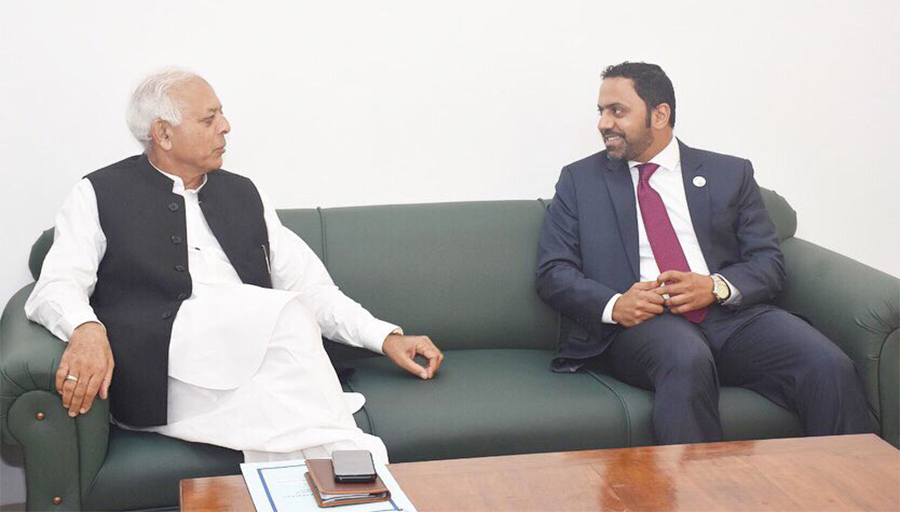


UAE Ambassador to Pakistan Hamad Obaid Ibrahim Salim Al-Zaabi, right, met with Pakistan’s aviation minister Ghulam Sarwar Khan in Islamabad on July 15, 2019. (Photo courtesy: UAE Embassy/Twitter)

PIA, Air Blue and Shaheen Air are the designated airlines of Pakistan and according to the memorandum of understanding (MoU) signed between the two countries on June 02, 2015 the three are entitled to operate unlimited number of frequencies between specific points in Pakistan and the UAE.
“Currently PIA is having 32 flight operations from Pakistan to Dubai,15 flight operations to Abu Dhabi and 9 flight operations to Sharjah. Similarly, Air Blue is currently having 20 flights to Dubai, 11 flight operations to Abu Dhabi and 18 flight operations to Sharjah,” the statement read.
Currently, Emirates and Air Dubai currently operate 134 flights between Dubai and Karachi, Islamabad, Lahore, Peshawar, Multan, Sialkot, Faisalabad and Quetta, while Etihad services 39 flight operations between Abu Dhabi and Karachi, Islamabad, Lahore, Peshawar, Sialkot and Multan; and Air Arabia operates 52 flights between the main cities of Pakistan.
According to official statistics, more than 1.6 million Pakistani expatriates live in the UAE and work in various fields in the public and private sectors.
In July last year, the Airbus A380 – the world’s largest passenger plane operated by Emirates airlines – landed at the Islamabad International Airport.
According to Emirates, the airline and Pakistan have a long-standing relationship that spans over 30 years, when the airline’s first flight flew from Dubai to Karachi on 25 October, 1985.
“Emirates also employs over 5,000 Pakistani nationals as Flight Deck crew, Cabin Crew and in various others positions across the airline,” the airline said in a statement.



Pakistan to invest $1 billion in AI by 2030 in push to modernize economy

Updated 5 sec ago
Follow

Pakistan to invest $1 billion in AI by 2030 in push to modernize economy

  • PM says government will introduce AI curriculum in schools nationwide
  • The transformation plan will help train 1 million non-IT professionals in AI

ISLAMABAD: Prime Minister Shehbaz Sharif on Monday announced that Pakistan would invest $1 billion in artificial intelligence (AI) by 2030, in a major step to modernize the South Asian nation’s digital economy.

Pakistan, a country of 240 million people, seeks to become a key participant in the global AI economy, amid growing interest from governments in the Global South to harness AI for productivity, skills development and innovation.

The South Asian nation has been actively developing its AI landscape and approved its National AI Policy in July last year, which was followed by the launch of the country’s sovereign AI cloud and a startup fund.

Speaking at the launch of the Indus AI Week 2026 in Islamabad, Sharif unveiled a multi-pronged roadmap intended to transform Pakistan from a provider of IT technicians into a global hub for AI expertise.

“I am pleased to announce that the Government of Pakistan is committed to invest $1 billion in AI by 2030, which will go a long way in building AI ecosystem in our country,” he told policymakers and international tech experts at Islamabad’s Jinnah Convention Center.

Sharif detailed several flagship initiatives to support this transformation, including a sweeping educational reform, at the event organized by the Information Technology (IT) Ministry, which will be running until Feb. 15, featuring strategic dialogues on sovereign AI and technical showcases.

“AI curriculum will be introduced not only in all federally controlled or run schools, but also in all schools of AJK, that is Azad Jammu and Kashmir, and Gilgit-Baltistan, as well as remote parts of Balochistan,” he said.

The government will provide 1,000 fully funded PhD scholarships in AI to postgraduates to bolster high-level research, according to the PM. It plans to launch a nationwide program to train 1 million “non-IT professionals in AI skills” to enhance productivity and improve livelihoods across traditional sectors of the economy.

Sharif emphasized that the focus would remain on high-impact sectors, including agriculture, mines and minerals, and the empowerment of Pakistan’s youth which makes up 60 percent of its 240 million population.

“We will, God willing, bring in programs to transform them from IT technicians to AI experts, which will lead to our agriculture production in terms of its yield, its quality, its efficiency, like never before,” he said.

Drawing parallels to previous digitization efforts in the Punjab province, such as land record digitization and the establishment of the first IT university in Lahore, Sharif framed the AI push as a “gamechanger” for national governance. He noted the Federal Board of Revenue is already undergoing a digital overhaul to curb smuggling and tax evasion.

“Pakistan is absolutely ready to accept the challenge and walk with our global partners absolutely with great commitment and dedication,” he said. “Our commitment is solid, unwavering. We will never look back.”