

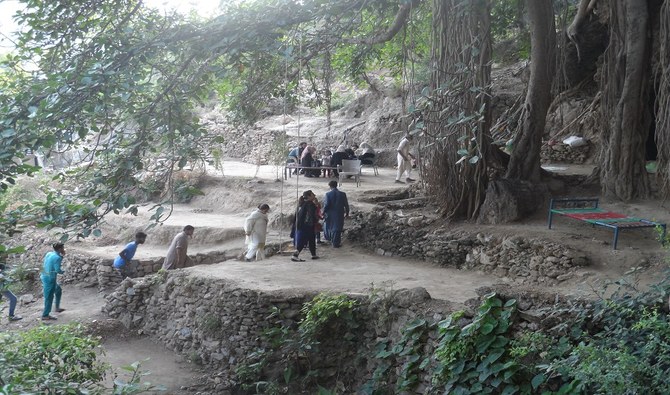
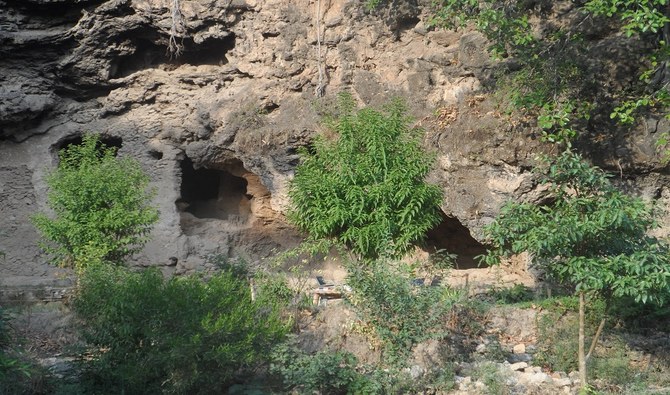

ISLAMABAD: Nestled in the Himalayan foothills in Pakistan’s cosmopolitan capital of Islamabad, a raggedly honeycomb of ancient caves in Shah Allah Ditta village is falling apart and with it, a huge part of the region’s history, from ancient Buddhism to the conquest trails of Mughal emperors, lies in jeopardy.
The 2,400 year old archaeological wonder in the Margalla Hills, a meditation site for 8th century Buddhist monks, is replete with mysterious pathways, relics, ancient murals, terraced caves, a historic mountain road and centuries-old Banyan trees with hanging roots and amulets that swing in the summer breeze.
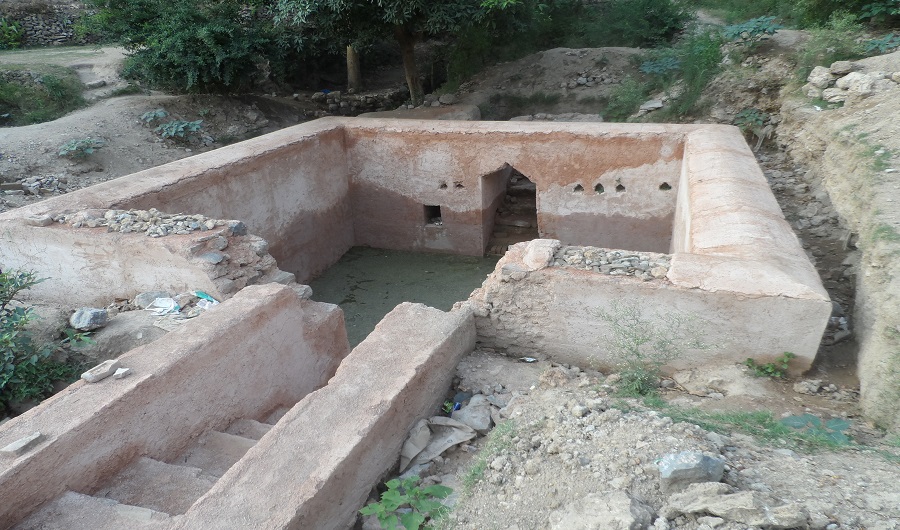
This July 8, 2019 picture captures the remains of a fresh water pool in front of the Shah Allah Ditta caves. The pool is now full of dirty water. (Aamir Saeed for Arab News)
But next to the caves, makeshift kiosks and fast-food restaurants have cropped up recently, serving up fried fritters and tea to tourists around the year. The heavy traffic and absence of conservation work has all but devastated the ancient location, and residents of the village fear that even the old ruins will soon vanish.
Muhammad Ismail, the self-appointed guardian of the site and a resident of Shah Allah Ditta village, said the rare remnants of Buddhist and Hindu religions were fading away because of a lack of preservation work and government apathy. Officials at the Department of Archaeology and Museums disputed this, saying the government was doing its best to preserve the site as well as discover new relics.
“Tourists from Japan, China and South Korea come here in huge numbers due to the religious significance of these caves,” Ismail told Arab News, pointing in the direction of a recently discovered, 2,000 year old Buddhist stupa on a mountain top where archaeological work was ongoing.
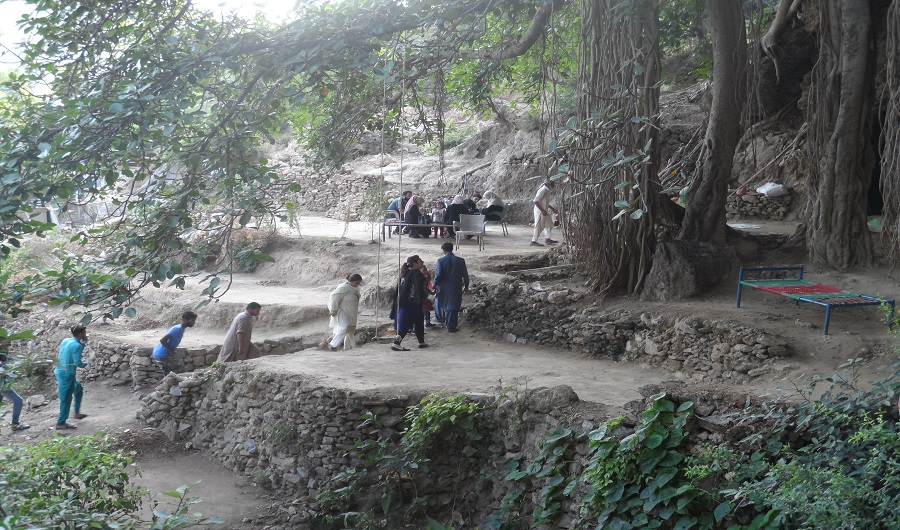
Families sit under centuries-old banyan trees in front of Buddhist caves in Shah Allah Ditta village, Islamabad, on July 8, 2019. (Aamir Saeed for Arab News)
A little over a decade ago, many of Buddhism’s most revered sites, statues and relics, including one of the largest rock sculptures in South Asia, were destroyed by militants around the Swat Valley in northwestern Pakistan before an army operation pushed the insurgents out of the valley in 2008.
Ismail said two acres of fruit orchards and a spring of fresh water were once part of Shah Allah Ditta village.
“But they have all vanished now,” he said, looking around him as the site teemed with visitors, and children grabbed the roots of the old Banyans to pose for selfies.
The village is estimated to be 700 years old, and part of an important route used by the famed Shah of Delhi, Sher Shah Suri, to get from Afghanistan to then India, as well as by other kings and emperors.
A road next to the caves that leads to the mountaintop was built on the exact path followed by Suri during his expeditions, archaeologists say.
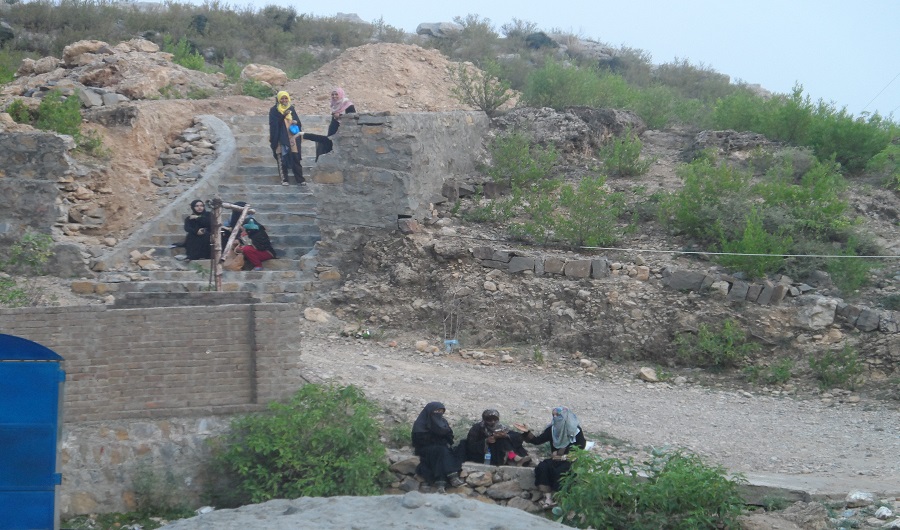
Female students from the archaeological department of the Punjab University, Lahore, visit the Shah Allah Ditta caveson July 8, 2019. (Aamir Saeed for Arab News)
Arshadullah, assistant director at the Department of Archaeology and Museums in Islamabad, said efforts were underway to discover more historic relics up in the mountains near the village, and preservation work on the discovered stupa was near completion. He added that the remains of a stepwell, built by Suri, had also been discovered in the hills overlooking the village.
“Archaeological evidence shows Sher Shah Suri and some other Mughal rulers used this area as a route from Afghanistan to Hindustan,” he said, referring to the old Persian name for India.
Abdur Rehman, an engineering student at a university near Islamabad, who had come out for a tour of the historic caves with a group of friends, said he was disappointed to see the state of the place.
“We came here to learn about our history and culture,” Rehman said. “These are relics of the Buddhist era from thousands of years ago and must be preserved,” he added, gesturing toward the restaurants and a resort near the caves where Islamabad’s Capital Development Authority insists construction work is not allowed.
“All this is destroying the ecology of the area and leading to the destruction of the caves,” Rehman said.
For its part, Islamabad’s administration has declared the Margalla Hills a national park with no commercial activity permitted, but a resort with eateries and a zip-line called ‘Sadhu’s Retreat’ is now functional nearby and at least five restaurants and a handful of kiosks are up and running in the immediate vicinity of the village and caves, visited by thousands of tourists a year.
“All unauthorized construction in the area will soon be demolished,” said Safdar Shah, a spokesman for the Capital Development Authority. “We are also devising a comprehensive plan to preserve historic places in the village.”
The subcontinent was the birthplace of four major religions, including Buddhism, Hinduism, Jainism and Sikhism, Muhammad Waqas Saleem, an anthropologist at the Quaid-e-Azam University in Islamabad told Arab News, adding that the site, if preserved, was a treasure trove for archaeologists and historians to understand the history and culture of the region.
As of now, however, the raised meditation platforms in front of the caves are the only tell-tale signs from a distance that an ancient community once thrived here.


