

Pakistan seeks Chinese investment in push to shift minerals sector toward value addition

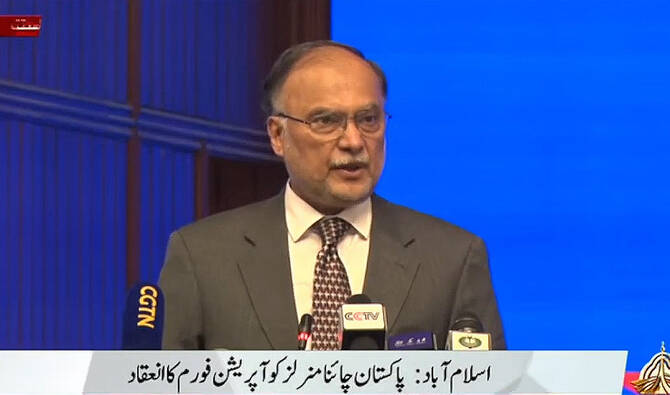
Screengrab showing Planning and Development Minister Ahsan Iqbal addressing the Pakistan-China Mineral Cooperation Forum in Islamabad, Pakistan, on January 28, 2026. (PTV Official/YouTube)
Short Url
Updated 28 January 2026
Follow

Pakistan seeks Chinese investment in push to shift minerals sector toward value addition

  • Islamabad says mineral exports could reach $6–8 billion annually with processing and refining
  • Pakistan aims to move beyond raw extraction toward processing, refining, export-oriented industrial clusters

ISLAMABAD: Pakistan on Wednesday said it was seeking Chinese investment to develop its vast but underexploited mineral resources, pitching a strategy focused on value addition, processing and export-oriented industrial clusters as it looks to turn mining into a pillar of long-term economic growth.

At the Pakistan–China Mineral Cooperation Forum in Islamabad, senior ministers said the government’s priority was to move beyond the export of raw minerals by developing processing plants, smelters and mineral-based industrial clusters linked to Special Economic Zones (SEZs), according to reports in state-run Radio Pakistan and the Associated Press of Pakistan (APP).

Pakistan holds significant reserves of copper, gold, coal and other critical minerals, but its mining sector has historically been constrained by limited infrastructure, regulatory complexity and a lack of downstream processing capacity. The government has identified mining as a potential source of foreign exchange and industrial development as it seeks international investment amid broader economic reforms.

The flagship of that strategy is the Reko Diq copper-and-gold project in Balochistan, one of the world’s largest undeveloped copper deposits, which officials see as a test case for attracting large-scale foreign capital and integrating Pakistan into global mineral supply chains.

Speaking at the forum, Planning and Development Minister Ahsan Iqbal said Pakistan’s mineral exports could rise substantially if value was added domestically rather than through raw material exports, stressing the importance of Chinese partnership in achieving that shift.

“Pakistan’s mineral exports have the potential to reach $6-8 billion dollars annually within this decade through value addition,” Ahsan Iqbal said, according to a Radio Pakistan report. 

He said Pakistan’s objective was to develop mineral processing plants, smelters and refining facilities, adding that “transformation of Pakistan’s mineral economy cannot happen without strategic partners and China’s role is central in this regard.”

Ahsan Iqbal also linked the minerals push to the second phase of the China–Pakistan Economic Corridor (CPEC), saying it aimed to translate infrastructure connectivity into productivity, exports and jobs, while reaffirming that the security of Chinese nationals and investments remained a top national priority.

Separately, Board of Investment Minister Qaiser Ahmed Sheikh said at the forum Pakistan and China were expanding cooperation in the minerals sector alongside broader economic engagement, citing growing business-to-business activity, according to an APP report.

He said more than 300 Pakistani companies visited China in September 2025 alone and that 167 memorandums of understanding were signed at a Pakistan–China business-to-business conference, with the Board of Investment working on their implementation.

Petroleum Minister Ali Pervaiz Malik invited Chinese firms to participate in the Pakistan Minerals Investment Forum 2026, scheduled for April 8–9, describing it as a platform for structured engagement with policymakers, regulators and project sponsors, according to APP.

He said China’s experience in rare earth elements, copper smelting and refining offered lessons for Pakistan as global demand accelerates for critical minerals linked to the energy transition, adding that Pakistan, with China’s support, was positioning itself as a long-term partner in global mineral supply chains.


Pakistan opposition to continue protest over ex-PM Khan’s health amid conflicting reports

Updated 16 February 2026
Follow

Pakistan opposition to continue protest over ex-PM Khan’s health amid conflicting reports

  • Pakistan’s government insists that the ex-premier’s eye condition has improved
  • Khan’s personal doctor says briefed on his condition but cannot confirm veracity

ISLAMABAD: Pakistan’s opposition alliance on Monday vowed to continue their protest sit-in at parliament and demanded “clarity” over the health of jailed former prime minister Imran Khan, following conflicting medical reports about his eye condition.

The 73-year-old former cricket star-turned-politician has been held at the high-security Adiala prison in Rawalpindi since 2023. Concerns arose about his health last week when a court-appointed lawyer, Barrister Salman Safdar, was asked to visit Khan at the jail to assess his living conditions. Safdar reported that Khan had suffered “severe vision loss” in his right eye due to central retinal vein occlusion (CRVO), leaving him with just 15 percent sight in the affected eye.

On Sunday, a team of doctors from various hospitals visited the prison to examine Khan’s eye condition, according to the Adiala jail superintendent, who later submitted his report in the court. On Monday, a Supreme Court bench led by Chief Justice Yahya Afridi observed that based on reports from the prison authorities and the amicus curiae, Khan’s “living conditions in jail do not presently exhibit any perverse aspects.” It noted that Khan had “generally expressed satisfaction with the prevailing conditions of his confinement” and had not sought facilities beyond the existing level of care.

Having carefully perused both reports in detail, the bench observed that their general contents and the overall picture emerging therefrom are largely consistent. The opposition alliance, which continued to stage its sit-in for a fourth consecutive day on Monday, held a meeting at the parliament building on Monday evening to deliberate on the emerging situation and discuss their future course of action.

“The sit-in will continue till there is clarity on the matter of [Khan's] health,”  Sher Ali Arbab, a lawmaker from Khan's Pakistan Tehreek-e-Insaf (PTI) party who has been participating in the sit-in, told Arab News, adding that PTI Chairman Gohar Ali Khan and Opposition Leader in Senate Raja Nasir Abbas had briefed them about their meeting with doctors who had visited Khan on Sunday.

Speaking to reporters outside parliament, Gohar said the doctors had informed them that Khan’s condition had improved.

“They said, 'There has been a significant and satisfactory improvement.' With that satisfactory improvement, we also felt satisfied,” he said, noting that the macular thickness in Khan’s eye had reportedly dropped from 550 to 300 microns, a sign of subsiding swelling.

Gohar said the party did not want to politicize Khan’s health.

“We are not doctors, nor is this our field,” he said, noting that Khan’s personal physician in Lahore, Dr. Aasim Yusuf, and his eye specialist Dr. Khurram Mirza had also sought input from the Islamabad-based medical team.

“Our doctors also expressed satisfaction over the report.”

CONFLICTING ACCOUNTS

Despite Gohar’s cautious optimism, Khan’s personal physician, Dr. Yusuf, issued a video message on Monday, saying he could neither “confirm nor deny the veracity” of the government’s claims.

“Because I have not seen him myself and have not been able to participate in his care... I’m unable to confirm what we have been told,” Yusuf said.

He appealed to authorities to grant him or fellow physician, Dr. Faisal Sultan, immediate access to Khan, arguing that the ex-premier should be moved to Shifa International Hospital in Islamabad for specialist care.

Speaking to Arab News, PTI’s central information secretary Sheikh Waqas Akram said Khan’s sister and their cousin, Dr. Nausherwan Burki, will speak to media on Tuesday to express their views about the situation.

The government insists that Khan’s condition has improved.

“His eye [condition] has improved and is better than before,” State Minister Talal Chaudhry told the media in a brief interaction on Monday.

“The Supreme Court of Pakistan is involved, and doctors are involved. What medicine he receives, whether he needs to be hospitalized or sent home, these decisions are made by doctors. Neither lawyers nor any political party will decide this.”