NYC power outage knocks out subways, businesses, elevators

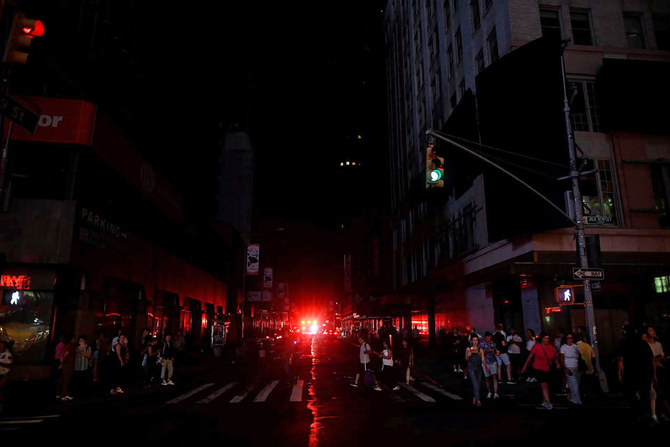
People walk down a street of Manhattan after a power outage hit the borough in New York City on July 13, 2019.(AFP / Johannes Eisele)
Updated 14 July 2019
Follow

NYC power outage knocks out subways, businesses, elevators

  • Blackout affected more than 44,000 customers along a 30-block stretch from Times Square to about 72nd Street and Broadway
  • City fire department blames power outage on a fire that hit a transformer at West 64th Street and West End Avenue

NEW YORK: Authorities were scrambling to restore electricity to Manhattan following a power outage that knocked out Times Square’s towering electronic screens, darkened marquees in the theater district and left businesses without electricity, elevators stuck and subway cars stalled.
The New York City Fire Department said a transformer fire Saturday evening at West 64th Street and West End Avenue affected more than 44,000 customers along a 30-block stretch from Times Square to about 72nd Street and Broadway.
Officials with Con Edison later tweeted that they were working to restore electricity to customers and businesses primarily on Manhattan’s Upper West Side.
The temperature was warm, above 80 even as the sun set, but not as steaming as Manhattan can get in July.
Power reportedly went out early Saturday evening at much of Rockefeller Center and reached the Upper West Side.
At Rockefeller Center, traffic lights were out. Some buildings in Rockefeller Plaza had lights on, others were dark.
The outage comes on the anniversary of the 1977 New York City outage that left most of the city without power.
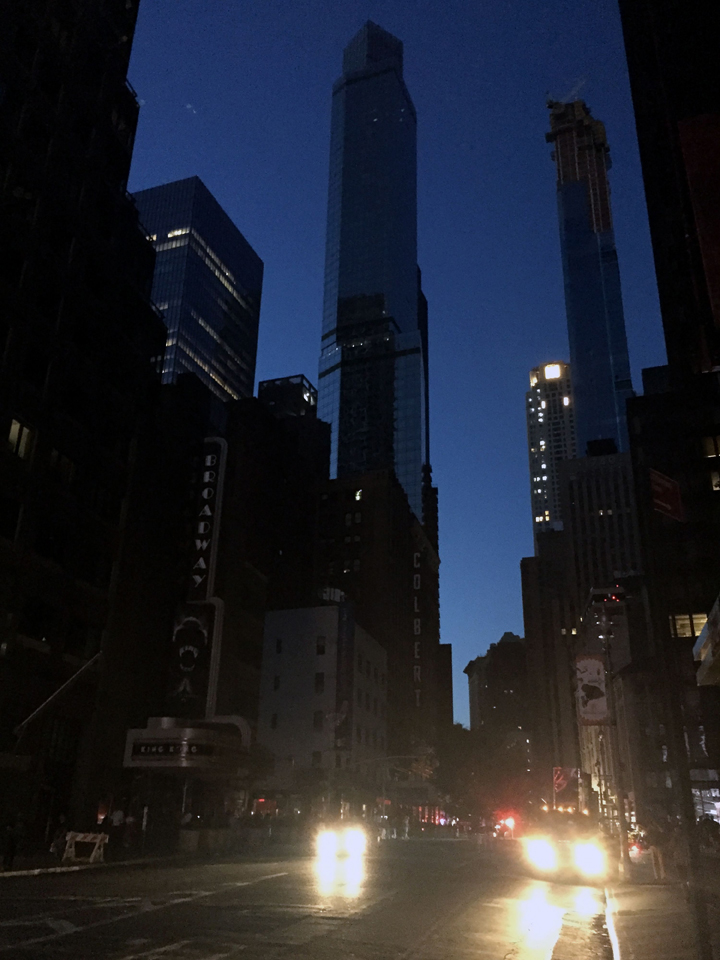


Broadway street is seen with no power after a power outage hit Manhattan in New York City on July 13, 2019. (AFP / Thomas Urbain)


Many Broadway musicals and plays canceled their Saturday evening shows, including “Hadestown,” which last month won the Tony Award for best musical. Several cast members from the show put on an impromptu performance in the street outside the theater for disappointed audience members.
Emily Totero, 30, planned to bring out-of-town guests to see “Moulin Rouge.” But once they got to the theater district, they saw the power go out.
“You could see all the theater lights across the street, all the marquees went out. That’s what we noticed first,” she said.
Some shows like “Frozen” were among the Broadway shows to announce it had canceled performances.
When the lights went out early Saturday evening, thousands of people streamed out of darkened Manhattan buildings, crowding Broadway next to bumper-to-bumper traffic.
People in Hell’s Kitchen began directing traffic themselves as stoplights and walking signs went dark.
Ginger Tidwell, a dance teacher and Upper West Side resident, was about to order at the West Side diner on Broadway and West 69th Street just before 7 p.m.
“When the lights started flickering, and then were out,” she said. “We got up and left, walking up Broadway with all the traffic lights out and businesses dark.”
But once they got to West 72nd Street, they found another diner that was open and had power.
“It was still sunny and everyone just came out to the street because they lost power and air conditioning; it was super-crowded,” she said. “Everyone was hanging out on the street on a nice night. All you could hear was fire trucks up and down Broadway. All of Broadway was without traffic lights.”


Winter storm packing snow and strong winds to descend on Great Lakes, Northeast

Updated 5 sec ago
Follow

Winter storm packing snow and strong winds to descend on Great Lakes, Northeast

  • The fierce winds on Lake Erie sent water surging toward the basin’s eastern end near Buffalo, New York, while lowering water on the western side in Michigan to expose normally submerged lakebed — even the wreck of a car and a snowmobile

NEW YORK: A wild winter storm was expected to bring strong winds, heavy snow and frigid temperatures to the Great Lakes and Northeast on Tuesday, a day after a bomb cyclone barreled across the northern US and left tens of thousands of customers without power.
The storm that hit parts of the Plains and Great Lakes on Monday brought sharply colder air, strong winds and a mix of snow, ice and rain, leading to treacherous travel. Forecasters said it intensified quickly enough to meet the criteria of a bomb cyclone, a system that strengthens rapidly as pressure drops.
Nationwide, more than 127,000 customers were without power Tuesday morning, more than a third of them in Michigan, according to Poweroutage.us.

BACKGROUND

The storm that hit parts of the Plains and Great Lakes on Monday brought sharply colder air, strong winds and a mix of snow, ice and rain, leading to treacherous travel.

As the storm moved into Canada, the National Weather Service predicted more inclement weather conditions for the Eastern US, including quick bursts of heavy snow and gusty winds known as snow squalls. Blustery winds were expected to add to the arctic chill, with low temperatures dipping below freezing as far south as the Florida panhandle, the agency said.
New York Gov. Kathy Hochul warned that whiteout conditions were expected Tuesday in parts of the state, including the Syracuse metro area.
“If you’re in an impacted area, please avoid all unnecessary travel,” she said in a post on the social platform X.
Snow piled up quickly in Michigan’s Upper Peninsula on Monday, where as much as 2 feet (60 centimeters) fell in some areas, according to the National Weather Service. Meteorologist Ryan Metzger said additional snow was expected in the coming days, although totals would be far lighter.
Waves on Lake Superior that were expected to reach 20 feet (6 meters) on Monday sent all but one cargo ship into harbors for shelter, according to MarineTraffic.com.
The fierce winds on Lake Erie sent water surging toward the basin’s eastern end near Buffalo, New York, while lowering water on the western side in Michigan to expose normally submerged lakebed — even the wreck of a car and a snowmobile.
Kevin Aldrich, 33, a maintenance worker from Monroe, Michigan, said he has never seen the lake recede so much and was surprised on Monday to spot remnants of piers dating back to the 1830s. He posted photos on social media of wooden pilings sticking up several feet from the muck.
“Where those are at would typically be probably 12 feet deep,” he said. “We can usually drive our boat over them.”
Dangerous wind chills plunged as low as minus 30 F (minus 34 C) across parts of North Dakota and Minnesota on Monday. And in northeast West Virginia, rare, nearly hurricane-force winds were recorded on a mountain near Dolly Sods, according to the National Weather Service.
In Iowa, after blizzard conditions eased by Monday morning, high winds continued blowing snow across roadways, keeping more than 200 miles (320 kilometers) of Interstate 35 closed. State troopers reported dozens of crashes during the storm, including one that killed a person.
On the West Coast, the National Weather Service warned that moderate to strong Santa Ana winds were expected in parts of Southern California through Tuesday, raising concerns about downed trees in areas where recent storms had saturated the soil. Two more storms were forecast later this week, with rain on New Year’s Day potentially soaking the Rose Parade in Pasadena for the first time in about two decades.