

Arab officials discuss Brexit opportunities in London

1 / 8
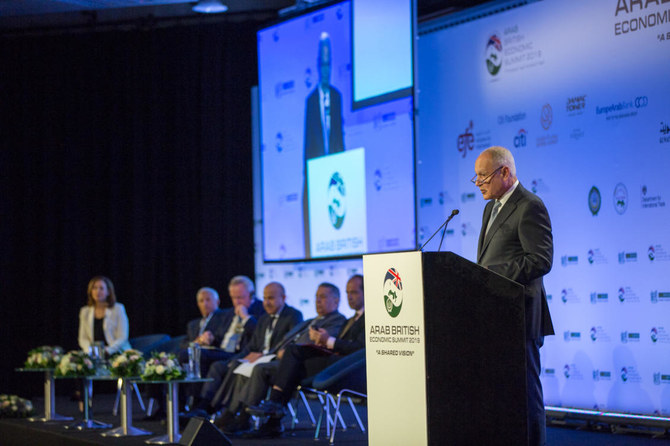
Arab League Secretary General Ahmed Aboul Gheit speaking at the event. (Supplied)
2 / 8
Arab League Secretary General Ahmed Aboul Gheit speaking at the event. (Supplied)
3 / 8
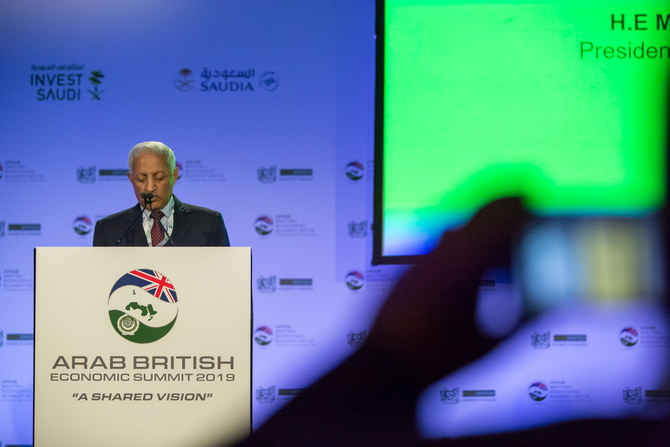
GCC Secretary General Abdullatif bin Rashid Al Zayani speaking at the event. (Supplied)
4 / 8
Mohamed Abdo Saeed, President of The Union of Arab Chambers addressing the event. (Supplied)
5 / 8
Mohamed Abdo Saeed, President of The Union of Arab Chambers addressing the event. (Supplied)
6 / 8
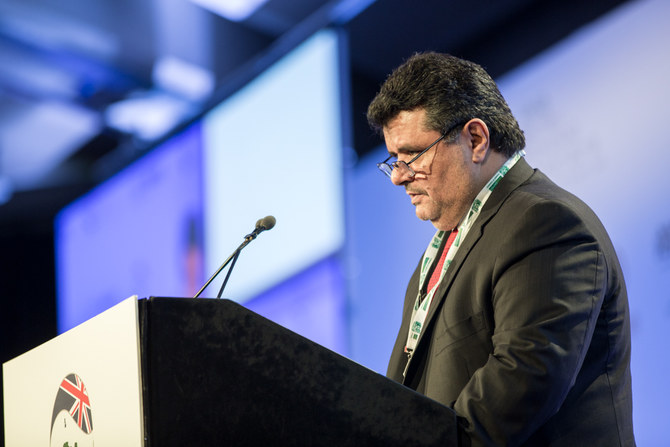
Dr. Sami A. Alabidi, Chairman of Council of Saudi Chambers make a speech during the event. (Supplied)
7 / 8
Arab British Economic Summit panel. (Supplied)
8 / 8
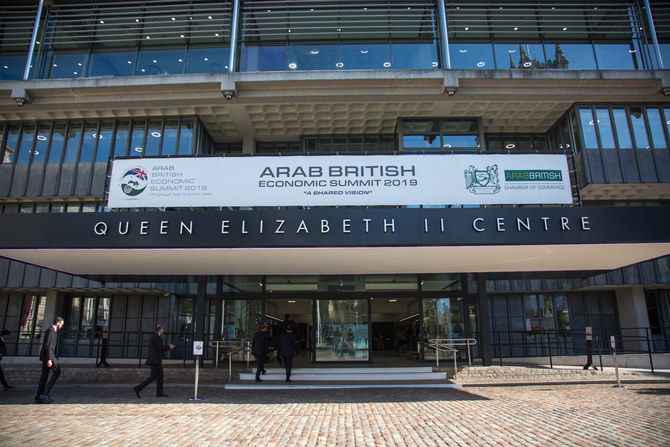
Arab British Economic Summit at Queen Elizabeth II Center in London (Supplied)
Updated 05 July 2019
Follow

Arab officials discuss Brexit opportunities in London

  • Conference, hosted by Arab British Chamber of Commerce (ABCC), tackled areas regarding infrastructure, investment, sustainable development and renewable energy
  • head of the Gulf Cooperation Council (GCC), Secretary-General Abdullatif Al-Zayani, spoke at the event

LONDON: Senior Arab officials and organizations met with their UK counterparts at a summit in London on Wednesday to discuss investment and bilateral opportunities, as the country prepares to leave the EU.
“Britain is on the verge of a crucial turning point in its relationships with the rest of the world,” said Arab League Secretary-General Ahmed Aboul Gheit. “The Arab world has a combined gross domestic product (GDP) exceeding $2.5 trillion annually. It has great economic power, wants sustainable investments in Britain, and sustainable British investments in its own countries.”
The head of the Gulf Cooperation Council (GCC), Secretary-General Abdullatif Al-Zayani, said harnessing the talents of young people — “a genuine asset to the region” — would be essential for any future relationship between the UK and GCC countries.
“If our societies can harness the energy and resourcefulness of our young people, then they can lead us into a vibrant new world with possibilities we could not have dreamed of a few years ago, but which to them are second nature,” he claimed.
The conference, hosted by the Arab British Chamber of Commerce (ABCC), tackled areas regarding infrastructure, investment, sustainable development and renewable energy opportunities in the Middle East and North Africa.

The chairman of the Council of Saudi Chambers, Sami Al-Abidi, said the Kingdom’s delegation represented Saudi Arabia’s experience in investment, infrastructure and reliance on sustainable development, as well as current projects being undertaken by the Saudi government and in the private sector. 
“Saudi Arabia has had a historic relationship with Britain with many old mutual investments, and now we are at a turning point as investment is increasing with very high returns due to the Vision 2030,” Al-Abidi told Arab News. 
Meanwhile, the President of the Union of Arab Chambers said commercial activities would expand between the two countries if the UK leaves the EU.
Mohamed Abdo Saeed said: “If the UK follows through with Brexit, this relationship is only going to be stronger and will see new British investments in the Kingdom, as well as Saudi capital in Britain.”

FASTFACT

£50 billion

The UK's trading relationship with the Middle East region exceeds £50 billion ($62.5 billion).

UK trade commissioner for the Middle East, Afghanistan and Pakistan, Simon Penney, said Britain’s trading relationships with the region exceeded £50 billion ($62.5 billion), and that the GCC was the UK’s fourth largest trading partner outside of the EU.
“We are very keen to partner with Saudi companies and Brexit offers many opportunities, particularly around Vision 2030, but also around future trading relationships,” he told Arab News, adding that he would be visiting Riyadh soon to follow up on their commitments and obligations toward the vision.
“We are a trading island nation that has done so for hundreds of years, and we have always traded with the Arab world, and want to ensure that those relationships are developed properly.”

The chair of the Arab International Women’s Forum, Baroness Symons, said the UK was focusing on technology, the environment, youth and their employment and women’s issues in the region.
“The Kingdom has opened not only windows, but doors as well, for women to be more engaged in the economy, get the best education and be given more opportunities,” she said.
ABCC Secretary-General Haifa Al-Kaylani stressed the long-standing relations between the two Kingdoms were “dramatically increasing” every year. 
Several Saudi businesses were present at the summit, among them Saudi Arabian Airlines (Saudia), to shed light on the Kingdom’s investment opportunities and support new businesses.
“Saudi Arabia is now on everybody’s mind when they talk about investment and I tell people this is the time to invest because, by 2025 and 2030, there will be a great return on investment,” Frank Valle, Saudia’s manager of sales and marketing in the UK and Ireland, told Arab News.


Saudi investment pipeline active as reforms advance, says Pakistan minister

Updated 19 min 33 sec ago
Follow

Saudi investment pipeline active as reforms advance, says Pakistan minister

ALULA: Pakistan’s Finance Minister Mohammed Aurangzeb described Saudi Arabia as a “longstanding partner” and emphasized the importance of sustainable, mutually beneficial cooperation, particularly in key economic sectors.

Speaking to Arab News on the sidelines of the AlUla Conference for Emerging Market Economies, Aurangzeb said the relationship between Pakistan and Saudi Arabia remains resilient despite global geopolitical tensions.

“The Kingdom has been a longstanding partner of Pakistan for the longest time, and we are very grateful for how we have been supported through thick and thin, through rough patches and, even now that we have achieved macroeconomic stability, I think we are now well positioned for growth.”

Aurangzeb said the partnership has facilitated investment across several sectors, including minerals and mining, information technology, agriculture, and tourism. He cited an active pipeline of Saudi investments, including Wafi’s entry into Pakistan’s downstream oil and gas sector.

“The Kingdom has been very public about their appetite for the country, and the sectors are minerals and mining, IT, agriculture, tourism; and there are already investments which have come in. For example, Wafi came in (in terms of downstream oil and gas stations). There’s a very active pipeline.”

He said private sector activity is driving growth in these areas, while government-to-government cooperation is focused mainly on infrastructure development.

Acknowledging longstanding investor concerns related to bureaucracy and delays, Aurangzeb said Pakistan has made progress over the past two years through structural reforms and fiscal discipline, alongside efforts to improve the business environment.

“The last two years we have worked very hard in terms of structural reforms, in terms of what I call getting the basic hygiene right, in terms of the fiscal situation, the current economic situation (…) in terms of all those areas of getting the basic hygiene in a good place.”

Aurangzeb highlighted mining and refining as key areas of engagement, including discussions around the Reko Diq project, while stressing that talks with Saudi investors extend beyond individual ventures.

“From my perspective, it’s not just about one mine, the discussions will continue with the Saudi investors on a number of these areas.”

He also pointed to growing cooperation in the IT sector, particularly in artificial intelligence, noting that several Pakistani tech firms are already in discussions with Saudi counterparts or have established offices in the Kingdom.

Referring to recent talks with Saudi Minister of Economy and Planning Faisal Alibrahim, Aurangzeb said Pakistan’s large freelance workforce presents opportunities for deeper collaboration, provided skills development keeps pace with demand.

“I was just with (Saudi) minister of economy and planning, and he was specifically referring to the Pakistani tech talent, and he is absolutely right. We have the third-largest freelancer population in the world, and what we need to do is to ensure that we upscale, rescale, upgrade them.”

Aurangzeb also cited opportunities to benefit from Saudi Arabia’s experience in the energy sector and noted continued cooperation in defense production.

Looking ahead, he said Pakistan aims to recalibrate its relationship with Saudi Arabia toward trade and investment rather than reliance on aid.

“Our prime minister has been very clear that we want to move this entire discussion as we go forward from aid and support to trade and investment.”