

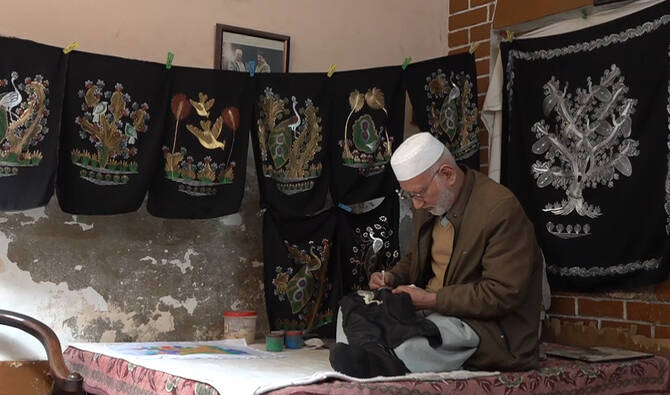
In Peshawar, 76-year-old artist struggles to keep near-extinct Mughal wax art alive

A 76-year-old artist practices the near-extinct Mughal wax art in Peshawar, on February 6, 2026. (AN Photo)
Short Url
Updated 09 February 2026
Follow

In Peshawar, 76-year-old artist struggles to keep near-extinct Mughal wax art alive

  • Craft involves intricate process using heated wax, oil, pigments, limestone to create textured, miniature artworks
  • Riaz Ahmad, who has trained his son in wax art, says he hopes to train more people to preserve traditional craft 

PESHAWAR: Riaz Ahmad, 76, stirs wax in a small plastic can with a long chopstick, takes it out on the palm of his left hand and adds natural color before drawing designs on a piece of cloth.

Surrounded by several such pieces of black cloth with unique art, Ahmad strives every passing day to keep the 500-year-old, Mughal-era wax art alive at his home near the Lahori Gate in the northwestern Pakistani city of Peshawar.

Ahmad comes from a well-known family of wax artists who were based in Shillong and Darjeeling in present-day India and had migrated to Peshawar during the 1947 partition of the sub-continent.

His work remains rooted in tradition, faithfully repeating patterns passed down through generations and winning Ahmad several awards both at home and abroad in recognition of his dedication.

“I have been making the same Mughal era designs that my forefathers used to make,” he told Arab News last week.
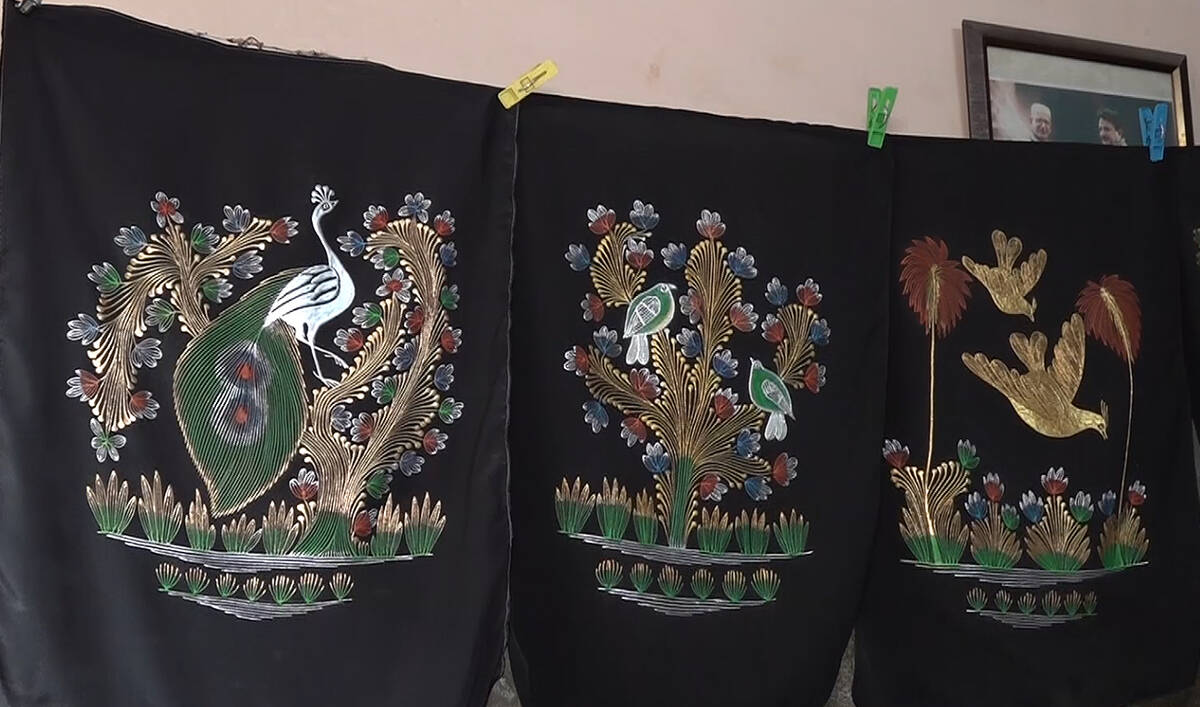


Art pieces of Mughal wax art made by artist Riaz Ahmad in Peshawar on February 8, 2026. (Photo by AN)

“I went to India in 2004, where I received the UNESCO Seal of Excellence [for Handicrafts] award... On 23 March, 2012, the Government of Pakistan awarded me the Tamgha-i-Imtiaz.”

The near-extinct traditional craft, which is believed to have originated in Central Asia and refined under the Mughal patronage, particularly in Peshawar, involves an intricate process using heated wax, linseed oil, powdered pigments, and limestone to create detailed, textured and often colorful miniature artworks by hand.

Ahmad learnt wax art from his father, Miran Bakhsh, nearly six decades ago.

“My parents used to do this work in Shillong and Darjeeling [in present-day India]. They had a shop there, and after the Partition, they migrated to Peshawar, Pakistan,” he said. “When they came here, they started doing the same work.”

A basic piece of his work costs around Rs3,000 ($10.7). A larger piece made on order can fetch between Rs5,000 and Rs15,000 ($17-$53), but such orders are rare.

“Wax and colors have become expensive. When I sell a piece for Rs3,000, around Rs1,000 goes into expenses, and Rs2,000 is my daily wage,” Ahmad said.

But the 76-year-old worries more about the future of the art form, which he insists cannot be learned quickly and requires “love and dedication.”

“Some people say they want to come, some from Karachi and some from Lahore, but it becomes difficult for me to go there or for them to come here,” he said.
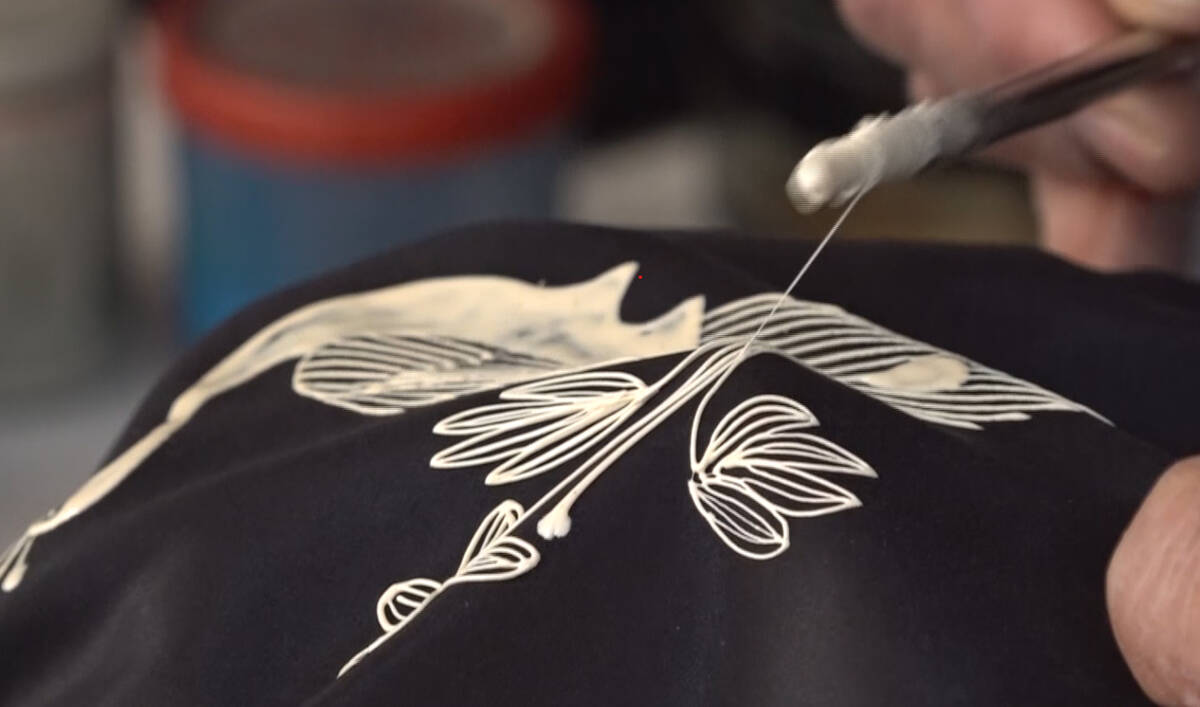


Riaz Ahmad, 76, prepares wax by stirring it in a small plastic can before adding natural color and drawing designs on cloth in Peshawar, on February 6, 2026. (Photo by AN)

Most wax artists in Peshawar have abandoned the art due to a lack of institutional support, according to Ahmad, who relies primarily on exhibitions to earn a living.

“The reason [for the decline of this art form] is that the government does not pay attention. They are caught in their own conflicts, and the culture is suffering,” Ahmad said.

“Other artists have left this art. Some are selling rice and some are driving rickshaws,” he added. “I have been doing this work inside my house. If there is any event, we go there and sell our art.”
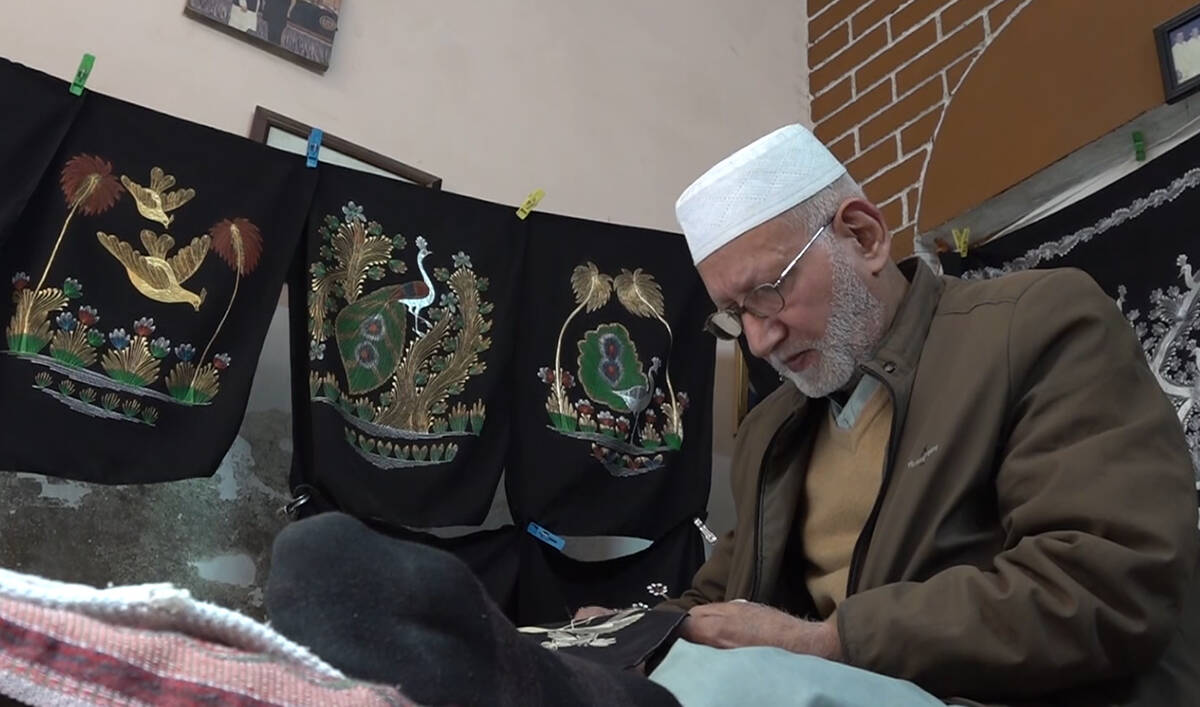


A 76-year-old artist practices the near-extinct Mughal wax art in Peshawar, on February 6, 2026. (Photo by AN)

Saad Bin Awais, a spokesperson for the Khyber Pakhtunkhwa Culture and Tourism Authority (KPCTA), said the government has engaged artisans in several projects. He said some of these projects have come to an end while others are ongoing.

“Riaz Ahmad is the only wax artist in Khyber Pakhtunkhwa and the authority is serious about facilitating him,” he said, adding that the KPCTA facilitates Ahmad’s participation in exhibitions across the country to showcase his art.

“We have also been collecting data of artists in Khyber Pakhtunkhwa for an upcoming project to facilitate them in any way possible.”

Ahmad has trained his son, Fayyaz, in wax art who now practices it in Islamabad. The septuagenarian says he wishes to train more people to preserve the dying art form.

“I cannot leave this work,” he said. “I will continue this art even though my hands shake.”


Pakistan military says 12 soldiers killed in border fighting as Kabul calls for dialogue

Updated 50 min 46 sec ago
Follow

Pakistan military says 12 soldiers killed in border fighting as Kabul calls for dialogue

  • Military says 274 Afghan fighters killed, over 400 injured in ongoing operation
  • Afghan authorities earlier said 55 Pakistani soldiers killed in retaliatory strikes

ISLAMABAD: Pakistan’s military said on Friday 12 soldiers had been killed in cross-border fighting with Afghan forces, as it detailed the scale of an ongoing border operation and accused the Kabul government of coordinating with militant groups targeting Pakistan.

The announcement followed days of escalating hostilities triggered by Pakistani airstrikes earlier this week on what Islamabad said were Tehreek-e-Taliban Pakistan (TTP) and Daesh militant camps inside Afghanistan. Since then, both governments have reported retaliatory operations and issued conflicting casualty figures, marking the most serious deterioration in relations between the neighbors in recent months.

The 2,600-kilometer (1,600-mile) shared frontier between the two nations, a key trade and transit corridor, has remained closed to trade and movement since October 2025 amid recurring tensions.

Lt. Gen. Ahmed Sharif Chaudhry, director general of Inter-Services Public Relations (ISPR), told a news conference in Rawalpindi that Pakistani forces had repelled coordinated attacks at 53 locations along the border and responded under what he described as Operation Ghazab lil-Haq.

“While safeguarding Pakistan’s honor and territorial integrity, 12 brave soldiers have embraced martyrdom in the operation so far, while 27 have been injured and one soldier is missing in action,” he said.

Chaudhry said Pakistan had killed 274 Taliban fighters and injured more than 400, describing those figures as conservative estimates. He added that 73 Afghan posts had been completely destroyed along the border and 18 had been captured.

He said Afghan Taliban forces had launched physical raids “in collusion and in support of an internationally declared terrorist organization” and accused the Taliban administration of acting in coordination with militant groups.

“The Afghan Taliban regime is the master proxy of these terrorist proxies which are operating from Afghanistan,” he said.

Kabul has repeatedly said it does not allow militants to operate in its territory. 

Chaudhry said Pakistan had targeted 22 locations across the border, including in Kabul, Kandahar, Paktia, Nangarhar, Khost and Paktika.

“All targets were selected with great care based on intelligence. They were military objectives, and utmost care was taken to avoid any civilian collateral damage,” he said.

He said the Taliban authorities faced a choice.

“Either they choose terrorists and terrorism or side with Pakistan,” he said.

KABUL CALLS FOR DIALOGUE 

Separately on Friday afternoon, Afghan Taliban spokesperson Zabihullah Mujahid called for talks to resolve the crisis.

“We have always emphasized peaceful resolution, and now too we want the issue to be resolved through dialogue,” he said.

In a detailed statement earlier in the day, Afghanistan’s Ministry of National Defense said it had carried out airstrikes inside Pakistan in response to what it described as Pakistani “aerial incursions” into Kabul, Kandahar and Paktia.

Afghan officials said 55 Pakistani soldiers were killed and that several posts were captured, claims denied by Islamabad.

None of the casualty figures or battlefield claims from either side could be independently verified.

Pakistan’s Information Minister Attaullah Tarar earlier said militants had attempted to launch drones inside Pakistani territory.

“Fitna al khawarij terrorists have attempted to launch small drones in Abbotabad, Swabi and Nowshera. Anti Drone Systems have brought down all the drones. No damage to life,” Tarar said.

“The incidents have again exposed direct linkages between Afghan Taliban Regime and Terrorism in Pakistan.”

Separately, Prime Minister Shehbaz Sharif on Friday visited General Headquarters (GHQ) in Rawalpindi, where he was briefed by the military leadership on the evolving situation. 

According to a statement from the Prime Minister’s Office, Sharif said there would be “zero tolerance” toward what he described as collusion between the Afghan Taliban regime and militant elements.

“Pakistan knows very well how to defend itself against any aggression,” the statement quoted him as saying, adding that the armed forces were ready to safeguard the country.
Regional concern

Cross-border violence has intensified in recent weeks, with Pakistan blaming a surge in suicide bombings and militant attacks on insurgents it says are based in Afghanistan. Kabul denies providing safe havens and says Pakistan’s security challenges are an internal matter.

The latest clashes mark the third major escalation between the neighbors in less than a year. Similar strikes last year triggered weeklong fighting before Qatar, Türkiye and other regional actors mediated a ceasefire in October.

Several countries, including China, Russia, Saudi Arabia and Iran, have expressed concern and urged restraint.

Operations on both sides were ongoing as of Friday evening.