DHAKA: Bangladesh’s election campaign entered its final day Monday ahead of the February 12 vote, as rival parties invoked the 2024 uprising that ended the autocratic rule of Sheikh Hasina.
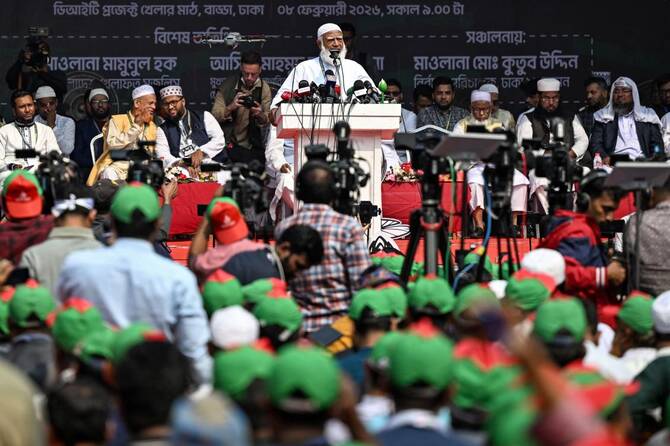
Tens of thousands of flag?waving supporters have attended weeks of rival rallies across the sprawling capital Dhaka, as parties each seek to harness the legacy of the mass uprising — and pitch competing visions of change for the country of 170 million.
The South Asian nation will elect a new parliament, with the Bangladesh Nationalist Party (BNP) — led by Tarique Rahman, who returned in December after 17 years in exile — widely tipped as a frontrunner.
The BNP’s Rahman led a rally on Sunday in Dhaka’s Mirpur neighborhood — constituency of Shafiqur Rahman, the leader of his main rival, Jamaat-e-Islami.
“I can talk about him forever, but that won’t benefit the people of Bangladesh,” the BNP leader said about the Islamist chief, to crowds waving flags with the party symbol, a sheaf of rice.
A heavy deployment of armed police monitored the rally, with drones hovering above, as he backed the local BNP candidate Shafiqul Islam Milton.
“Help him win the election, and he will take care of you once elected,” Rahman told the BNP crowds.
Rahman, 60, better known in Bangladesh as Tarique Zia, assumed leadership of the BNP following the death of his mother, former prime minister Khaleda Zia, who died in December at the age of 80.
Hasina’s Awami League was banned by the interim government from running in the elections, a move criticized by rights groups.
- ‘Long live the revolution’ -
Jamaat-e-Islami chief Shafiqur Rahman meanwhile addressed a packed rally in the Dhaka-11 constituency, a flashpoint during the August 5, 2024 uprising that toppled the Awami League government of Hasina after 15 years in power.
Shafiqur Rahman, leading a coalition of Islamist parties — under the symbol of weighing scales — accused the former ruling party of widespread repression, but warned that new forms of abuse had quickly followed its fall.
“A section of the oppressed turned into oppressors just a day after August 5,” he said, alleging extortion and corruption by returning political figures.
“Common people, business owners — even beggars — are now fed up. Justice has been sent into exile.”
Jamaat, ideologically aligned with the Muslim Brotherhood, and seeking a return to formal politics after years of bans and crackdowns, has allied with the National Citizen Party (NCP), formed by student leaders who spearheaded the uprising.
NCP leader Nahid Islam accused major parties of quietly sharing the “businesses of extortion and crime” for decades.
“If you elect me, I will dedicate myself to the betterment of the area,” Islam vowed, especially thanking women supporters and warning: “If we lose, August 5 will also lose.”
Supporters chanted popular slogans from the uprising.
“Long live the revolution!” supporters shouted.
“Slavery or freedom?,” they chanted, replying in unison, “Freedom, freedom!“
Among them was Mohammed Harun, 65, who said he had not voted in 17 years but would back the Jamaat-led alliance in hopes of a “just, corruption and violence-free country.”
Fatema Begum, a 40-year-old housewife, said she wanted a Bangladesh where people could “live independently and speak freely.”
First-time voter Abdullah-al-Rahat, 21, a Dhaka University student who took part in the 2024 uprising, said Jamaat leaders appeared “honest and humble,” but favored a unity government if no party won a majority.
Hasina, 78, sentenced to death in absentia in November for crimes against humanity for the deadly crackdown on protesters in her failed bid to cling to power, remains in hiding in India.

Bangladesh poll rivals rally on final day of campaign
Short Url
https://arab.news/6e2uk
Bangladesh poll rivals rally on final day of campaign
- Bangladesh’s election campaign entered its final day Monday ahead of the February 12 vote, as rival parties invoked the 2024 uprising that ended the autocratic rule of Sheikh Hasina
Mistrial declared in the case of Stanford students charged after pro-Palestinian protests in 2024
SAN FRANCISCO, US: A judge declared a mistrial Friday in the case of five current and former Stanford University students charged after pro-Palestinian protests in 2024, when they barricaded themselves inside the university president and provost executive offices.
The trial in Santa Clara County was a rare instance of demonstrators facing felony charges from protests over the Israel-Hamas war that roiled campuses across the country. The two sides argued over free speech, lawful dissent and crime during the three-week proceedings.
The jury voted 9 to 3 to convict on a felony charge of vandalism and 8 to 4 to convict on a felony charge of conspiracy to trespass. After deliberating for five days, jurors said they could not reach a verdict.
Judge Hanley Chew asked each one if more time deliberating would help break the impasse, and all answered, “No.”
“It appears that this jury is hopelessly deadlocked, and I’m now declaring a mistrial in counts one and two,” Chen said. He then dismissed the jurors.
Demonstrators barricaded themselves inside the offices for several hours on June 5, 2024, the last day of spring classes at the university.
Prosecutors said the defendants spray-painted the building, broke windows and furniture, disabled security cameras and splattered a red liquid described as fake blood on items throughout the offices.
Defense attorneys said the protest was protected speech and there was insufficient evidence of an intent to damage the property. They also said the students wore protective gear and barricaded the offices out of fear of being injured by police and campus security.
If convicted, the defendants would have faced up to three years in prison and been obligated to pay restitution of over $300,000.
Santa Clara County District Attorney Jeff Rosen said he would pursue a new trial.
“This case is about a group of people who destroyed someone else’s property and caused hundreds of thousands of dollars in damage,” Rosen said in a statement. “That is against the law and that is why we will retry the case.”
As the mistrial was announced, the students, some wearing kaffiyehs, sat on a bench in the courtroom and did not show a visible reaction.
“The District Attorney’s Office had Stanford University supporting them and other multibillion-dollar institutions behind them, and even then the district attorney was unable to convict us,” Germán González, who was a sophomore at Stanford when he was arrested, told The Associated Press by phone later. “No matter what happens, we will continue to fight tooth and nail for as long as possible, because at the end of the day, this is for Palestine.”
Authorities initially arrested and charged 12 people in the case, but one pleaded no contest under an agreement that allows some young people to have their cases dismissed and records sealed if they successfully complete probation.
He testified for the prosecution, leading to a grand jury indictment of the others in October of the others. Six of those accepted pretrial plea deals or diversion programs, and the remaining five pleaded not guilty and sought a jury trial.
Protests sprung up on campuses across the country over the Israel-Hamas conflict, with students setting up camps and demanding their universities stop doing business with Israel or companies that support its war efforts against Hamas.
About 3,200 people were arrested in 2024 nationwide. While some colleges ended demonstrations by striking deals with students or simply waited them out, others called in police. Most criminal charges were ultimately dismissed.
The trial in Santa Clara County was a rare instance of demonstrators facing felony charges from protests over the Israel-Hamas war that roiled campuses across the country. The two sides argued over free speech, lawful dissent and crime during the three-week proceedings.
The jury voted 9 to 3 to convict on a felony charge of vandalism and 8 to 4 to convict on a felony charge of conspiracy to trespass. After deliberating for five days, jurors said they could not reach a verdict.
Judge Hanley Chew asked each one if more time deliberating would help break the impasse, and all answered, “No.”
“It appears that this jury is hopelessly deadlocked, and I’m now declaring a mistrial in counts one and two,” Chen said. He then dismissed the jurors.
Demonstrators barricaded themselves inside the offices for several hours on June 5, 2024, the last day of spring classes at the university.
Prosecutors said the defendants spray-painted the building, broke windows and furniture, disabled security cameras and splattered a red liquid described as fake blood on items throughout the offices.
Defense attorneys said the protest was protected speech and there was insufficient evidence of an intent to damage the property. They also said the students wore protective gear and barricaded the offices out of fear of being injured by police and campus security.
If convicted, the defendants would have faced up to three years in prison and been obligated to pay restitution of over $300,000.
Santa Clara County District Attorney Jeff Rosen said he would pursue a new trial.
“This case is about a group of people who destroyed someone else’s property and caused hundreds of thousands of dollars in damage,” Rosen said in a statement. “That is against the law and that is why we will retry the case.”
As the mistrial was announced, the students, some wearing kaffiyehs, sat on a bench in the courtroom and did not show a visible reaction.
“The District Attorney’s Office had Stanford University supporting them and other multibillion-dollar institutions behind them, and even then the district attorney was unable to convict us,” Germán González, who was a sophomore at Stanford when he was arrested, told The Associated Press by phone later. “No matter what happens, we will continue to fight tooth and nail for as long as possible, because at the end of the day, this is for Palestine.”
Authorities initially arrested and charged 12 people in the case, but one pleaded no contest under an agreement that allows some young people to have their cases dismissed and records sealed if they successfully complete probation.
He testified for the prosecution, leading to a grand jury indictment of the others in October of the others. Six of those accepted pretrial plea deals or diversion programs, and the remaining five pleaded not guilty and sought a jury trial.
Protests sprung up on campuses across the country over the Israel-Hamas conflict, with students setting up camps and demanding their universities stop doing business with Israel or companies that support its war efforts against Hamas.
About 3,200 people were arrested in 2024 nationwide. While some colleges ended demonstrations by striking deals with students or simply waited them out, others called in police. Most criminal charges were ultimately dismissed.
© 2026 SAUDI RESEARCH & PUBLISHING COMPANY, All Rights Reserved And subject to Terms of Use Agreement.