GENEVA: The Red Cross warned Thursday that displaced people in and around Syria's Al-Hol camp were facing an "apocalyptic" conditions, urging countries to quickly repatriate family members of suspected foreign fighters.
The International Committee of the Red Cross warned of the extreme difficulties facing those left behind after the last vestige of the Daesh self-proclaimed caliphate collapsed in northeastern Syria in March.
Around 100,000 people in Al-Hol and surrounding camps, "are kept in a kind of legal limbo in an unstable place, in a disputed area", Fabrizio Carboni, who heads the ICRC's Near and Middle East operations, told reporters in Geneva.
"One hundred thousand people who spent the last months, if not years, under the bombs, starved, wounded, sick, traumatised," he said, adding: "It is just apocalyptic."
The Red Cross is one of the main humanitarian organisations providing assistance inside the overfilled Al-Hol camp, which is housing more than 70,000 people, including more than 11,000 family members of suspected Daesh fighters from dozens of countries.
The issue of whether to repatriate nationals who are family members of suspected jihadists has been a thorny one for Western nations, which have experienced attacks by homegrown extremists and have little interest in seeing more return.
Britain has gone so far as stripping Daesh members of citizenship, while France has said it will only repatriate children and evaluate cases individually.
"Our position is to say to states ' take your nationals back'," Carboni said, condemning the stigmatisation of people, especially children, and efforts to create "categories of good victims and bad victims".
"As if kids can be something else than just victims."
Carboni said two thirds of the residents in Al-Hol were children, mainly under 12, insisting it was unconscionable to leave them there.
"You don't leave kids in the middle of nowhere exposed to extreme heat, extreme cold, violence," he said.
He warned that countries needed to recognise that "at one stage there will be a price to pay," and that if they put off dealing with this issue, "it is going to be higher".
ICRC, which runs a field hospital in Al-Hol, provides food, water and builds latrines, is doing its best to address the needs of the people stuck in a desperate situation in and around the camp, Carboni said.
"But nobody should expect the ICRC to deal with 100,000... for the next 25-30 years," he said. "This is states' responsibility."
He acknowledged that for many countries, repatriating family members of suspected jihadists is "politically toxic", but urged government to take responsibility.
Some of the countries which today are reluctant to bring home children in Al-Hol "have for decades defended (the principle) that kids are victims and cannot be considered as combatants", he said.
Their foot-dragging on the issue today, he said, "doesn't look good".

Conditions in Syria’s Al-Hol camp ’apocalyptic’: Red Cross
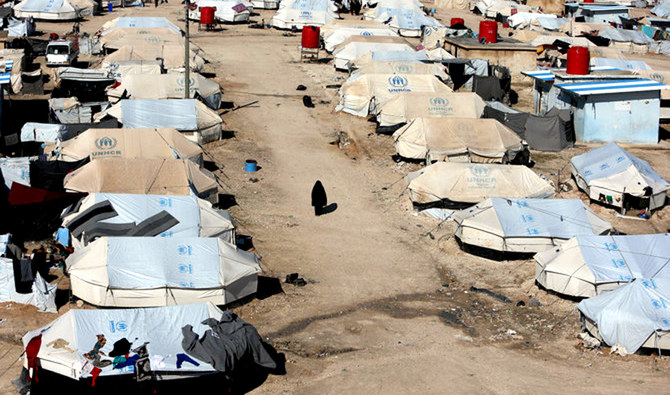
- The issue of whether to repatriate nationals who are family members of suspected jihadists has been a thorny one for Western nations
Security officer arrested over Syria killings: official
DAMASCUS: Syria’s authorities have arrested an internal security officer as a suspect in the killing of four civilians in the majority-Druze Sweida province, the local internal security chief said.
Four people were shot dead and a fifth seriously wounded in the incident on Saturday, in the village of Al-Matana, said Hossam Al-Tahan, the state news agency SANA reported.
The initial investigation, carried out with the help of one of the survivors of the attack, indicated that one suspect was a member of the local Internal Security Directorate, he said.
“The officer was immediately detained and referred for investigation,” he added.
The Syrian Observatory for Human Rights had earlier reported that four people were killed and a fifth wounded by gunfire from unknown assailants as they were harvesting olives.
The authorities had cleared the olive pickers to be in the northern part of the province controlled by government forces, it added.
Sweida province is the stronghold of the Druze minority in the south of the country.
Violence erupted there briefly in July last year, with clashes between Druze fighters and Sunni Bedouin that rapidly escalated, drawing in government forces and tribal fighters from other parts of Syria.
Syrian authorities have said their forces intervened to stop the clashes, but witnesses, Druze factions and the London-based Observatory have accused them of siding with the Bedouin and committing abuses against the Druze.
Although a ceasefire was reached later that month, the situation remained tense and access to Sweida difficult.
Residents accuse the government of having imposed a blockade on the province, from which tens of thousands of inhabitants have fled — a charge Damascus denies.
Several aid convoys have entered since then.
According to the Syrian Observatory for Human Rights, more than 185,000 people remain uprooted.
Four people were shot dead and a fifth seriously wounded in the incident on Saturday, in the village of Al-Matana, said Hossam Al-Tahan, the state news agency SANA reported.
The initial investigation, carried out with the help of one of the survivors of the attack, indicated that one suspect was a member of the local Internal Security Directorate, he said.
“The officer was immediately detained and referred for investigation,” he added.
The Syrian Observatory for Human Rights had earlier reported that four people were killed and a fifth wounded by gunfire from unknown assailants as they were harvesting olives.
The authorities had cleared the olive pickers to be in the northern part of the province controlled by government forces, it added.
Sweida province is the stronghold of the Druze minority in the south of the country.
Violence erupted there briefly in July last year, with clashes between Druze fighters and Sunni Bedouin that rapidly escalated, drawing in government forces and tribal fighters from other parts of Syria.
Syrian authorities have said their forces intervened to stop the clashes, but witnesses, Druze factions and the London-based Observatory have accused them of siding with the Bedouin and committing abuses against the Druze.
Although a ceasefire was reached later that month, the situation remained tense and access to Sweida difficult.
Residents accuse the government of having imposed a blockade on the province, from which tens of thousands of inhabitants have fled — a charge Damascus denies.
Several aid convoys have entered since then.
According to the Syrian Observatory for Human Rights, more than 185,000 people remain uprooted.
© 2026 SAUDI RESEARCH & PUBLISHING COMPANY, All Rights Reserved And subject to Terms of Use Agreement.


