ANKARA: A former Turkish prime minister and close ally of President Tayyip Erdogan on Saturday harshly criticised the ruling AK Party after a stinging electoral defeat in Istanbul last week that was widely seen as ominous for Erdogan at national level.
The AKP last week lost the mayor's post in Turkey's biggest city to the main opposition party for the first time in 25 years by a hefty margin, having forced a re-run following an earlier narrow defeat.
Ahmet Davutoglu, who served as prime minister between 2014 and 2016 before falling out with Erdogan, has criticised the president and his policies before.
But his latest comments come as former deputy prime minister Ali Babacan and former president Abdullah Gul, both founding members of the AKP, plan to launch a new rival party this year.
"There used to be a government that realised all its pledges over time," Davutoglu said at an event in the province of Elazig, adding that those who caused a "slide" in the party's principles should "pay the price".
"If we lose an election that we first lost by 13,000 votes again by 800,000 votes, as was the case in Istanbul, the one responsible for this is not a prime minister who delivered a clear parliamentary majority (in last year's general election), but rather those who have caused a serious slide in rhetoric, actions, morals and politics."
During the Istanbul campaign, Erdogan accused the opposition of links to terrorism and highlighted a call by Kurdish militant leader Abdullah Ocalan, jailed on the island prison of Imrali, for a pro-Kurdish party to remain neutral.
Davutoglu was dismissive:
"Saying the elections are valid even if (won) by one vote and then changing your stance; talking about a matter of survival in one election and labelling anyone who thinks otherwise a terrorist but then getting in touch with Imrali in the next vote is a detachment from the public conscience."
Voters appeared to be blaming the AKP for a recession that wiped 30% off the lira's value last year and another 10% this year.
"We are facing economic problems as we did in 2008. Then, there were people at the helm of the economy who understood economy. There was vision," Davutoglu said.
"We cannot get out of this crisis with the mentality of knowing best for everything, belittling, and thinking teamwork is just bringing together your inner circle."
Last year, after winning sweeping powers under a new executive presidential system that Davutoglu called "distorted", Erdogan made his son in-law Berat Albayrak finance minister.
"The AKP is not the party of one person, one family or one group alone," Davutoglu said. "State structure and family ties must absolutely be separated. There must be no first-degree relatives."
Davutoglu had been rumoured to be joining the breakaway party. Last week, a source close to him said he was planning a 'new step', but did not plan to join Gul and Babacan for now.
Instead, he issued what appeared to be a rallying cry to Erdogan's critics within the AKP.
"Today is not the time to be silent. It is not the time to keep the truths we discuss behind closed doors silent in front of the open doors too," he said. "We need a new understanding of politics."


![]()

Former Turkish PM Davutoglu slams Erdogan's AKP after Istanbul defeat
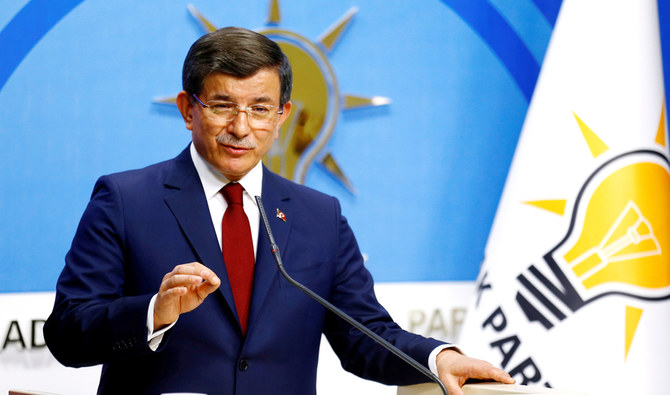
Former Turkish PM Davutoglu slams Erdogan's AKP after Istanbul defeat
- The AKP last week lost the mayor's post in Turkey's biggest city to the main opposition party


Latest updates


© 2026 SAUDI RESEARCH & PUBLISHING COMPANY, All Rights Reserved And subject to Terms of Use Agreement.