

Lost in Arrivals: A reporter's Osaka G20 summit diary

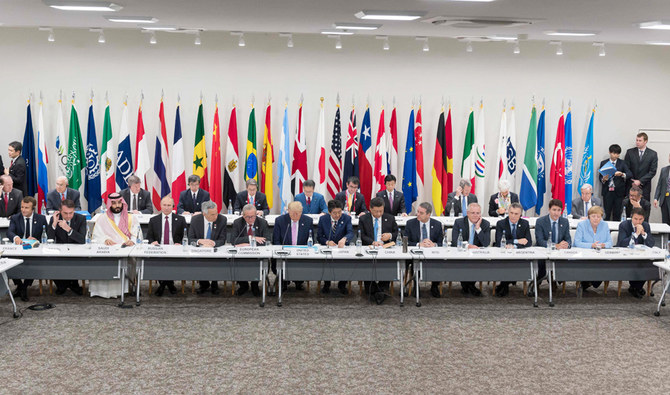
Leaders attend a meeting on the digital economy at the G20 Summit in Osaka on June 28, 2019. (AFP)
Updated 29 June 2019
Follow

Lost in Arrivals: A reporter's Osaka G20 summit diary

  • The G20 meeting's location is a vast mix of industrial estate, exhibition centre and hotel complex built on reclaimed land
  • The organizers of the world's most anticipated global gathering had banned taxis from the Osaka airport arrival terminal

‘Strangers in a foreign land, the two find escape, distraction and understanding” in Japan, according to the blurb for the 2003 Oscar-winning movie Lost in Translation.
I and my travel companion — sadly not Scarlett Johansson — took quite a long time to find anything at Kansai airport on a squally, wet night ahead of the G20 summit in the city of Osaka.
With the most powerful people in the world all heading there with their huge entourages, the organizers of the summit decided — on perfectly sound security grounds, I’m sure — to ban taxis from the airport arrival terminal.
The helpful lady at the airport information desk advised me to take a train, and handed me a map of the city’s transport system. It looked like the electrical wiring circuit for NASA mission control in Houston, but with not a word of English on it. I declined.
After a humid couple of hours in the airport terminal, our problem was solved, thanks to the intervention of the Saudi delegation in the city who took pity and sent a car to pick us up. We were on our way, in the fuzzy, sleepwalking way induced by a 10-hour overnight flight and the kind of culture shock the Bill Murray character suffered in Lost in Translation.
Osaka probably has some beautiful areas. I look forward to seeing the 16th-century shogunate castle, for example. But the airport drive is through miles of light industrial facilities, the occasional gigantic steel works, and uniformly drab residential developments.
That night passed in the jet-lagged haze the French call a “nuit blanche,” interrupted by phone calls from various people in the Middle East who hadn’t cottoned on to the five-hour time difference.
Bleary-eyed the following morning, it was time to embark on what I had anticipated would be the most demanding part of the two-day power extravaganza: getting media accreditation.
The problem was that to get inside the security cordon around the Intex center where the G20 was being held, you needed a lanyard and a badge. But the collection center for these essential documents was — you guessed it — inside the security cordon.
I solved that problem by hiring a traditional Osaka taxi driver, complete with white gloves and antimacassars, to take me to the venue.
How could the security forces suspect such a reassuring figure of anything sinister? My reasoning was sound — with much bowing of heads we sailed through the cordon.
The Intex complex is a vast mix of industrial estate, exhibition center and hotel complex built on reclaimed land in the shallow waters of Osaka Bay. The media hall for the G20 is a cavernous aircraft hanger of a building, a good 2km walk from the main entrance. It reminded me of an Ikea store, but without the Scandinavian charm.
I had made it anyway, and straight down to business. The opening press conference of the day was from the European Union, represented by EU Council president Donald Tusk and Jean Claude Junker, head of the Commission.
It was immediately obvious that the “Lost in Translation” theme had occurred to the two EU men too. Tusk revealed that “due to jet lag” he had read every word of the big exclusive interview the Financial Times had carried that morning with President Vladimir Putin of Russia.
“What I really object to are authoritarianism, personality cults and the role of oligarchs,” Tusk said. I wonder who he could have been referring to.
Junker appeared equally jet-lagged so early in the morning. He had strongly disagreed with Putin’s view that liberal democracy was an outdated concept, and stuck up for the libertarian multiculturalism the EU represents.
With a press conference under my belt by 10am, it has been a surreal few hours. I thought for one brief moment I caught a glimpse of Scarlett walking through the Intex complex but was probably hallucinating by then.

Frank Kane is an award-winning journalist based in Dubai. Twitter: @frankkanedubai


AI, automation creating new jobs and displacing traditional roles: Saudi HR minister

Updated 15 sec ago
Follow

AI, automation creating new jobs and displacing traditional roles: Saudi HR minister

  • Ahmad Al-Rajhi: Expect significant growth in tech-centric jobs like AI specialists and data analysts, while roles such as data entry and administrative assistants may decline
  • Al-Rajhi: Rising living costs and economic slowdowns will shape which skills are most valued, like resilience, flexibility and creative thinking

RIYADH: Artificial intelligence, robotics and automation are creating new opportunities while displacing traditional roles, Saudi Arabia’s Minister of Human Resources and Social Development Ahmad Al-Rajhi said in his opening remarks at a conference in Riyadh on Monday.

Al-Rajhi was speaking during the opening of the third Global Labor Market Conference, which is being held under the theme “Future in Progress” and brings together decision-makers, thought leaders and experts from around the world.

“Expect significant growth in tech-centric jobs like AI specialists and data analysts, while roles such as data entry and administrative assistants may decline,” he said.

Al-Rajhi added that the green transition is driving demand for renewable energy engineers and environmental specialists.

“We will see a surge in green jobs as industries adapt to climate goals,” he said.

The minister also pointed to broader economic and geopolitical pressures shaping labor markets globally, including rising living costs and slowing growth.

“Rising living costs and economic slowdowns will shape which skills are most valued, like resilience, flexibility and creative thinking,” he said.

Al-Rajhi added that demographic shifts, including aging populations in some regions and expanding working-age populations in others, will continue to influence labor supply and demand, increasing the need for healthcare, training and inclusive job creation.

Turning to the global youth employment challenge, he said international trends highlight the urgency of coordinated action.

“More than 262 million young people worldwide are not in employment, education or training in many regions, and job creation is not keeping pace with population growth, while other countries are facing the pressure of aging workforces and rising dependency ratios,” Al-Rajhi said, citing international estimates.

He added that rapid technological change is outpacing education and training systems, making continuous upskilling essential across both advanced and emerging economies.

“These pressures differ by region, but they are too complex for countries to address in isolation,” he said.

Highlighting Saudi Arabia’s domestic workforce transformation, Al-Rajhi said more than 2.5 million Saudis have joined the private sector since 2020, describing young men and women as a growing national asset driving new fields and skills development.

“These indicators, among others, show an economy movement for people who are investing in themselves, learning, competing and shaping the future with confidence,” he said.

During the event, Saudi Minister of Industry and Mineral Resources Bandar Al-Khorayef announced the launch of an occupations and skills framework for the mining and industrial sectors, aimed at clarifying job roles and workforce requirements.

He said the framework will cover more than 500 occupations and outline the skills, job descriptions and titles needed across the sectors, helping private companies, educators and training providers to align workforce development with industry demand.

“This is an important framework to allow different players in the ecosystem, from private sector who will actually need (those) kinds of jobs, but it will allow, I think, most importantly, training and the training ecosystem,” Al-Khorayef said

Saudi Minister of Tourism Ahmed Al-Khateeb added global travel is expected to continue rising over the next decade, driving demand for tourism workers as the Kingdom expands new destinations and cities.

He said the global tourism sector is expected to create 91 million jobs by 2035, while facing a projected shortfall of 43 million workers.

“(This is) good news for the job market in Saudi Arabia. We’re projecting to create an additional 400,000 jobs to 600,000 jobs in the next five to six years, just to fill the new destinations, the new cities that we are building today.”

Al-Khateeb added that tourism does not require highly specialized skills in the same way as sectors such as engineering or medicine, but instead builds soft skills that can deliver positive outcomes.

He said that employment in the tourism sector has risen sharply since the Kingdom launched its tourism strategy in 2019, contributing to job creation and lower unemployment, and underscoring the importance of training and workforce development.

“When we launched tourism back in 2019, we used to have 750,000 people working in the sector. Last year, we surpassed 1 million,” he said.

He added that tourism has become one of the most impactful sectors for reducing unemployment and creating jobs, with an emphasis on ensuring that workers entering the industry are well trained.

Saudi Minister of Transport and Logistics Services Saleh Al-Jasser said infrastructure investment plays a key role in driving economic growth, development and job creation, citing its strong multiplier effect across sectors.

Al-Jasser also cited a recent World Bank statement at the World Economic Forum in Davos on the scale of the labor market challenge ahead.

“There would be 1.2 billion (entering) the labor market in the next 10 years … but only 400 million jobs will be opening up,” he said.

He added that the growing global focus on job creation will be decisive in determining whether development succeeds or falls short in the years ahead.

The event will run from Jan. 26–27 and will focus on six key pillars: trade changes and employment; informal economies; the new global skills landscape; the real impact of artificial intelligence on jobs and productivity; building resilient labor markets in times of crisis; and improving job quality, with particular attention to youth as the foundation of the future economy.