


OSAKA: The opening day of the 2019 G20 summit of world leaders closed without the turbulence many had predicted, but there was still concern that tensions over trade and climate change could derail the newfound cordiality on day two.
US President Donald Trump — around whom many of the forecasts of antagonism had swirled — seemed in lighthearted mood, and was even able to joke with his Russian counterpart Vladimir Putin about alleged Russian meddling in US elections.
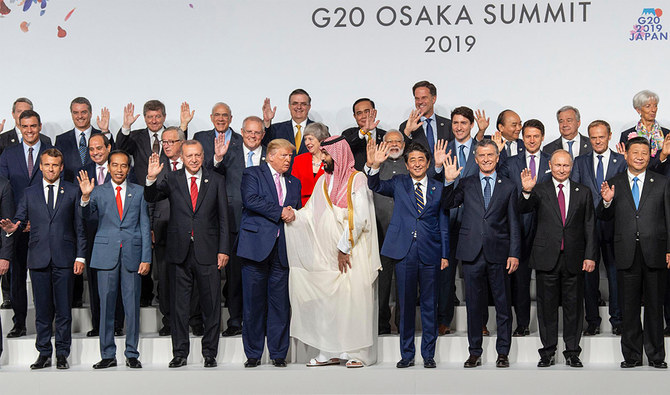
There was an outbreak of cordiality, too, between Trump and the Japanese Prime Minister, Shinzo Abe, with the latter unveiling a list of Japanese investments in the US, as well as a jovial “family photograph” gathering in which Saudi Arabia Crown Prince Mohammed bin Salman figured prominently.
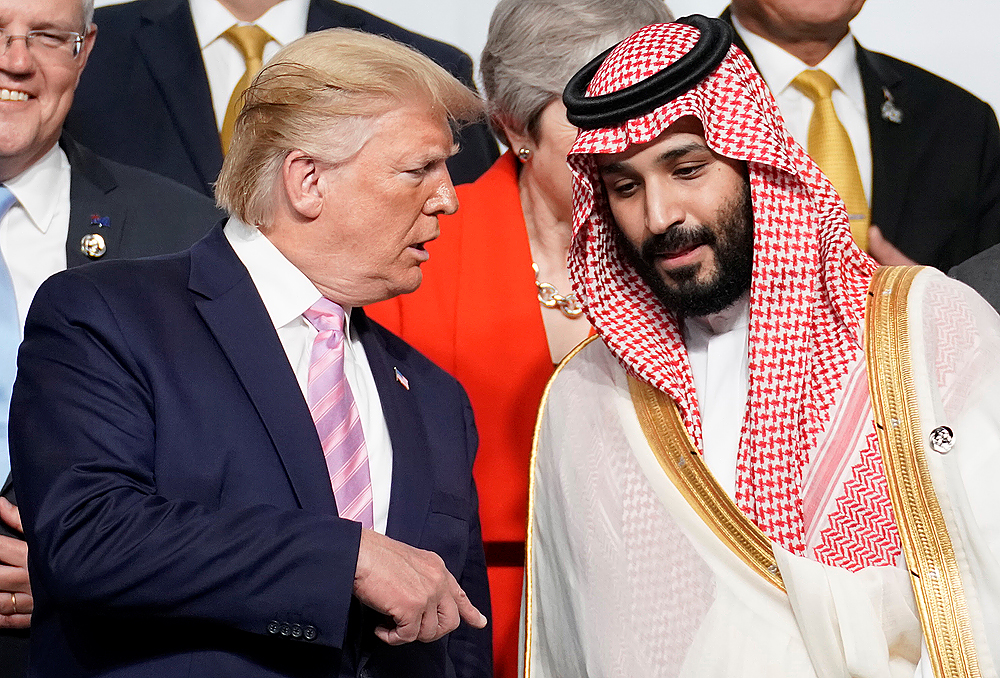
The crown prince had a prominent position alongside Trump at the first discussion session between the leaders, focusing on data technology. Saudi Arabia joined other G20 countries in signing the “Osaka declaration” calling for “effective use” of data to promote economic growth.
A bilateral meeting was held Saturday between the crown prince and the US leader to discuss the issue of Iran.
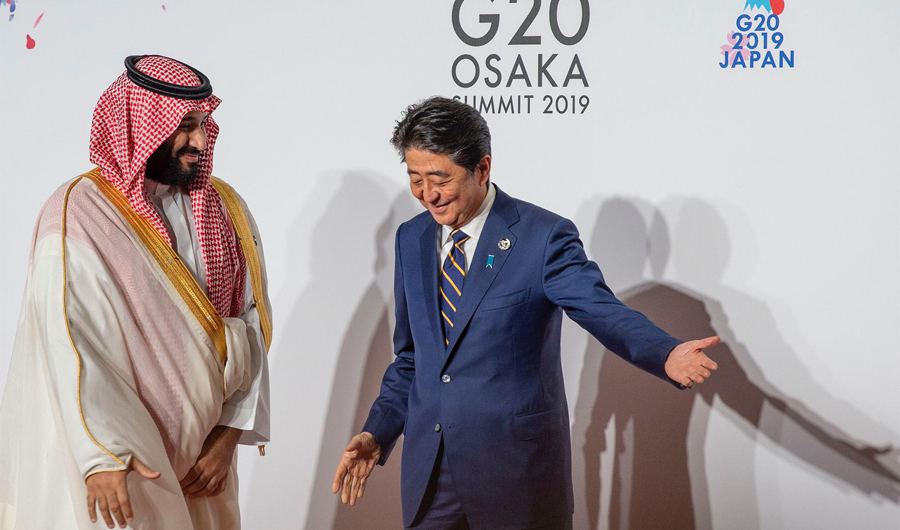
The Saudi leader is due to have private meetings with several other G20 leaders at the event, people close to the Saudi delegation said.
Saudi Arabia is also preparing to take over the G20 baton from Japan after being awarded the right to stage the summit in Riyadh next year.
In a briefing after the first day of the summit, the international spokesman for Japan’s G20 presidency, Takeshi Osuga, said that progress had been made in closed-door sessions on trade. Leaders had agreed that trade disputes presented a risk to the global economy and recognized the need to reform the dispute-settlement mechanisms of the World Trade Organization.
He said there had been “no notable dissent” on climate change. “The sherpas (advisers to the leaders) are working hard at a good outcome document and we’ll see it tomorrow,” Osuga added, referring to the end-of-summit communique that traditionally closes the G20 and is intended to show the leaders’ unity.
But observers cautioned against reading too much into the first day’s gathering of the most powerful leaders in the world when many of the potentially troublesome meetings are due to take place on Saturday, including the long-awaited face-to-face between Trump and President Xi Jinping of China on the thorny subject of trade hostilities between the two biggest economies.
There were hints of tensions below the surface in early comments by Xi and EU leaders.
The Chinese president warned of the dangers of protectionism in world trade — one of Trump’s most often used tactics — which he said was endangering the global commercial system.
“All this is destroying the global trade order. This also affects the common interests of our countries, and overshadows peace and stability worldwide,” he said.
Chinese concern was echoed by the Japanese leader, who had been the target of barbed tweets by Trump over security.
“I harbor great concern about the current situation on global trade.The world is watching the direction at which we are going. Now is the time we communicate a strong message for the maintenance and strengthening of a free, fair and non-discriminatory trading system,” Abe said.
European leaders also seemed at odds with Trump on other issues. Emmanuel Macron, president of France, indicated that he will refuse to sign the joint communique if it fails to match his ambitions on reducing climate change.
“If we do not talk about the Paris accord and if, in order to reach agreement among the 20 in the room, we are not able to defend climate ambitions, it will be without France,” he said before arriving in Osaka.
However, these tensions did not figure highly on the opening day of the 2019 summit. A one-to-one televised discussion between Putin and Trump even raised some amusement when the US leader, answering a question about alleged Russian involvement in the 2016 poll, wagged a finger at the Russian and told him: “Don’t meddle in elections.”


