

Saudi Arabia reaffirms commitment to world market oil supply after Korea visit

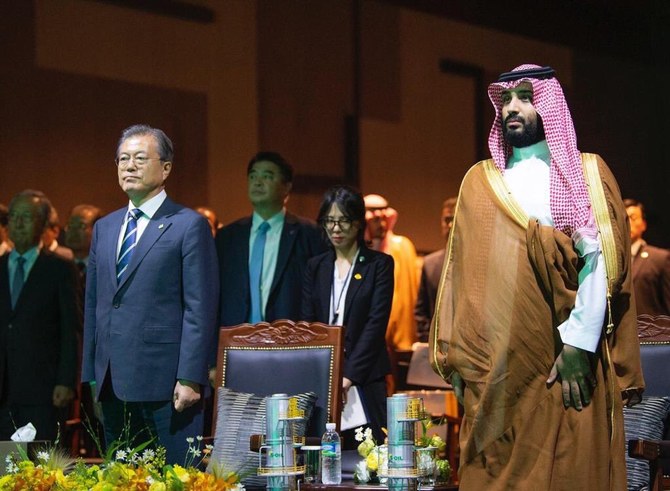
Crown Prince Mohammed bin Slaman's visit to Korea included deals between Saudi Aramco and Korean company S-Oil. (Saudi Foreign Ministry)
Updated 28 June 2019
Follow

Saudi Arabia reaffirms commitment to world market oil supply after Korea visit

  • Statement comes in a joint communique from Crown Prince Mohammed bin Salman's visit to South Korea
  • The countries signed an $8.3 billion economic cooperation pact that included a $6 billion deal between Saudi Aramco and the Korean company S-Oil

RIYADH: Saudi Arabia said it was committed to ensuring world markets are supplied with oil after Crown Prince Mohammed bin Salman visited South Korea.

The Kingdom also confirmed its commitment to compensating for shortages that may occur as a result of any supply disruptions from other sources.

In a joint communique issued by Saudi Arabia and South Korea on Thursday, the Kingdom said that as “the world’s largest reliable source of oil,” it would make sure that oil markets were well supplied.

South Korea, the world’s fifth-largest importer of crude oil, depends on the Middle East for the vast majority of its supplies.

Asian countries have been worried about oil supply after two tankers were attacked in the Gulf of Oman this month. The attacks on the Japanese owned Kokuka Courageous and Norwegian Front Altair were blamed on Iran.

Saudi Arabia’s Crown Prince Mohammed bin Salman visited South Korea on Wednesday in a bid to strengthen economic ties between the two countries.

“Saudi Arabia, a key ally of South Korea, is the biggest oil supplier to our government and the largest economic partner among the Middle Eastern countries,” South Korean presidential spokeswoman Koh Min-jung said.

South Korea halted its Iranian oil imports in May as its waivers from US sanctions on Tehran expired.

The communique detailed the agreements made and meetings held by the two countries during the visit. 

The countries signed an $8.3 billion economic cooperation pact that included a $6 billion deal between Saudi Aramco and the Korean company S-Oil to build an oil refinery and downstream petrochemical facilities in South Korea.


Saudi POS spending jumps 28% in final week of Jan: SAMA

Updated 06 February 2026
Follow

Saudi POS spending jumps 28% in final week of Jan: SAMA

RIYADH: Saudi Arabia’s point-of-sale spending climbed sharply in the final week of January, rising nearly 28 percent from the previous week as consumer outlays increased across almost all sectors. 

POS transactions reached SR16 billion ($4.27 billion) in the week ending Jan. 31, up 27.8 percent week on week, according to the Saudi Central Bank. Transaction volumes rose 16.5 percent to 248.8 million, reflecting stronger retail and service activity. 

Spending on jewelry saw the biggest uptick at 55.5 percent to SR613.69 million, followed by laundry services which saw a 44.4 percent increase to SR62.83 million. 

Expenditure on personal care rose 29.1 percent, while outlays on books and stationery increased 5.1 percent. Hotel spending climbed 7.4 percent to SR377.1 million. 

Further gains were recorded across other categories. Spending in pharmacies and medical supplies rose 33.4 percent to SR259.19 million, while medical services increased 13.7 percent to SR515.44 million. 

Food and beverage spending surged 38.6 percent to SR2.6 billion, accounting for the largest share of total POS value. Restaurants and cafes followed with a 20.4 percent increase to SR1.81 billion. Apparel and clothing spending rose 35.4 percent to SR1.33 billion, representing the third-largest share during the week. 

The Kingdom’s key urban centers mirrored the national surge. Riyadh, which accounted for the largest share of total POS spending, saw a 22 percent rise to SR5.44 billion from SR4.46 billion the previous week. The number of transactions in the capital reached 78.6 million, up 13.8 percent week on week. 

In Jeddah, transaction values increased 23.7 percent to SR2.16 billion, while Dammam reported a 22.2 percent rise to SR783.06 million. 

POS data, tracked weekly by SAMA, provides an indicator of consumer spending trends and the ongoing growth of digital payments in Saudi Arabia.  

The data also highlights the expanding reach of POS infrastructure, extending beyond major retail hubs to smaller cities and service sectors, supporting broader digital inclusion initiatives.  

The growth of digital payment technologies aligns with Saudi Arabia’s Vision 2030 objectives, promoting electronic transactions and contributing to the Kingdom’s broader digital economy.