

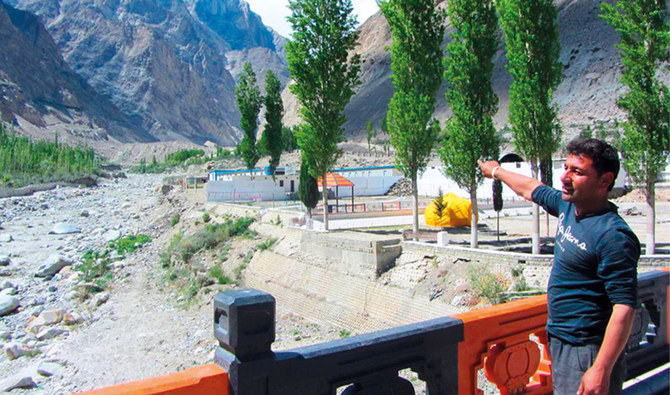

HUNZA, Pakistan: In this district in northern Pakistan flanked by soaring mountain ranges and glaciers, plastic shopping bags are now illegal.
In late April, the provincial government banned their “use, purchase, export or import” in an effort to cut plastic waste and pollution, and rolled out first deliveries of cloth shopping bags.
Now those hang in shops, and many customers have started bringing bags from home — though not everyone is happy with the change.
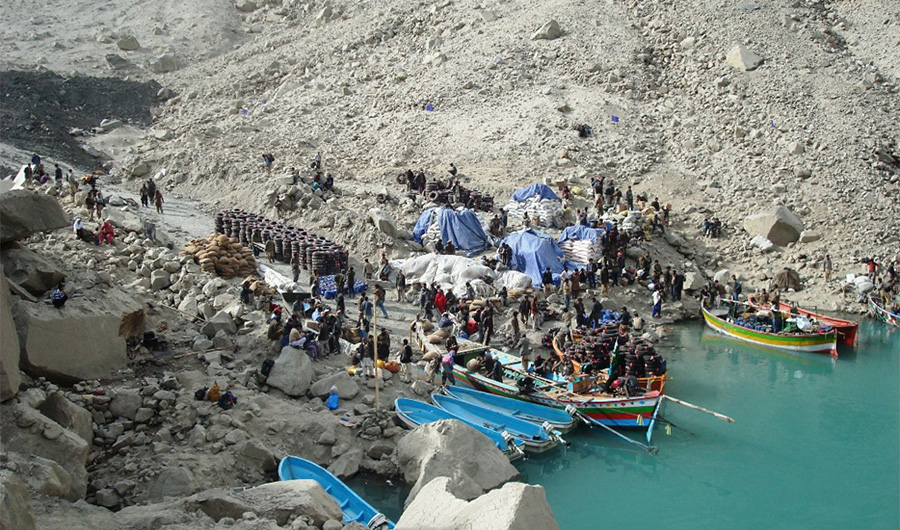
In this image taken on Thursday, March 11, 2010, Pakistani loaders carrying goods imported from neighboring China which are ferried through a lake due to blockade of the Karakoram Highway, in Attabad, northern Pakistan. A massive landslide early this year formed a natural dam in the Hunza River created a lake that is consuming upstream as it expands. If the dam breaks, a flash flood could threaten downstream villages. (AP/File)
“The use of plastic bags is not only handy, but also very cheap as compared to cloth and paper bags,” said Ikram Jamal, a trader in the city’s main market.
“It is a challenge for customers as well as for traders to instantly ban plastic bags, amid the lack of availability of an alternate option,” he said, noting only a limited supply of cloth bags was so far available.
But 50-year-old Shamim Bagum, a shopper in the market, said she was adjusting.
“After shopkeepers refused to give us polythene bags, I now myself bring a cloth bag to take groceries home,” she said.
Carrying cloth bags for all shopping can be a challenge, but people need to obey the government’s decision, she said.
Around the world, cities, regions, and countries are trying to cut back on plastic waste, banning the use of items such as throw-away plastic shopping bags and drinking straws.
The pioneers of the movement, however, are not just in richer nations, but in many developing ones as well, from Tanzania to Bangladesh and now Pakistan’s Gilgit-Baltistan region, the country’s northernmost territory.
WIDENING BANS
Hunza was the first district in Pakistan to ban plastic shopping bags, said Malik Amin Aslam, the prime minister’s adviser on climate change.
But the bans are now spreading, with Punjab province and the city of Quetta now outlawing bags as well, and Islamabad set to do the same in August.
In Hunza, the provincial government worked with the Gilgit-Baltistan Environmental Protection Agency and the Karakoram Area Development Organization to launch the pilot ban, which aims to clean up the narrow, mountain-flanked valley that attracts more than half a million tourists a year.
The scenic Karakoram Highway, which connects Pakistan with China, runs through the district.
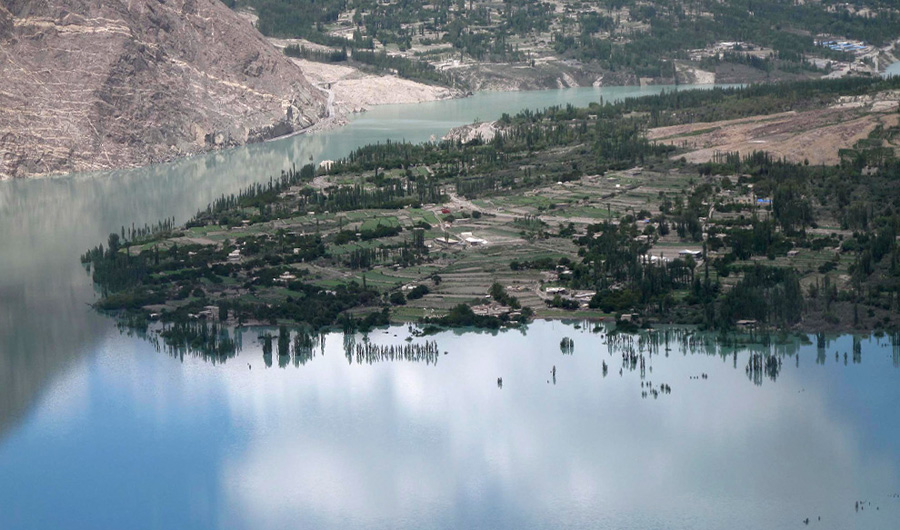
A view from a military helicopter of the lake growing behind a natural dam caused by a landslide which passes through Sheeshgat village in Hunza district of northern Pakistan May 24, 2010. (REUTERS/File)
At least some tourists stopping in Hunza said they thought the bag ban was a good idea.
“The shopkeeper declined to give me a plastic bag when I purchased a bottle of mineral water from his shop in a market in Hunza. This is a positive change,” said 30-year Ishtiaq Bhatti, visiting Hunza’s Sikandarabad village from Lahore.
Kamal Uddin, chief executive of the Karakoram Area Development Organization, said the ban came about after his group and the city of Hunza discovered in a survey that about 70,000 plastic bags were used and discarded each month in the valley.
Uddin said using cloth bags for shopping is hardly an innovation — until the arrival of cheap plastic bags it was the norm in the area, he said.
Restoring the use of cloth bags also can provide jobs, he said.
At least 50 local women and more than a dozen disabled people have been hired to stitch bags, he said.
An initial 10,000 shopping bags, carrying slogans about the anti-plastic campaign, were provided by the government and distributed free locally, said Shahzad Shigri, director of the Gilgit-Baltistan environmental protection agency.
But additional bags will be produced locally, Uddin said.
SUPPORT — AND CHALLENGES
Local people and traders say the plastic ban is a good step toward greater environmental protection — but the changeover is proving a bit of a headache.
“We appreciate the initiative for a good cause”, said Taj Muhammad Rumi, a trader in Sust market near the Chinese border. He said population growth and a large number of tourists have had an adverse impact on the area’s environment.
“But the challenge is still there that no proper and systematic mechanism is in place to provide cloth bags,” he said.
Qasim Ejaz, Hunza’s assistant district commissioner, said the plastic bag ban needs to be expanded to all plastic throwaway items. But policing even the bag ban will be challenging, he said, with tourists often bringing in bags from outside.
The valley sees 600,000 to 700,000 visitors a year, he said.
Shigri, of the Gilgit-Baltistan environmental protection agency, said his agency now aims to expand the plastic bag ban to all national parks in the northern territory.
For now, despite the ban, plastic bags still lurk in the region’s markets
A young trader in the main Aliabad city market said that shop owners are still parceling a few out to customers that come without a shopping bag, particularly if cloth bags are unavailable.
“Though there is no open display of plastic bags in the market due to fear of administrative curbs, yet they are still in use in some areas amid unavailability of cloth and paper bags,” he said.
Uddin, of the Karakoram Area Development Organization, said that’s to be expected.
“It is a huge task and will take some time to completely phase (plastic) out,” he said.
(Reporting by Peer Muhammad; editing by Laurie Goering: (Please credit the Thomson Reuters Foundation, the charitable arm of Thomson Reuters, that covers humanitarian news, climate change, resilience, women’s rights, trafficking and property rights.


