WASHINGTON: Special counsel Robert Mueller has agreed to testify publicly before Congress on July 17 after Democrats issued subpoenas to compel him to appear, the chairmen of two House committees announced Tuesday.
Mueller’s unusual back-to-back testimony in front of the House Judiciary and Intelligence committees is likely to be the most highly anticipated congressional hearing in years, particularly given Mueller’s resolute silence throughout his two-year investigation into Russian contacts with President Donald Trump’s campaign. Mueller never responded to angry, public attacks from Trump, nor did he ever personally join his prosecutors in court or make announcements of criminal charges from the team.
His sole public statement came from the Justice Department podium last month as he announced his departure, when he sought to explain his decision to not indict Trump or to accuse him of criminal conduct. He also put lawmakers on notice that he did not ever intend to say more than what he put in the 448-page report.
“We chose those words carefully and the work speaks for itself,” Mueller said May 29. “I would not provide information beyond what is already public in any appearance before Congress.”
Those remarks did little to settle the demands for his testimony. The two committees continued negotiations that had already been going on for weeks, saying they still wanted to hear from Mueller no matter how reluctant he was.
“When you accept the role of special counsel in one of the most significant investigations in modern history you’re going to have to expect that you’re going to be asked to come and testify before Congress,” House Intelligence Committee Chairman Adam Schiff, D-Calif., told reporters shortly after the announcement.
Trump himself simply tweeted, “Presidential Harassment!”
In the report issued in April, Mueller concluded there was not enough evidence to establish a conspiracy between Trump’s presidential campaign and Russia, which was the original question that started the investigation. But he also said he could not exonerate Trump on obstruction of justice. The report examined several episodes in which Trump attempted to influence the investigation.
Democrats say it is now the job of Congress to assess the report’s findings. Lawmakers are likely to confront Mueller on why he did not come to a firm conclusion on obstruction of justice. They are also likely to seek his reaction to a drumbeat of incessant criticism from the president and ask for his personal opinion about whether Trump would have been charged were he not the commander-in-chief.
Schiff and House Judiciary Committee Chairman Jerrold Nadler said they issued the subpoenas Tuesday, and Mueller agreed to testify pursuant to those subpoenas. In a letter to Mueller accompanying the subpoenas, the committee chairmen said “the American public deserves to hear directly from you about your investigation and conclusions.”
Schiff said there will be two hearings “back to back,” one for each committee, and they will also meet with Mueller’s staff in closed session afterward.
The Justice Department declined to comment.
Republicans have criticized Democrats for their continuing investigations of the president. House Minority Leader Kevin McCarthy, R-Calif., questioned why they would still want to hear from Mueller after the lengthy report was issued. “He said he didn’t want to talk to us anymore, didn’t he?”
But Georgia Rep. Doug Collins, the top Republican on the Judiciary panel, has said he has no objections to Mueller’s testimony.
“May this testimony bring to House Democrats the closure that the rest of America has enjoyed for months, and may it enable them to return to the business of legislating,” Collins said.

Special counsel Mueller to testify publicly before US House committees
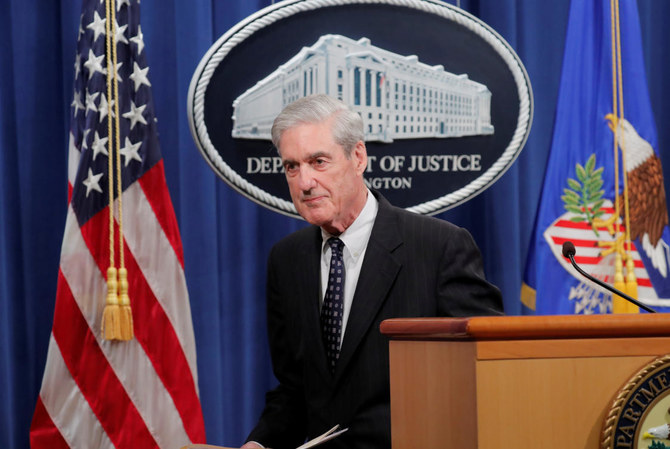
- Robert Mueller’s unusual back-to-back testimony likely to be the most highly anticipated congressional hearing in years
- Mueller earlier said there was not enough evidence to establish a conspiracy between Donald Trump’s presidential campaign and Russia
Trump has ‘productive’ talks with Putin before Zelensky meet
- Trump’s upbeat tone on peace deal comes after Russia carried out another massive bombardment of Kyiv
- US president due to meet Zelensky at his Mar-a-Lago estate today
PALM BEACH: Donald Trump said Sunday he had “productive” talks with Russian leader Vladimir Putin hours before the US president meets Ukraine’s Volodymyr Zelensky, in a year-end sprint to seal a deal to end the war.
Trump’s renewed upbeat tone comes despite wide skepticism in Europe about Putin’s intentions after Russia carried out another massive bombardment of the Ukrainian capital Kyiv just as Zelensky was heading to Trump’s Florida estate.
“I just had a very good and productive telephone call with President Putin of Russia,” Trump announced on his Truth Social platform.
The Kremlin gave a more pointed readout, saying that Trump agreed that a mere ceasefire “would only prolong the conflict” as it demanded Ukraine compromise on territory.
Trump is meeting Zelensky in the dining room of his Mar-a-Lago estate, where he frequently brings both foreign guests and domestic supporters.
Trump has made ending the Ukraine war a centerpiece of his second term as a self-proclaimed “president of peace,” and he has repeatedly blamed both Kyiv and Moscow for the failure to secure a ceasefire.
Zelensky, who has faced verbal attacks from Trump, has sought to show willingness to work with the contours of the US leader’s plans, but Putin has offered no sign that he will accept it.
Sunday’s meeting will be Trump’s first in-person encounter with Zelensky since October, when the US president refused to grant his request for long-range Tomahawk missiles.
And the Ukrainian leader could face another hard sell this time around, with Trump insisting that he “doesn’t have anything until I approve it.”
- European allies -
The talks are expected to last an hour, after which the two presidents are scheduled to hold a joint call with the leaders of key European allies.
Polish Prime Minister Donald Tusk, who will join the call, wrote on X that the Russian attacks on Kyiv were “contrary to President Trump’s expectations and despite the readiness to make compromises” by Zelensky.
The revised peace plan, which emerged from weeks of intense US-Ukraine negotiations, would stop the war along its current front lines and could require Ukraine to pull troops back from the east, allowing the creation of demilitarized buffer zones.
As such, it contains Kyiv’s most explicit acknowledgement yet of possible territorial concessions.
It does not, however, envisage Ukraine withdrawing from the 20 percent of the eastern Donetsk region that it still controls — Russia’s main territorial demand.
The Ukrainian leader said he hoped the talks in Florida would be “very constructive” but stressed that Putin had shown his hand with a deadly drone and missile assault on Kyiv that temporarily knocked out power and heating to hundreds of thousands of residents during freezing temperatures.
“This attack is again Russia’s answer on our peace efforts. And this really showed that Putin doesn’t want peace,” he said as he visited Canada.
He also told reporters that he would press Trump on the importance of providing security guarantees that would prevent any renewed Russian aggression if a ceasefire were secured.
“We need strong security guarantees. We will discuss this and we will discuss the terms,” he said.
Ukraine insists it needs more European and US funding and weapons — especially drones.
- Russian opposition -
Russia has accused Ukraine and its European backers of trying to “torpedo” a previous US-brokered plan to stop the fighting, and recent battlefield gains — Russia announced on Saturday it had captured two more towns in eastern Ukraine — are seen as strengthening Moscow’s hand when it comes to peace talks.
“If the authorities in Kyiv don’t want to settle this business peacefully, we’ll resolve all the problems before us by military means,” Putin said on Saturday.
Russian Foreign Minister Sergei Lavrov told state news agency TASS that Moscow would continue its engagement with US negotiators but criticized European governments as the “main obstacle” to peace.
“They are making no secret of their plans to prepare for war with Russia,” Lavrov said, adding that the ambitions of European politicians are “literally blinding them.”
Trump’s renewed upbeat tone comes despite wide skepticism in Europe about Putin’s intentions after Russia carried out another massive bombardment of the Ukrainian capital Kyiv just as Zelensky was heading to Trump’s Florida estate.
“I just had a very good and productive telephone call with President Putin of Russia,” Trump announced on his Truth Social platform.
The Kremlin gave a more pointed readout, saying that Trump agreed that a mere ceasefire “would only prolong the conflict” as it demanded Ukraine compromise on territory.
Trump is meeting Zelensky in the dining room of his Mar-a-Lago estate, where he frequently brings both foreign guests and domestic supporters.
Trump has made ending the Ukraine war a centerpiece of his second term as a self-proclaimed “president of peace,” and he has repeatedly blamed both Kyiv and Moscow for the failure to secure a ceasefire.
Zelensky, who has faced verbal attacks from Trump, has sought to show willingness to work with the contours of the US leader’s plans, but Putin has offered no sign that he will accept it.
Sunday’s meeting will be Trump’s first in-person encounter with Zelensky since October, when the US president refused to grant his request for long-range Tomahawk missiles.
And the Ukrainian leader could face another hard sell this time around, with Trump insisting that he “doesn’t have anything until I approve it.”
- European allies -
The talks are expected to last an hour, after which the two presidents are scheduled to hold a joint call with the leaders of key European allies.
Polish Prime Minister Donald Tusk, who will join the call, wrote on X that the Russian attacks on Kyiv were “contrary to President Trump’s expectations and despite the readiness to make compromises” by Zelensky.
The revised peace plan, which emerged from weeks of intense US-Ukraine negotiations, would stop the war along its current front lines and could require Ukraine to pull troops back from the east, allowing the creation of demilitarized buffer zones.
As such, it contains Kyiv’s most explicit acknowledgement yet of possible territorial concessions.
It does not, however, envisage Ukraine withdrawing from the 20 percent of the eastern Donetsk region that it still controls — Russia’s main territorial demand.
The Ukrainian leader said he hoped the talks in Florida would be “very constructive” but stressed that Putin had shown his hand with a deadly drone and missile assault on Kyiv that temporarily knocked out power and heating to hundreds of thousands of residents during freezing temperatures.
“This attack is again Russia’s answer on our peace efforts. And this really showed that Putin doesn’t want peace,” he said as he visited Canada.
He also told reporters that he would press Trump on the importance of providing security guarantees that would prevent any renewed Russian aggression if a ceasefire were secured.
“We need strong security guarantees. We will discuss this and we will discuss the terms,” he said.
Ukraine insists it needs more European and US funding and weapons — especially drones.
- Russian opposition -
Russia has accused Ukraine and its European backers of trying to “torpedo” a previous US-brokered plan to stop the fighting, and recent battlefield gains — Russia announced on Saturday it had captured two more towns in eastern Ukraine — are seen as strengthening Moscow’s hand when it comes to peace talks.
“If the authorities in Kyiv don’t want to settle this business peacefully, we’ll resolve all the problems before us by military means,” Putin said on Saturday.
Russian Foreign Minister Sergei Lavrov told state news agency TASS that Moscow would continue its engagement with US negotiators but criticized European governments as the “main obstacle” to peace.
“They are making no secret of their plans to prepare for war with Russia,” Lavrov said, adding that the ambitions of European politicians are “literally blinding them.”
© 2025 SAUDI RESEARCH & PUBLISHING COMPANY, All Rights Reserved And subject to Terms of Use Agreement.


