


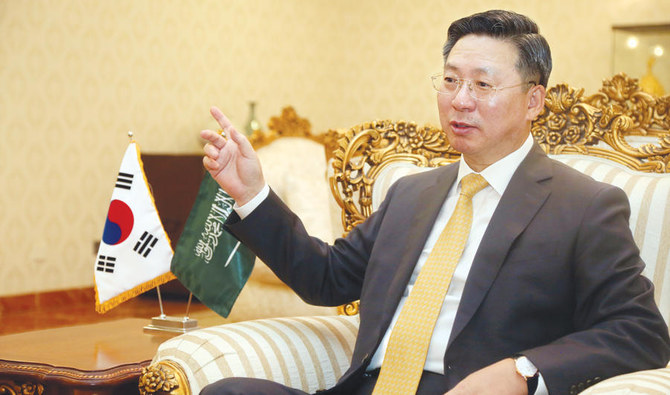

RIYADH: The ties of friendship and cooperation between Saudi Arabia and South Korea have expanded to unprecedented levels during King Salman’s reign, South Korean Ambassador Jo Byung-wook told Arab News.
“In particular, after the launch of Saudi Vision 2030, economic and social reforms driven by Crown Prince Mohammed bin Salman have provided new opportunities for expanding the bilateral cooperation,” Jo said.
With shared interests and cooperation between the two countries around Vision 2030, the South Korean government has closely consulted with the Kingdom to help realize the wide-ranging reform program, the envoy said.
“The Korea-Saudi Vision 2030 Committee, launched in October 2017, will be the umbrella under which the joint efforts of our two countries will produce more fruitful outcomes,” he said.
The committee serves as an institutional platform to review projects and explore partnership opportunities under Vision 2030. The second Saudi-Korean committee meeting was held in Seoul in April, and the two countries have agreed to carry out 43 projects across five major sectors.
However, it is Crown Prince Mohammed bin Salman’s visit to South Korea June 26-27 that is most eagerly awaited.
It will be the highest-level visit from Saudi Arabia to South Korea since the then-Crown Prince Abdullah led a delegation to Seoul in 1998.
Jo described the forthcoming visit “as one of the most notable and historic events, which shows an even closer friendship and bilateral relations.”
The visit will serve as “a turning point for further strides in bilateral relations between the Republic of Korea and the Kingdom of Saudi Arabia,” he said.
The crown prince will take part in the first official bilateral summit with South Korean President Moon Jae-in.
“The summit is expected to establish future-oriented and mutually beneficial bilateral relations on a basis of the longstanding friendship and partnership between the two countries nurtured for more than half a century,” the South Korean envoy said.
Both countries stand to benefit from the joint opportunities resulting from a growing partnership, Jo said.
“Saudi Arabia has allocated a large amount of resources in order to transform the country into a leading industrial powerhouse and reduce excessive oil-dependency in its economy. This strategy will provide a unique environment for South Korean companies to work with their Saudi counterparts,” he said.
“Until now, Korean companies have focused on exporting ‘Made in Korea’ products, such as cars, electronics and machinery, to the Kingdom. However, the time has come for Korean companies to move beyond simple trade transactions and pursue a ‘Made with Saudi’ strategy.
“Korean companies can work together with Saudi companies in areas such as idea development, design, engineering, manufacturing and even maintenance. In this process, strengths that both countries possess — technology and expertise from Korea, and finance and plentiful young labor from Saudi Arabia, for instance — will create synergies for greater achievements,” the envoy said.
FASTFACT
• Crown Prince Mohammed bin Salman is scheduled to visit South Korea June 26-27.
• The crown prince will take part in the first official bilateral summit with South Korean President Moon Jae-in.
• Recently launched collaborations between the two countries include the International Maritime Industries Co., Saudi Aramco joint venture with Hyundai Heavy Industries to build the Gulf’s biggest shipyard in Ras Al-Khair.
• The two countries have also designed a SMART reactor, which is an integral-type small reactor originally developed and designed by the Korea Atomic Energy Research Institute especially for small or remote cities.
• The crown prince’s visit is likely to facilitate over 43 projects under VIsion 2030.
Recently launched collaborations between South Korea and the Kingdom include the International Maritime Industries (IMI) Co., Saudi Aramco joint venture with Hyundai Heavy Industries (HHI) to build the Gulf’s biggest shipyard in Ras Al-Khair.
HHI, the world’s third-largest shipbuilding company, will be responsible for design and engineering work at the shipyard. When complete, the SR19.5 billion ($5.2 billion) project will be the centerpiece of the Saudi shipbuilding industry, creating up to 80,000 jobs for the local workforce.
In addition, HHI and Saudi Aramco have been developing another joint project at Ras Al-Khair to produce up to 200 ship engines a year.
Cooperation in the nuclear sector is another “exemplary instance” of strengthening ties between the two countries, Jo said.
“In accordance with the memorandum of understanding signed between the Korean government and King Abdullah City for Atomic and Renewable Energy in 2015, the two countries have further designed the SMART reactor, which is an integral-type small reactor originally developed and designed by the Korea Atomic Energy Research Institute especially for small or remote cities,” he said.
“This collaboration also includes human capacity-building projects with the participation of Saudi nuclear engineers and experts. Through this joint process, I expect that Korea will be able to share with Saudi Arabia its experience and lessons learned that have been accumulated from designing, building and operating nuclear reactors over a long period of time.”
In addition to the SMART reactor, a consortium led by the Korea Electric Power Corp. (KEPCO) is bidding for a project to build the Kingdom’s first two large-size nuclear power plants.
KEPCO, which oversaw construction of the Barakah nuclear power plant in the UAE, is the world’s only contractor with experience of building a nuclear reactor in a desert environment.
“Korea has a proven track record of operating multiple nuclear reactors both safely and economically, and has earned a reputation for building world-class nuclear reactors on time and within budget,” Jo said. “I am confident that Korea will be an optimal partner for Saudi Arabia as it seeks to develop its own nuclear energy industry.”
Jo said: “The two countries have been developing other joint projects which will be new symbols of the close and strong partnership in the future. The crown prince’s visit to Korea will facilitate and accelerate the realization of 43 and possibly even more projects under Vision 2030.”


