Parliament fills key Cabinet posts in Iraq

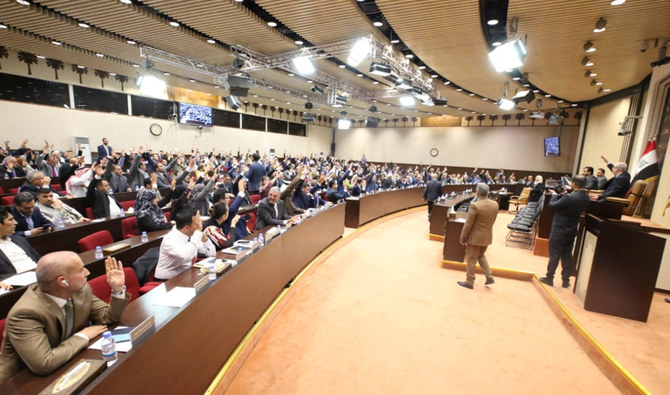
Members of the Iraqi parliament are seen vote on remaining cabinet ministers at the parliament headquarters in Baghdad, Iraq June 24, 2019. (Reuters)
Updated 24 June 2019
Follow

Parliament fills key Cabinet posts in Iraq

  • In October, Iraq’s Parliament voted to confirm Prime Minister Adel Abdul Mahdi’s new government while leaving the four Cabinet posts unfilled

BAGHDAD: Iraq’s Parliament on Monday filled three key ministerial positions to end seven months of failed negotiations and political deadlock in the country.

The Parliament approved Najah Al-Shammari as defense minister, Yassin Al-Yassiri as interior minister and Farouq Amin Othman as justice minister. The three were sworn in on Monday.

The election of an education minister was postponed after its candidate was voted down.

In October, Iraq’s Parliament voted to confirm Prime Minister Adel Abdul Mahdi’s new government while leaving the four Cabinet posts unfilled, a move that underlined the country’s deep political divisions.

Parliamentary approval of the three ministers came on the eve of a deadline by Shiite cleric Moqtada Al-Sadr to the prime minister and leaders of political blocs to fill the vacant ministries.

Al-Sadr, one of the most influential clerics in the country, with millions of followers, a large armed faction and a parliamentary bloc, last week threatened to withdraw his support for the government if Abdul Mahdi failed to finalize his Cabinet within 10 days.

In response, Iraq’s leader rushed to provide a list of candidates to fill the vacant ministries.

Abdul Mahdi’s government resulted from an agreement between the parliamentary Reform coalition led by Al-Sadr and the pro-Iranian parliamentary Construction Coalition led by Hadi Al-Amiri, commander of the Badr Organization, one of the most powerful Shiite armed factions.

The two coalitions agreed to share ministries, support the government and vote for each other’s candidates, but a dispute erupted when Al-Amiri and his allies insisted on the nomination of Falih Al-Fayyadh, the current national security adviser, as interior minister. Al-Sadr and his allies within Reform rejected the nomination, saying Al-Fayadh was backed by Qassem Sulaimani, leader of Iran’s Revolutionary Guards.

The vote to fill the three ministerial vacancies is unlikely to end Iraq’s political turmoil, analysts warned.

“Now Abdul Mahdi can catch his breath until the next crisis,” Abdul Wahid Tuama, an independent analyst, told Arab News.

“Nothing will be changed after the election of these ministers. The performance of the government will not change and the problems facing the prime minister will not be resolved.

“The most important thing achieved today is that the pressure submitted by Al-Sadr on Abdul Mahdi and the heads of blocs will ease for a while.”


UN rights chief Shocked by ‘unbearable’ Darfur atrocities

Updated 18 January 2026
Follow

UN rights chief Shocked by ‘unbearable’ Darfur atrocities

  • Mediation efforts have failed to produce a ceasefire, even after international outrage intensified last year with reports of mass killings, rape, and abductions during the RSF’s takeover of El-Fasher in Darfur

PORT SUDAN: Nearly three years of war have put the Sudanese people through “hell,” the UN’s rights chief said on Sunday, blasting the vast sums spent on advanced weaponry at the expense of humanitarian aid and the recruitment of child soldiers.
Since April 2023, Sudan has been gripped by a conflict between the army and the paramilitary Rapid Support Forces that has left tens of thousands of people dead and around 11 million displaced.
Speaking in Port Sudan during his first wartime visit, UN Human Rights commissioner Volker Turk said the population had endured “horror and hell,” calling it “despicable” that funds that “should be used to alleviate the suffering of the population” are instead spent on advanced weapons, particularly drones.
More than 21 million people are facing acute food insecurity, and two-thirds of Sudan’s population is in urgent need of humanitarian aid, according to the UN.
In addition to the world’s largest hunger and displacement crisis, Sudan is also facing “the increasing militarization of society by all parties to the conflict, including through the arming of civilians and recruitment and use of children,” Turk added.
He said he had heard testimony of “unbearable” atrocities from survivors of attacks in Darfur, and warned of similar crimes unfolding in the Kordofan region — the current epicenter of the fighting.
Testimony of these atrocities must be heard by “the commanders of this conflict and those who are arming, funding and profiting from this war,” he said.
Mediation efforts have failed to produce a ceasefire, even after international outrage intensified last year with reports of mass killings, rape, and abductions during the RSF’s takeover of El-Fasher in Darfur.
“We must ensure that the perpetrators of these horrific violations face justice regardless of the affiliation,” Turk said on Sunday, adding that repeated attacks on civilian infrastructure could constitute “war crimes.”
He called on both sides to “cease intolerable attacks against civilian objects that are indispensable to the civilian population, including markets, health facilities, schools and shelters.”
Turk again warned on Sunday that crimes similar to those seen in El-Fasher could recur in volatile Kordofan, where the RSF has advanced, besieging and attacking several key cities.
Hundreds of thousands face starvation across the region, where more than 65,000 people have been displaced since October, according to the latest UN figures.