

Bodies of foreign climbers retrieved from Indian mountain, one still missing

1 / 2
Ruth McCance. (Twitter)
2 / 2
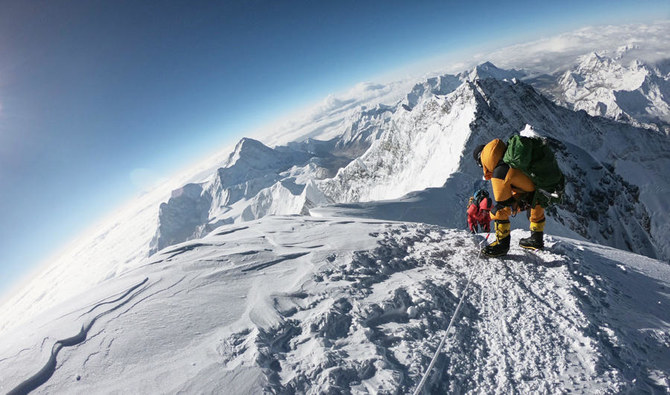
In this file photo taken on May 17, 2018 mountaineers make their way to the summit of Mount Everest, as they ascend on the south face from Nepal. (AFP)
Updated 24 June 2019
Follow

Bodies of foreign climbers retrieved from Indian mountain, one still missing

  • Eleven people died on the world’s highest peak, and some of the fatalities were blamed on overcrowding

NEW DELHI: The bodies of seven climbers killed on India’s second-highest mountain were retrieved Sunday, capping a nearly month-long search by mountaineering experts in treacherous Himalayan terrain.
The eight-person group that went missing in late May included four Britons, two Americans, one Indian and one Australian.
They had set out to summit a previously “unclimbed peak” in India’s northern state of Uttarakhand.
A group of mountaineers from the paramilitary Indo-Tibetan Border Police (ITBP) found the seven bodies near an unnamed peak on Nanda Devi East.
The search for the last remaining body would continue on Monday, ITBP spokesman Vivek Kumar Pandey told AFP.
Those retrieved have been “taken to a nearby site,” Pandey said, adding: “We have also found some mountaineering equipment and gear.”
The bodies have not yet been identified.
The eight climbers were part of a 12-strong expedition, but four Britons were rescued after breaking away.
The main group, which was led by experienced British mountaineer Martin Moran, had permission only to climb the eastern peak of Nanda Devi.
But a Facebook post by Moran’s firm on May 22 said they planned to attempt “an unclimbed peak” around 6,500 meters (21,300 feet) high.
The missing climbers last communicated on May 26, a day before heavy snow fell and massive avalanches hit the heights.
Indian authorities began a search but operations were affected by bad weather and difficult terrain.
Pandey said it took five hours on Sunday to retrieve the bodies.
“The terrain conditions were extremely difficult due to steep gradient, snow accumulation and wind conditions,” he said.
Aerial searches for the climbers were repeatedly hindered earlier by turbulent winds, the risk of avalanches and the bowl-shaped terrain.

On June 3, a helicopter spotted five bodies and climbing equipment in the snow, at a height of about 5,000 meters but attempts to drop troops by air to retrieve them were aborted due to the risks.
In addition to Moran, the climbers have been named as John McLaren, Rupert Whewell and University of York lecturer Richard Payne from Britain, US nationals Anthony Sudekum and Ronald Beimel, Australian Ruth McCance and Indian guide Chetan Pandey.
Officials earlier told AFP the climbers had risked their lives by taking an untested route for which they did not have permission.
The climbers may have fallen from an ice ridge or an overhanging mass of snow during the avalanches, a military source said.
Hundreds of mountaineers from around the world visit India to scale peaks across the Himalayan chain, and those in Nanda Devi sanctuary are considered among the toughest.
The first successful ascent of Nanda Devi was in 1936.
India has 10 peaks above 7,000 meters, including Kangchenjunga — the world’s third highest — sandwiched between India and Nepal.
The deaths in India followed the deadliest climbing season in years on Nepal’s Mount Everest. Eleven people died on the world’s highest peak, and some of the fatalities were blamed on overcrowding.


Nigeria signals more strikes likely in ‘joint’ US operations

Updated 26 December 2025
Follow

Nigeria signals more strikes likely in ‘joint’ US operations

  • Nigeria on Friday signalled more strikes against jihadist groups were expected after a Christmas Day bombardment by US forces against militants in the north of the country

LAGOS: Nigeria on Friday signalled more strikes against jihadist groups were expected after a Christmas Day bombardment by US forces against militants in the north of the country.
The west African country faces multiple interlinked security crises in its north, where jihadists have been waging an insurgency in the northeast since 2009 and armed “bandit” gangs raid villages and stage kidnappings in the northwest.
The US strikes come after Abuja and Washington were locked in a diplomatic dispute over what Trump characterised as the mass killing of Christians amid Nigeria’s myriad armed conflicts.
Washington’s framing of the violence as amounting to Christian “persecution” is rejected by the Nigerian government and independent analysts, but has nonetheless resulted in increased security coordination.
“It’s Nigeria that provided the intelligence,” the country’s foreign minister, Yusuf Tuggar, told broadcaster Channels TV, saying he was on the phone with US State Secretary Marco Rubio ahead of the bombardment.
Asked if there would be more strikes, Tuggar said: “It is an ongoing thing, and we are working with the US. We are working with other countries as well.”
Targets unclear
The Department of Defense’s US Africa Command, using an acronym for the Daesh group, said “multiple Daesh terrorists” were killed in an attack in the northwestern state of Sokoto.
US defense officials later posted video of what appeared to be the nighttime launch of a missile from the deck of a battleship flying the US flag.
Which of Nigeria’s myriad armed groups were targeted remains unclear.
Nigeria’s jihadist groups are mostly concentrated in the northeast of the country, but have made inroads into the northwest.
Researchers have recently linked some members from an armed group known as Lakurawa — the main jihadist group located in Sokoto State — to Islamic State Sahel Province (ISSP), which is mostly active in neighboring Niger and Mali.
Other analysts have disputed those links, though research on Lakurawa is complicated as the term has been used to describe various armed fighters in the northwest.
Those described as Lakurawa also reportedly have links to Al-Qaeda affiliated group for the Support of Islam and Muslims (JNIM), a rival group to ISSP.
While Abuja has welcomed the strikes, “I think Trump would not have accepted a ‘No’ from Nigeria,” said Malik Samuel, an Abuja-based researcher for Good Governance Africa, an NGO.
Amid the diplomatic pressure, Nigerian authorities are keen to be seen as cooperating with the US, Samuel told AFP, even though “both the perpetrators and the victims in the northwest are overwhelmingly Muslim.”
Tuggar said that Nigerian President Bola Tinubu “gave the go-ahead” for the strikes.
The foreign minister added: “It must be made clear that it is a joint operation, and it is not targeting any religion nor simply in the name of one religion or the other.”