

Iran linked to rocket attack on US oil targets in southern Iraq

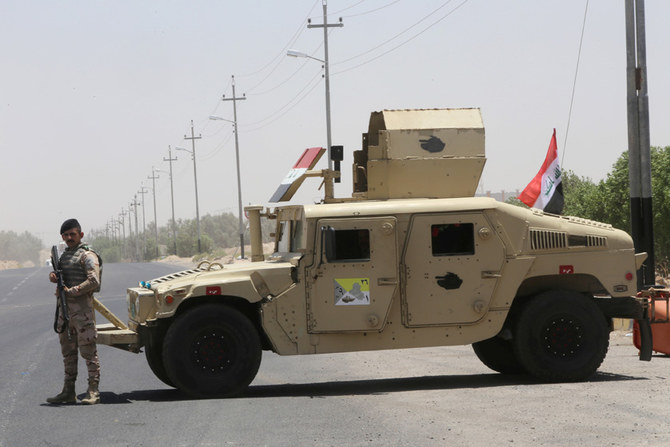
An Iraqi soldier stands next to a military vehicle at the entry of Zubair oilfield after a rocket struck the site of residential and operations headquarters of several oil companies at Burjesia area, in Basra, Iraq, on June 19, 2019. (REUTERS/Essam Al-Sudani)
Updated 20 June 2019
Follow

Iran linked to rocket attack on US oil targets in southern Iraq

  • Fourth oil-related terrorist assault since Tehran’s threat to halt exports from Gulf
  • Three people were injured in Wednesday’s incident

BAGHDAD, Iraq:  Iran was accused of sowing further chaos on Wednesday when a rocket hit a site near Basra in southern Iraq used by US and other oil companies.

The attack came hours after three rockets landed in the Rumailah oil field in Basra, near a camp used by the US oil services company Baker Hughes.

It was the fourth oil-related terrorist attack since Tehran threatened to halt exports from the Arabian Gulf in response to US sanctions aimed at reducing Iran’s oil sales to zero.

Three people were injured in Wednesday’s incident, when a short-range Katyusha rocket hit a drilling site in the Burjesiya area near Basra, an operational area for oil companies including Royal Dutch Shell, Eni of Italy and the US giant ExxonMobil.

The finger of blame was immediately pointed at Iran-backed armed groups in the area, particularly Kata’ib Hezbollah. “They are equipped with this type of rocket, which is ubiquitous among the Iranian-supported militias,” security analyst Dr. Theodore Karasik told Arab News.

TIMELINE OF TERROR

● July 21, 2018 Iran’s supreme leader Ayatollah Ali Khamenei says if Iran’s oil sales are impeded by sanctions, ‘no other country in the region will export oil either.’

● April 21, 2019 US says it will end sanctions exemptions allowing some countries to buy Iranian oil, with the aim of reducing its exports to zero.

● May 12 Four tankers — two Saudi, one Emirati and one Norwegian — are sabotaged with explosive mines off the coast of Fujairah in the UAE. ● May 14 Drone attacks on two oil pumping stations temporarily shut down pipeline from eastern Saudi Arabia to Yanbu port on the Red Sea.

● June 13 Two tankers, one Japanese and one Norwegian, are attacked in the Gulf of Oman, leaving one ablaze and both adrift.

● June 19 Rocket attack targets foreign oil installations near Basra in southern Iraq, where Iran-backed militias are active.

“The Islamic Republican Guard Corps has created a supply network for local militias that helped to build up a weapons stock around Basra. It is easily fed by new supplies from Iran because of the porous nature of the border between the two, both on land and at sea,” said Karasik, senior adviser at Gulf State Analytics in Washington, DC.

An Iraqi security source also blamed Iran-backed militias. “The team that launched the rocket is made up of more than one group and were well trained in missile launching,” he said.

The rocket was fired from farmland about 4 km away and landed 100 meters from part of the site used as a residence and operations center by Exxon. Company staff were flown to Dubai.

Abbas Maher, mayor of the nearby town of Zubair, said he believed Iran-backed groups had specifically targeted Exxon to “send a message” to the US.

“We cannot separate this from regional developments, meaning the US-Iranian conflict,” he said. “These incidents have political objectives.”

Meanwhile US investigators presented more evidence that Iran was behind last week’s tanker attacks in the Gulf of Oman.

“The limpet mine used in the attack … bears a striking resemblance to Iranian mines already publicly displayed in Iranian military parades,” said US Navy Commander Sean Kido.



Abbas reiterates opposition to displacement of Palestinians

Russian President Vladimir Putin with Palestinian President Mahmoud Abbas at the Senate Palace of the Kremlin in Moscow. (AP)
Updated 23 January 2026
Follow

Abbas reiterates opposition to displacement of Palestinians

  • During Moscow talks, president calls for immediate halt to Israeli acts of terror
  • Historically, Russia has supported and stood by the Palestinian people at political and diplomatic levels

MOSCOW: The Palestinian National Authority’s President Mahmoud Abbas has reiterated his opposition to all attempts to displace Palestinian people from their land.

Speaking with Russian President Vladimir Putin at the presidential palace in Moscow, Abbas was reported by the Kremlin’s official website as saying that “the Palestinian people are holding on to their land, and we categorically oppose attempts by the Americans and Israelis to expatriate Palestinians beyond Palestinian territory.” 
He said the Palestinian people “will not abandon their land, whatever the cost.” Abbas stressed the need to fully implement US President Donald Trump’s peace plan, leading to the withdrawal of occupation forces and the launch of the reconstruction process.
He emphasized that the Palestinian Authority would assume a central role in administering the Gaza Strip, and that the enclave and the West Bank constituted two parts of a single territorial unit, with a unified and undifferentiated system of civilian institutions.
He stressed the need for an immediate halt to “Israeli settler colonialism and Israeli acts of terror in the West Bank, including Jerusalem, along with the release of withheld Palestinian funds and the cessation of all measures that undermined the Palestinian Authority and the two-state solution.”
He reaffirmed his commitment to continue the struggle for the realization of the Palestinian people’s right to self-determination and of their right to a fully sovereign, independent state based on the borders of June 4, 1967, with East Jerusalem as its capital, while living in security and peace with neighbors.
He told Putin: “What we need is peace, and we hope that with your help and support, we can achieve it — a peace built on the basis of international legal resolutions, decisions of the United Nations, and the principles established following the wars of 1967 and 1973.
“East Jerusalem remains the capital of Palestine, and we know that Russia has always supported — indeed, was the first to support — Palestine, maintaining a firm stance in support of our people.”
Abbas thanked his Russian counterpart for Moscow’s support and commended the bilateral “bonds of friendship” between both countries. He added: “We are friends of Russia and the Russian people. For over 50 years our nations have been bound by a strong friendship that has developed over the decades and continues on the correct path. Russia is a great friend and a nation upon which we rely in many spheres.
“Historically, Russia has supported and stood by the Palestinian people at political and diplomatic levels. Your economic and financial support is both significant in scale and crucial in importance.”
Abbas emphasized moving forward with the implementation of a comprehensive national reform program aimed at consolidating the rule of law, strengthening the principles of good governance, transparency, and accountability, and ensuring the separation of powers.
Putin affirmed Moscow’s “principled and consistent approach” to the Palestinian question.
He said: “We believe that only the establishment and full functioning of the Palestinian state can lead to a lasting settlement of the Middle East conflict.”