

US intelligence proves ‘without question’ Iran behind tanker attacks

1 / 2
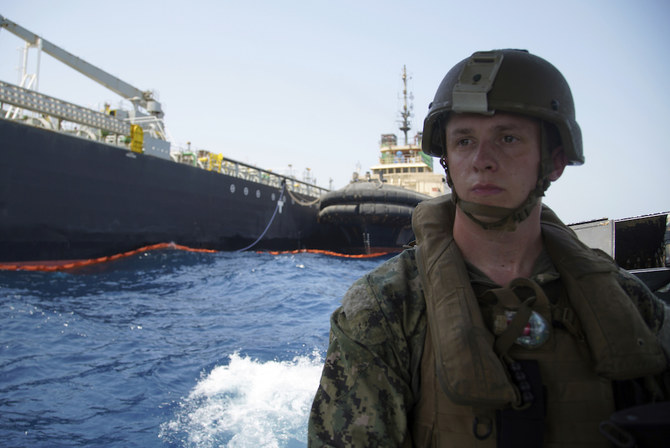
The US Navy says the Kokuka Courageous was damaged by a limpet mine that was similar to devices previously displayed by Tehran. (AP)
2 / 2
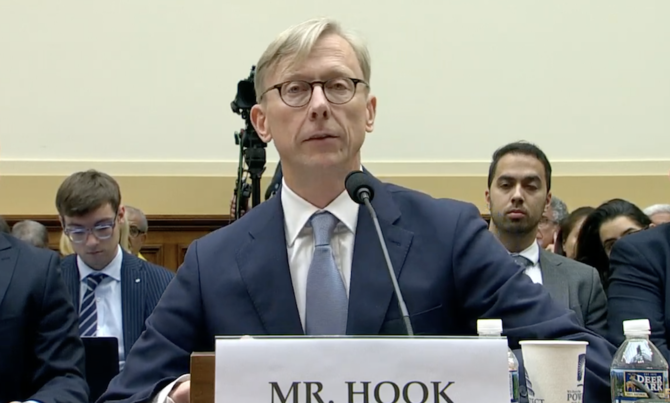
Brian Hook, pictured, said that Iranian vessels operating in and around the Strait of Hormuz on June 12 and 13 approached tankers Front Altair and Kokuka Courageous before they suffered explosions. (Screenshot/Congress)
Updated 20 June 2019
Follow

US intelligence proves ‘without question’ Iran behind tanker attacks

  • Hook: Iranian vessels operating in and around the Strait of Hormuz on June 12 and 13 approached tankers
  • Pentagon says new troops will include a Patriot missile battalion, manned and unmanned surveillance aircraft and 'other deterrence capabilities.'

WASHINGTON: The US envoy to Iran Brian Hook said Wednesday US intelligence proves “without question” Iran was behind the attack on two tankers in the Gulf of Oman.

Hook said that Iranian vessels operating in and around the Strait of Hormuz on June 12 and 13 approached tankers Front Altair and Kokuka Courageous before each ship suffered explosions on June 13. 

“Those who have seen the intelligence all come away without any question Iran is behind these attacks,” Hook told a conressional hearing on the Trump adminstration's Iran policy.

Hook added that the intelligence showed a senior Islamic Republican Guard Corps (IRGC) official confirmed that its personnel had “completed two actions.”

Earlier the US Navy displayed mine fragments and a magnet it said it had removed from one of two oil tankers, saying the mines bore a striking resemblance to Iranian ones.

Addressing Iran’s involvement in Yemen, committee member Joe Wilson referred to the Houthi attack on Abha airport last week, which injured 26 people. He asked Hook how the US planned to hold Iran accountable for such actions, given Tehran’s support for the Houthis.

Hook said the US supported the right of countries like Saudi Arabia “who are on the front lines of Iranian agression” in their right to defend themselves when attacked, especially by the Houthi rebels.

“Iran has spent hundreds of millions of dollars organizing, training and equipping the Houthis to fight at a level beyond which makes any normal sense and it has prolonged and intensified the conflict,” Hook said.

“Iran is playing a very long game in Yemen They would very much like to do in Yemen what they have been able to do in Lebanon and to use the Houthis in the same model that they have used Hezbollah in Lebanon.”

Hook said there had been half a dozen attacks in the last six weeks and that this was why the US had beefed up its military presence in the region “to establish deterrents.”

The US on Monday announced the deployment of about 1,000 more troops to the region because of the threat from Iran. The deployment is in addition to a 1,500-troop increase announced last month. The US has also sent an aircraft carrier strike group and B-52 bombers.

The Pentagon Wednesday said the additional 1,000 troops would include a Patriot missile battalion, manned and unmanned surveillance aircraft and "other deterrence capabilities".
"The United States does not seek conflict with Iran, but we are postured and ready to defend U.S. forces and interests in the region," a Pentagon spokeswoman said.

Also during the hearing, Hook said Iran was trying to “sow military roots in Syria,” and is attempting to destabilize Lebanon through its support for Hezbollah.


UN rights chief Shocked by ‘unbearable’ Darfur atrocities

Updated 18 January 2026
Follow

UN rights chief Shocked by ‘unbearable’ Darfur atrocities

  • Mediation efforts have failed to produce a ceasefire, even after international outrage intensified last year with reports of mass killings, rape, and abductions during the RSF’s takeover of El-Fasher in Darfur

PORT SUDAN: Nearly three years of war have put the Sudanese people through “hell,” the UN’s rights chief said on Sunday, blasting the vast sums spent on advanced weaponry at the expense of humanitarian aid and the recruitment of child soldiers.
Since April 2023, Sudan has been gripped by a conflict between the army and the paramilitary Rapid Support Forces that has left tens of thousands of people dead and around 11 million displaced.
Speaking in Port Sudan during his first wartime visit, UN Human Rights commissioner Volker Turk said the population had endured “horror and hell,” calling it “despicable” that funds that “should be used to alleviate the suffering of the population” are instead spent on advanced weapons, particularly drones.
More than 21 million people are facing acute food insecurity, and two-thirds of Sudan’s population is in urgent need of humanitarian aid, according to the UN.
In addition to the world’s largest hunger and displacement crisis, Sudan is also facing “the increasing militarization of society by all parties to the conflict, including through the arming of civilians and recruitment and use of children,” Turk added.
He said he had heard testimony of “unbearable” atrocities from survivors of attacks in Darfur, and warned of similar crimes unfolding in the Kordofan region — the current epicenter of the fighting.
Testimony of these atrocities must be heard by “the commanders of this conflict and those who are arming, funding and profiting from this war,” he said.
Mediation efforts have failed to produce a ceasefire, even after international outrage intensified last year with reports of mass killings, rape, and abductions during the RSF’s takeover of El-Fasher in Darfur.
“We must ensure that the perpetrators of these horrific violations face justice regardless of the affiliation,” Turk said on Sunday, adding that repeated attacks on civilian infrastructure could constitute “war crimes.”
He called on both sides to “cease intolerable attacks against civilian objects that are indispensable to the civilian population, including markets, health facilities, schools and shelters.”
Turk again warned on Sunday that crimes similar to those seen in El-Fasher could recur in volatile Kordofan, where the RSF has advanced, besieging and attacking several key cities.
Hundreds of thousands face starvation across the region, where more than 65,000 people have been displaced since October, according to the latest UN figures.