

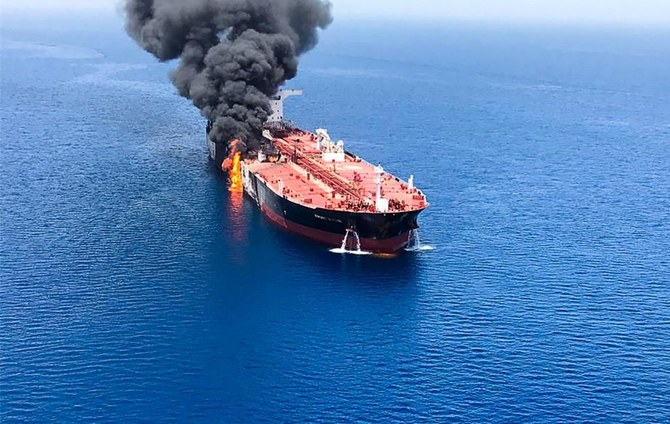
US Navy says mine fragments point to Iran in Gulf of Oman tanker attacks

1 / 8
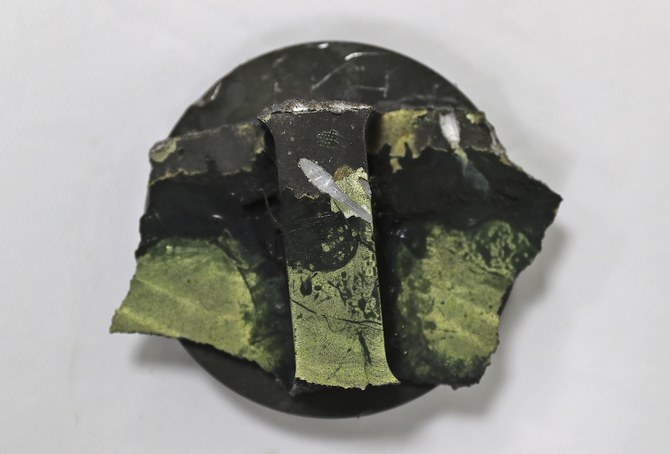
Items collected by the US Navy from Japanese-owned Kokuka Courageous tanker are displayed at a UAE Naval facility near the port of Fujairah in the UAE Wednesday. (Reuters)
2 / 8
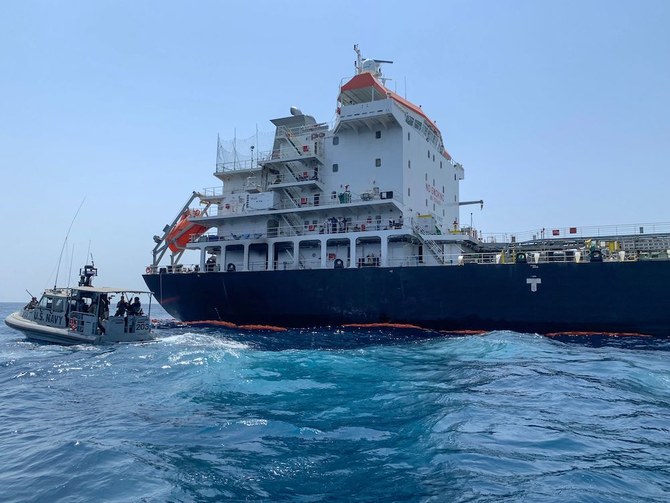
Damage to the hull of the Kokuka Courageous tanker during a tour of the vessel by the US Navy on Wednesday. (Reuters)
3 / 8
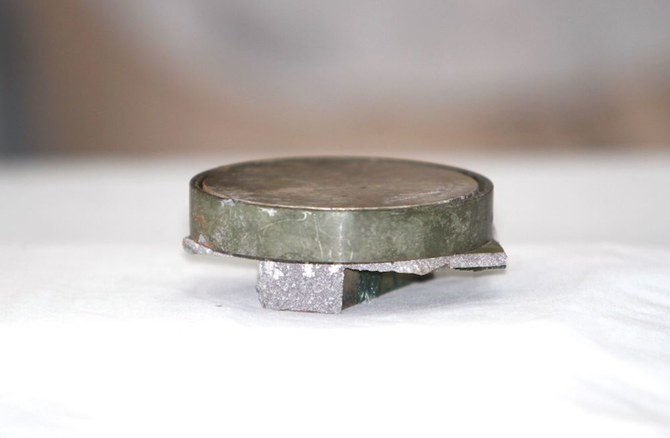
A magnet that the US Navy said came from a limpet mine that didn't explode on Kokuka Courageous. (AP Photo/Kamran Jebreili)
4 / 8
Items collected by the US Navy from Japanese-owned Kokuka Courageous tanker are displayed at a UAE Naval facility near the port of Fujairah in the UAE Wednesday. (AFP)
5 / 8
Items collected by the US Navy from Japanese-owned Kokuka Courageous tanker are displayed at a UAE Naval facility near the port of Fujairah in the UAE Wednesday. (AFP)
6 / 8
The Japanese oil tanker Kokuka Courageous off the port of Fujairah on Wednesday. (AFP)
7 / 8
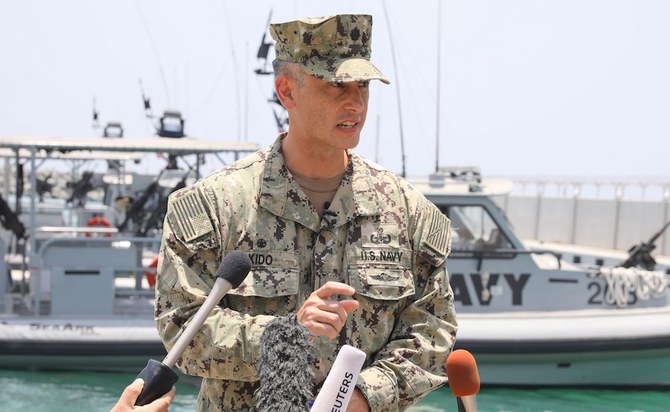
US Navy Commander Sean Kido speaks during a press briefing at a UAE Naval facility near the port of Fujairah on Wednesday about the attack on the Japanese-owned Kokuka Courageous oil tanker in the Gulf of Oman last week. (AFP)
8 / 8
The two oil tankers were attacked in Gulf of Oman. (FILE)
Updated 20 June 2019
Follow

US Navy says mine fragments point to Iran in Gulf of Oman tanker attacks

  • The mines bear a resemblance to some that were displayed in Iranian military parades
  • The US commander talked to reporters in a NACENT facility in Fujairah

FUJAIRAH, UAE: The United States Navy on Wednesday displayed limpet mine fragments and a magnet it said it had removed from one of two oil tankers attacked in the Gulf of Oman last week, saying the mines bore a striking resemblance to Iranian ones.
The United States, waging a “maximum pressure” sanctions campaign against Iran to curb its nuclear and regional activities, has been trying to build an international consensus that Iran was behind last week’s blasts, as well as a May 12 strike on four oil tankers off the UAE.

Tehran has denied any involvement in both attacks near the Strait of Hormuz, a major transit route for global oil supplies, but the incidents have raised fears of broader confrontation in the Gulf region.


Damage to the hull of the Kokuka Courageous tanker during a tour of the vessel by the US Navy on Wednesday. (Reuters)

The US military previously released images it said showed Iran’s Revolutionary Guard (IRGC) removing an unexploded limpet mine from the Japanese-owned tanker Kokuka Courageous, which was hit by explosions along with the Norwegian-owned Front Altair ship on June 13.
“The limpet mine that was used in the attack is distinguishable and also strikingly bearing a resemblance to Iranian mines that have already been publicly displayed in Iranian military parades,” said Commander Sean Kido, commanding officer of an explosive ordinance dive and salvage task group in the Naval Forces Central Command (NAVCENT).
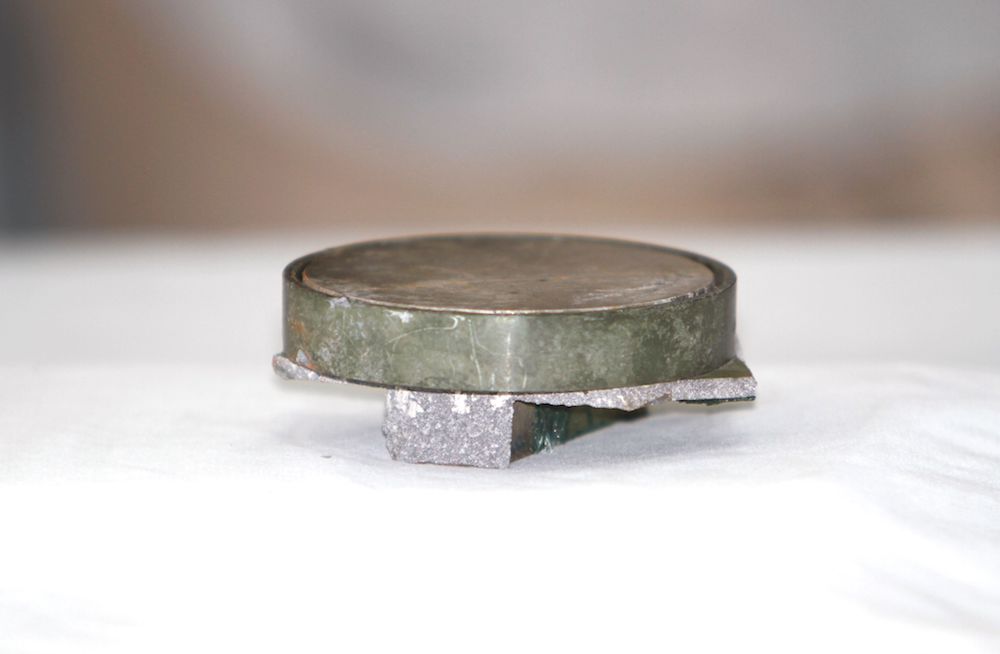


Items collected by the US Navy from Japanese-owned Kokuka Courageous tanker are displayed at a UAE Naval facility near the port of Fujairah in the UAE Wednesday. (AFP)

He was speaking to reporters at a NAVCENT facility near the UAE port of Fujairah. Small fragments said to have been removed from the Kokuka Courageous were on display alongside a magnet purportedly left by the IRCG team allegedly captured on video.The Japanese company that owns the Kokuka Courageous had said that its ship was damaged by two “flying objects,” but NAVCENT dismissed this.
“The damage at the blast hole is consistent with a limpet mine attack, it is not consistent with an external flying object striking the ship,” Kido said, adding that nail holes visible in the hull indicated how the mine was attached to the ship.

The location of the mine above the ship’s waterline indicated the intention was not to sink the vessel, he said.
Kido also said NAVCENT had collected biometric information including fingerprints from the ship’s hull that would help in building a criminal case.
He said the United States was working with regional partners on a “joint and combined investigation,” but declined to name the countries taking part.
Washington and Riyadh have publicly blamed Iran for last week’s attack and the sabotaging last month of four ships, including two Saudi tankers, off Fujairah, a major bunkering hub. Several European nations have said more evidence is needed.
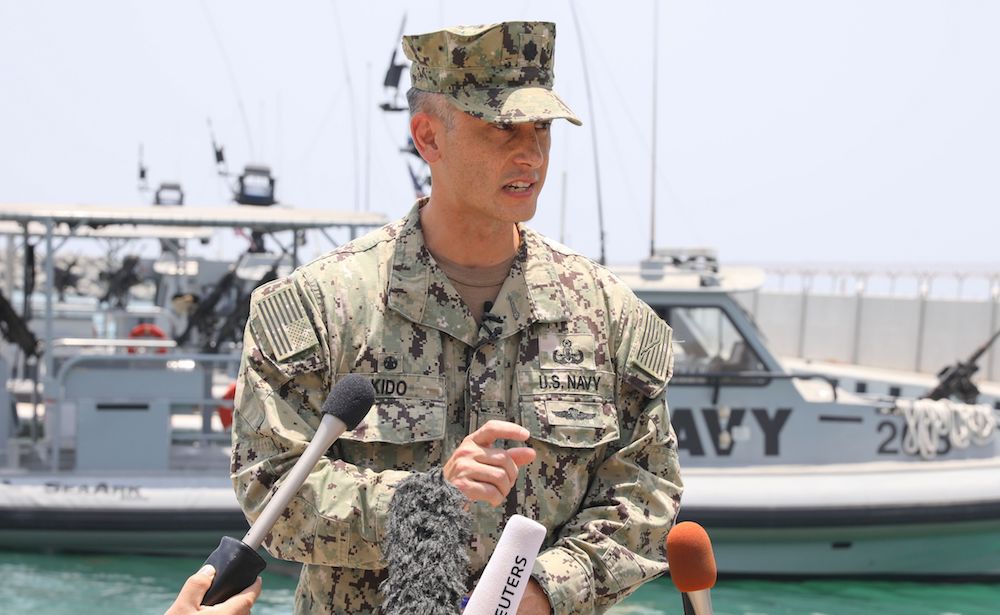


US Navy Commander Sean Kido speaks during a press briefing at a UAE Naval facility near the port of Fujairah on Wednesday about the attack on the Japanese-owned Kokuka Courageous oil tanker in the Gulf of Oman last week. (AFP)

The UAE has said an inquiry into the May 12 attack pointed to a state actor, without naming a country. That inquiry said it was highly likely that limpet mines placed by trained divers were the cause.
“The dynamics of the two attacks are not clear, and the video that the US said demonstrated Iran’s role was also not clear,” a Western diplomat in the Gulf told Reuters.
“The European line is that de-escalation (from possible conflict) must be a priority. Abu Dhabi is very much in line with the EU views on this,” the diplomat said.
US Secretary of State Mike Pompeo said on Tuesday that Washington would maintain its pressure campaign on Iran and continue to deter aggression in the region but does not want the confrontation with Tehran to escalate.

*********

READ MORE: 

US shares new images of Iranian activity after tanker attack

Saudi Arabia backs US charge Iran behind Gulf of Oman tanker attacks

Tankers attacked with ‘mine and torpedo’ in Gulf of Oman

*********

The United States said on Monday it would send around 1,000 more troops to the Middle East, in addition to a 1,500-troop increase announced last month that it said was prompted by Iranian threats.
A Western military source told Reuters that countries with military personnel based in the Gulf are waiting for the United States to lead efforts to enhance security in Gulf waters.
Frontline, which operates the Front Altair, said on Tuesday the vessel was in stable condition anchored off Fujairah and that it was working with third parties, including governmental officials, to determine the cause of the blast. It ruled out mechanical or human error.
“Until further information is received regarding the cause of the explosion and the security of this important shipping lane is secured, Frontline will exercise extreme caution when considering new contracts in the region,” it said in a statement.


Israel to partially reopen Gaza’s Rafah crossing

Updated 01 February 2026
Follow

Israel to partially reopen Gaza’s Rafah crossing

  • Reopening comes amid ongoing violence in the Palestinian territory
  • Gaza’s civil defense agency says dozens killed in Israeli attacks on Saturday

RAFAH, Palestinian Territories: Israel is set to partially reopen the Rafah crossing between the war-devastated Gaza Strip and Egypt on Sunday, following months of urging from humanitarian organizations, though access will be limited to the movement of people.

The reopening comes amid ongoing violence in the Palestinian territory, with Gaza’s civil defense agency reporting dozens killed in Israeli attacks on Saturday, while the Israeli military said it was retaliating against ceasefire violations.

The Rafah crossing is a vital gateway for both civilians and aid, but has remained closed since Israeli forces seized control of it in May 2024 during the war with Hamas, aside from a brief and limited reopening in early 2025.

Israel had previously said it would not reopen the crossing until the remains of Ran Gvili — the last Israeli hostage held in Gaza — were returned.

His remains were recovered days ago and he was laid to rest in Israel on Wednesday.

“The Rafah Crossing will open this coming Sunday (February 1st) in both directions, for limited movement of people only,” COGAT, an Israeli defense ministry body overseeing civil affairs in the occupied Palestinian territories, said on Friday.

Entry and exit “will be permitted in coordination with Egypt, following prior security clearance of individuals by Israel, and under the supervision of the European Union mission,” it added.

However, key details remain unclear, including how many people will be allowed to cross and whether those seeking to return to Gaza will be permitted entry.

A source at the border told AFP that Sunday would be largely devoted to preparations and logistical arrangements.

The crossing is set to open on Sunday on a trial basis to allow the passage of wounded individuals, ahead of a regular reopening scheduled for Monday, three sources at the crossing said.

However, no agreement has yet been reached on the number of Palestinians permitted to enter or exit, the sources added, noting that Egypt plans to admit “all Palestinians whom Israel authorizes to leave” the territory.

“Every day that passes drains my life and worsens my condition,” said Mohammed Shamiya, 33, who suffers from kidney disease and requires dialysis treatment abroad.

“I’m waiting every moment for the opening of the Rafah land crossing.”

Anxious wait

Safa Al-Hawajri, who has received a scholarship to study overseas, is also eagerly awaiting the reopening on Sunday.

“I’m waiting in the hope of fulfilling my ambition, which is tied to the reopening of the crossing,” said Hawajri, 18.

“I hope to be able to travel as soon as it opens.”

Located on Gaza’s southern border with Egypt, Rafah is the only crossing into and out of the territory that does not pass through Israel.

The crossing lies in an area held by Israeli forces following their withdrawal behind the so-called “Yellow Line” under the terms of a US-brokered ceasefire that came into effect on October 10.

Israeli troops still control more than half of Gaza, while the rest remains under Hamas authority.

The ceasefire has now entered its second phase and calls for reopening the crossing following the release or return of all Israeli hostages held by Palestinian militants.

Hamas had called for its full reopening in both directions after the remains of Gvili were brought back to Israel.

The reopening is expected to facilitate the entry of a 15-member Palestinian technocratic body, the National Committee for the Administration of Gaza (NCAG), established to oversee the day-to-day governance of the territory’s 2.2 million residents.

The committee is to operate under the supervision of the so-called “Board of Peace” chaired by US President Donald Trump.

The NCAG, headed by former Palestinian Authority deputy minister Ali Shaath, is expected to enter the Gaza Strip once the Rafah crossing reopens.

Violence continued ahead of the crossing’s reopening.

At least 32 people, including children, were killed on Saturday in Israeli air strikes in Gaza, reported the civil defense agency, which operates as a rescue force under the Hamas authority.

Israel’s military said the strikes were retaliation for an incident on Friday in which eight Palestinian fighters exited a tunnel in the city of Rafah, which it said violated the ceasefire.