TOKYO: Oil prices rose on Monday after US Secretary of State Mike Pompeo said Washington will take all actions necessary to guarantee safe navigation in the Middle East, as tensions mounted following attacks on tankers last week.
Brent futures had climbed 26 cents, or 0.4 percent, to $62.27 a barrel by 0314 GMT. They gained 1.1 percent on Friday.
US West Texas Intermediate (WTI) crude futures were up 17 cents, or 0.3 percent, at $52.68 a barrel. They rose 0.4 percent in the previous session.
Prices had jumped as much as 4.5 percent on Thursday after the attacks on two oil tankers near Iran and the Strait of Hormuz.
It was the second time in a month tankers have been attacked in the world’s most important zone for oil supplies as tensions increase between the United States and Iran. Washington blamed Iran for Thursday’s attacks, prompting a denial and criticism from Tehran.
“We don’t want war. We’ve done what we can to deter this,” Pompeo said in an interview with Fox News Sunday, adding: “The Iranians should understand very clearly that we will continue to take actions that deter Iran from engaging in this kind of behavior.”
Tensions between Iran and the United States have risen since US President Donald Trump pulled out of a deal last year between Iran and global powers that aimed to curb Tehran’s nuclear ambitions in exchange for sanctions relief.
Iran has repeatedly warned it would block the Strait of Hormuz if it cannot sell its oil because of US sanctions.
“Growing tensions in the Middle East remain a cause for concern as traders fear supply disruptions over an escalation toward militaristic conflicts,” said Benjamin Lu, an analyst at Phillip Futures in Singapore.
Also supporting prices were comments over the weekend by the Saudi energy minister, Khalid Al-Falih, that OPEC would probably meet in the first week of July and he hoped it would reach an agreement on extending oil output curbs.
“We are hoping that we will reach consensus to extend our agreement when we meet in two weeks time in Vienna,” Falih told reporters while attending a G20 energy and environment ministerial meeting in Karuizawa, northwest of Tokyo.
The Organization of the Petroleum Exporting Countries plus Russia and other producers, an alliance known as OPEC+, have a deal to cut output by 1.2 million barrels per day (bpd) from Jan. 1. The pact ends this month and the group meets in coming weeks to decide the next move.
US energy companies also cut the number of oil rigs operating for a second week in a row, with production growth expected to slow as crude prices fell to near their lowest levels of the year.


Oil prices rise after tanker attacks stoke Middle East tensions
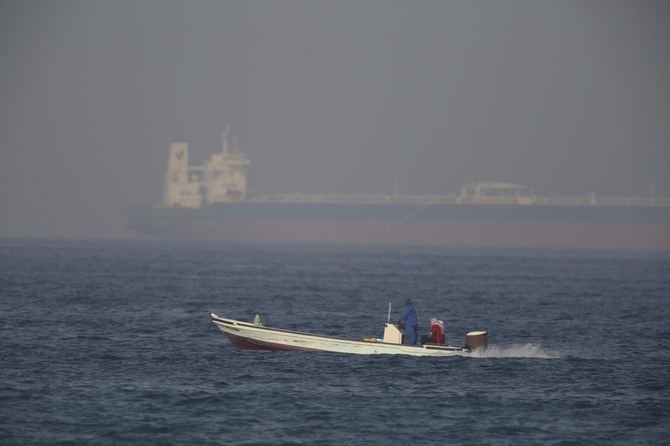
Oil prices rise after tanker attacks stoke Middle East tensions

- Second time in a month tankers have been attacked in the world’s most important zone for oil supplies
- Washington blames Iran for Thursday’s attacks


Lebanese social entrepreneur Omar Itani recognized by Schwab Foundation
- FabricAID co-founder among 21 global recipients recognized for social innovation
DAVOS: Lebanon’s Omar Itani is one of 21 recipients of the Social Entrepreneurs and Innovators of the Year Award by the Schwab Foundation for Social Entrepreneurship.
Itani is the co-founder of social enterprise FabricAID, which aims to “eradicate symptoms of poverty” by collecting and sanitizing secondhand clothing before placing items in stores in “extremely marginalized areas,” he told Arab News on the sidelines of the World Economic Forum in Davos, Switzerland.
With prices ranging from $0.25 to $4, the goal is for people to have a “dignified shopping experience” at affordable prices, he added.
FabricAID operates a network of clothing collection bins across key locations in Lebanon and Jordan, allowing people to donate pre-loved items. The garments are cleaned and sorted before being sold through the organization’s stores, while items that cannot be resold due to damage or heavy wear are repurposed for other uses, including corporate merchandise.
Since its launch, FabricAID has sold more than 1 million items, reached 200,000 beneficiaries and is preparing to expand into the Egyptian market.
Amid uncertainty in the Middle East, Itani advised young entrepreneurs to reframe challenges as opportunities.
“In Lebanon and the Arab world, we complain a lot,” he said. Understandably so, as “there are a lot of issues” in the region, resulting in people feeling frustrated and wanting to move away. But, he added, “a good portion of the challenges” facing the Middle East are “great economic and commercial opportunities.”
Over the past year, social innovators raised a combined $970 million in funding and secured a further $89 million in non-cash contributions, according to the Schwab Foundation’s recent report, “Built to Last: Social Innovation in Transition.”
This is particularly significant in an environment of geopolitical uncertainty and at a time when 82 percent report being affected by shrinking resources, triggering delays in program rollout (70 percent) and disruptions to scaling plans (72 percent).
Francois Bonnici, director of the Schwab Foundation for Social Entrepreneurship and a member of the World Economic Forum’s Executive Committee, said: “The next decade must move the models of social innovation decisively from the margins to the mainstream, transforming not only markets but mindsets.”
Award recipients take part in a structured three-year engagement with the Schwab Foundation, after which they join its global network as lifelong members. The program connects social entrepreneurs with international peers, collaborative initiatives, and capacity-building support aimed at strengthening and scaling their work.


