Worshippers in hard hats to attend Notre-Dame’s first mass since fire

1 / 4
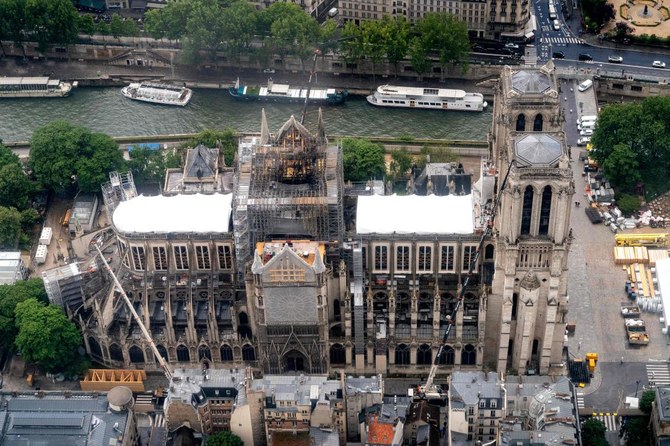
This aerial picture taken on June 12, 2019 in the French capital Paris shows the Notre Dame de Paris cathedral under repair after it was badly damaged by a huge fire on April 15. (AFP)
2 / 4
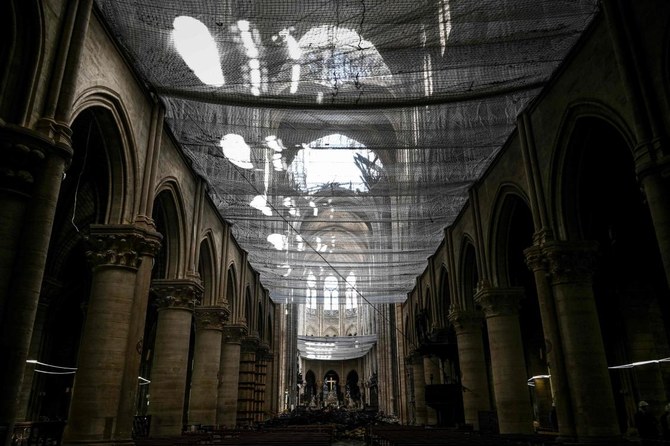
In this file photo taken on May 15, 2019 in Paris shows a protective net in the Notre Dame de Paris Cathedral during preliminary work one month after it sustained major fire damage. (AFP)
3 / 4
This aerial picture taken on June 12, 2019 in the French capital Paris shows the Notre Dame de Paris cathedral under repair after it was badly damaged by a huge fire on April 15. (AFP)
4 / 4
In this file photo taken on April 16, 2019, bystanders look on as flames and smoke billow from the roof at Notre-Dame Cathedral in Paris. (AFP)
Updated 15 June 2019
Follow

Worshippers in hard hats to attend Notre-Dame’s first mass since fire

  • Church leaders are keen to show life goes on at the cathedral as donations to help rebuild it trickle in
  • Less than 10% of the 850 million euros pledged by billionaires, business leaders and others has been received so far, the French government said

PARIS: A small congregation wearing hard hats will attend mass at Notre-Dame Cathedral in Paris on Saturday, the first service to be held since fire devastated the Gothic landmark two months ago.
Church leaders are keen to show life goes on at the cathedral as donations to help rebuild it trickle in. Less than 10% of the 850 million euros pledged by billionaires, business leaders and others has been received so far, the French government said.
Saturday’s mass, which commemorates the cathedral’s consecration as a place of worship, is due to be held at 1600 GMT in a side-chapel, with attendance limited to about 30 people who will wear the protective headgear for safety reasons.
“It is a nice symbol. A very small group of people will attend and one can understand why as there are still major safety issues,” Culture Minister Franck Riester told Europe 1 radio.
He told France 2 television on Friday the cathedral was still “in a fragile state, namely the vault, which has not yet been secured. It can still collapse.”
The April 15 blaze caused the roof and spire of the architectural masterpiece to collapse, triggering a worldwide outpouring of sadness as well as the multi-million-euro pledges for reconstruction work.
Among the high-profile people who promised to donate to the rebuilding effort were luxury goods tycoons Bernard Arnault and François-Henri Pinault.
“There could be people who promised to donate then in the end did not,” Riester said, without giving further details. “But more importantly, and this is normal, the donations will be paid as restoration work progresses.”
French President Emmanuel Macron has set a target of five years for restoring the cathedral, though Riester was more cautious.
“The president was right to give a target, an ambition. But obviously what matters in the end is the quality of the work,” he said. “So it does not mean that work will be totally finished in exactly five years.”
The archbishop of Paris, Michel Aupetit will lead Saturday’s service, which will be broadcast live on a religious TV channel.


Lawsuit challenges Trump administration’s ending of protections for Somalis

Updated 8 sec ago
Follow

Lawsuit challenges Trump administration’s ending of protections for Somalis

  • The lawsuit cites a series of statements Trump has made describing Somalis as “garbage” and “low IQ people” who “contribute nothing.”

BOSTON: Immigrant rights advocates filed a lawsuit on Monday seeking to stop US President Donald Trump’s administration from next ​week ending legal protections that allow nearly 1,100 Somalis to live and work in the United States. The lawsuit, brought by four Somalis and two advocacy groups, challenges the US Department of Homeland Security’s decision to end Temporary Protected Status for Somali immigrants, whom Trump has derided in public remarks. Outgoing Homeland Security Secretary Kristi Noem in January announced that TPS for Somalis would end on March 17, arguing that Somalia’s conditions had improved, despite fighting continuing between Somali forces and Al-Shabab militants. The plaintiffs, who ‌include the groups ‌African Communities Together and Partnership for the Advancement ​of ‌New ⁠Americans, in the ​lawsuit filed ⁠in Boston federal court argue the move was procedurally flawed and driven by a discriminatory, predetermined agenda.
The lawsuit cites a series of statements Trump has made describing Somalis as “garbage” and “low IQ people” who “contribute nothing.”
The plaintiffs said the administration is ending TPS for Somalia and other countries due to unconstitutional bias against non-white immigrants, not based on objective assessments of country conditions.
“The termination of TPS for Somalia is racism masking as immigration policy,” ⁠Omar Farah, executive director at the legal group Muslim Advocates, said ‌in a statement.
DHS did not respond to ‌a request for comment. It has previously said TPS ​was “never intended to be a de ‌facto amnesty program.”
TPS is a form of humanitarian immigration protection that shields eligible migrants ‌from deportation and allows them to work. Under Noem, DHS has moved to end TPS for a dozen countries, sparking legal challenges. The administration on Saturday announced plans to pursue an appeal at the US Supreme Court in order to end TPS for over 350,000 Haitians. It ‌also wants the high court to allow it to end TPS for about 6,000 Syrians.

SOMALI COMMUNITY TARGETED
Somalia was first designated ⁠for TPS in ⁠1991, with its latest extension in 2024. About 1,082 Somalis currently hold TPS, and 1,383 more have pending applications, according to DHS. Somalis in Minnesota in recent months had become a target of Trump’s immigration crackdown, with officials pointing to a fraud scandal in which many people charged come from the state’s large Somali community. The Trump administration cited those fraud allegations as a basis for a months-long immigration enforcement surge in Democratic-led Minnesota, during which about 3,000 immigration agents were deployed, spurring protests and leading to the killing of two US citizens by federal agents.
In November, Trump announced he would end TPS for Somalis in Minnesota, and a month later said ​he wanted them sent “back to where they ​came from.”
The US Department of State advises against traveling to Somalia, citing crime and civil unrest among numerous factors.