

Israel has ‘right’ to annex West Bank land, says US ambassador

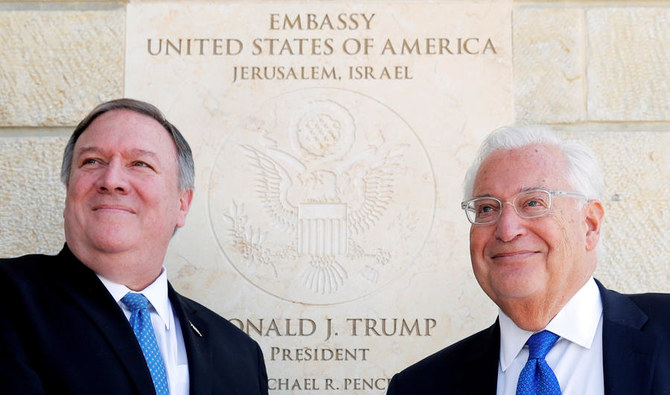
US Secretary of State Mike Pompeo and U.S. Ambassador to Israel David Friedman stand next to the dedication plaque at the U.S. embassy in Jerusalem March 21, 2019. (REUTERS)
Updated 09 June 2019
Follow

Israel has ‘right’ to annex West Bank land, says US ambassador

  • Following persistent expansion of the settlements by successive Netanyahu governments, more than 600,000 Jewish settlers now live in the West Bank

JERUSALEM: The US ambassador has said Israel has the right to annex at least “some” of the occupied West Bank, in comments likely to deepen Palestinian opposition to a long-awaited US peace plan.
The Palestinians have rejected the plan before it has even been unveiled, citing a string of moves by US President Donald Trump that they say show his administration is irredeemably biased.
They are likely to see the latest comments by US Ambassador to Israel David Friedman as new nail in the coffin of a peace process that is already on life support.
In the interview published by the New York Times on Saturday, Friedman said that some degree of annexation of the West Bank would be legitimate. “Under certain circumstances, I think Israel has the right to retain some, but unlikely all, of the West Bank,” he said.
Senior Palestinian official Saeb Erekat has said any such policy would be tantamount to “US complicity with Israeli colonial plans.”
The establishment of a Palestinian state in territories, including the West Bank, that Israel occupied in the Six-Day War of 1967, has been the focus of all past Middle East peace plans.
No firm date has yet been set for the unveiling of the Trump administration’s plan although a conference is to be held in Bahrain later this month on its economic aspects.
The public comments made by administation officials so far suggest the plan will lean heavily on substantial financial support for the Palestinian economy, much of it funded by the Gulf Arab states, in return for concessions on territory and statehood. “The absolute last thing the world needs is a failed Palestinian state between Israel and Jordan,” Friedman said in the Times interview.

SPEEDREAD

The Palestinians have rejected the plan before it has even been unveiled, citing a string of moves by US President Donald Trump that they say show his administration is irredeemably biased.

“We’re relying upon the fact that the right plan, for the right time, will get the right reaction over time.”
Friedman, a staunch supporter of the Israeli settlements, told the Times that the Trump plan was aimed at improving the quality of life for Palestinians but would fall well short of a “permanent resolution to the conflict.”

He said he did not believe the plan would trigger Palestinian violence.
But he said the United States would coordinate closely with Arab ally Jordan, which could face unrest among its large Palestinian population over a plan perceived as overly favorable to Israel.
Publication of the plan looks set to be further delayed after the Israeli paraliament called a snap general election for September, the second this year.
The plan is regarded as too sensitive to release during the campaign.
During campaigning for the first general election in April, Prime Minister Benjamin Netanyahu pledged to annex West Bank Jewish settlements, a move long supported by nearly all lawmakers in his alliance of right-wing and religious parties.
Earlier, in February, Netanyahu told lawmakers he had been discussing with Washington a plan that would effectively annex settlements.
In a rare public show of disunity between the close allies, the White House then flatly denied any such discussion.
Following persistent expansion of the settlements by successive Netanyahu governments, more than 600,000 Jewish settlers now live in the West Bank, including annexed east Jerusalem, among some three million Palestinians.
The international community regards the settlements as illegal and the biggest obstacle to peace.


Turkiye’s approval of peace roadmap is important step, PKK source says

Updated 8 sec ago
Follow

Turkiye’s approval of peace roadmap is important step, PKK source says

  • “The vote is considered an achievement and an important step toward consolidating democracy in Turkiye,” said the PKK source
  • There were foundations for resolving the Kurdish issue, but there was a lack of clarity on the issue in the report

BAGHDAD: A Turkish parliamentary commission’s approval of a report setting out a roadmap for legal reforms alongside the disbandment of the Kurdistan Workers Party (PKK) militant group is an important step and the beginning of a fundamental change in Turkish policy, a PKK source told Reuters on Thursday.
The commission voted overwhelmingly on Wednesday to approve the report, advancing a peace process designed to end decades of conflict.
“The vote is considered an achievement and an important step toward consolidating democracy in Turkiye,” said the PKK source.
The PKK — designated a terrorist ⁠organization by Turkiye, ⁠the United States and the European Union — halted attacks last year and said in May it had decided to disband and end its armed struggle.
The parliamentary vote shifts the peace process to the legislative theater, as President Tayyip Erdogan, Turkiye’s leader of more than two decades, bids to end a conflict focused on mainly Kurdish southeast Turkiye.
The insurgency began in 1984 and has killed more than 40,000 people, sowing deep discord at home and ⁠spreading violence across borders into Iraq and Syria.

IMPORTANT ISSUES OUTSTANDING
The PKK source said there were foundations for resolving the Kurdish issue, but there was a lack of clarity on the issue in the report.
“There also remain other important issues, such as initiating constitutional amendments, especially in aspects related to the Kurdish language as well as amendments to the anti-terrorism law,” the source said.
Another issue was legislation concerning the return of PKK militants to Turkiye and their integration into society, the source said.
A key element of Wednesday’s report recommended strengthening mechanisms to ensure compliance with decisions by the European Court of Human Rights (ECHR) and the Constitutional Court.
Among key ECHR decisions related to Turkiye are rulings that the rights of ⁠jailed former pro-Kurdish ⁠party leader Selahattin Demirtas had been violated and that he should be released immediately.
Ankara’s final appeal against that was rejected in November.

SIGN OF INTENT
Demirtas’ lawyer Mahsuni Karaman told Reuters the report’s comments on the ECHR were important as a sign of intent.
“We hope this will be reflected in judicial practice— that is our wish and expectation,” Karaman said.
Demirtas was detained in November 2016 on terrorism-related charges, which he denies. In May 2024, a court convicted him in connection with deadly 2014 protests and sentenced him to more than 40 years in prison.
Turkish nationalist leader Devlet Bahceli, a key Erdogan ally whose call in 2024 triggered the current PKK peace process, said in November that it “would be beneficial” to release Demirtas from prison.
The opposition pro-Kurdish DEM Party — the successor party of Demirtas’ HDP — remains parliament’s third-largest bloc and has cooperated closely with the parliamentary commission.