




JEDDAH: Expatriates are enjoying a taste of both worlds as they celebrate Eid in the Kingdom, mixing the old with the new, and local Saudi flavors with those from their homeland.
For expats spending Ramadan in the Kingdom, many have their eyes set on Eid preparations at least 10 days in advance. With all the authoritative figures in the home equipping themselves with cleaning gear and readying the house for the holiday, decorations are hung, food is prepared in advance and gifts are wrapped.
Wajiha Fatima, 26, from India, told Arab News how her family home is decked out for the festive occasion, with members of the family contributing and banding together to help. “We start Eid preparations with cleaning and decorating the house followed by oud incense,” she said.
Bushra Khalid, an entrepreneur from Pakistan who was raised in Jeddah, told Arab News: “I prepare for Eid like all girls do; I bought a dress, got a new perfume, in addition to pampering myself at home before the big day,” she said.
BACKGROUND
• There were more than 12.5 million expatriates living in Saudi Arabia in 2018.
• Many of these have founded age-old communities who cater to their community by providing support and goods.
• Many families across Saudi Arabia use social media and other forms of audio and visual communication to keep in touch with families in their home countries.
• For Pakistanis and Indians, the time difference is two to three hours, allowing families to hold long video calls as they watch each others’ festivities, an interesting and convenient way which keeps bonds strong and lessens the burden of distance.
“Seeing how hot and humid the weather is in Jeddah, I had to get a dress that isn’t too heavy — the choice for a dress will of course be true to our culture,” she said.
For those from the South Asian region, Eid is a happy time for those with a sweet tooth.
Khalid told Arab News: “We stock up on a lot of sweets, buy all types of chocolate. In addition, we make a Pakistani sweet called sheer khurma following in the footsteps of our prophet who ate something sweet before performing the Eid prayer. As someone with a sweet tooth myself, this part is very important.”
“We make sheer khurma with milk, vermicelli and lots of nuts and dry fruits.”
Many families across Saudi Arabia use social media and other forms of audio and visual communication to keep in touch with families in their home countries. For Pakistanis and Indians, the time difference is two to three hours, allowing families to hold long video calls as they watch each others’ festivities, an interesting and convenient way which keeps bonds strong and lessens the burden of distance.
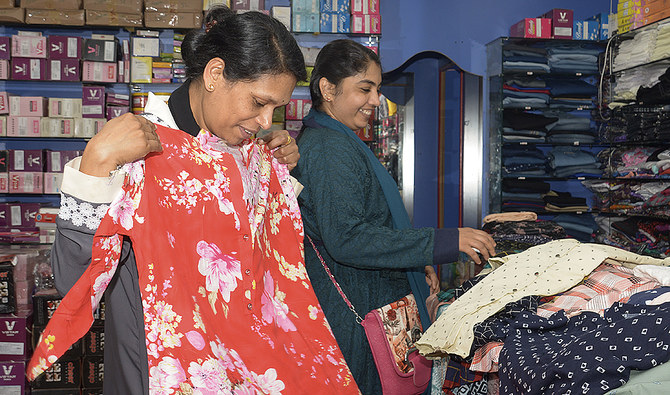
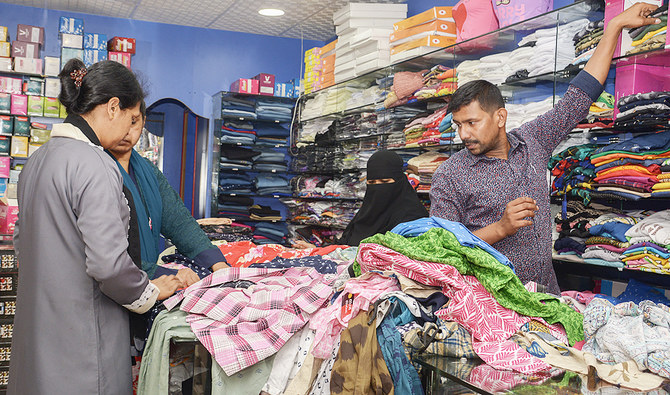
Many of the fabrics and ready-made dresses are imported from the original countries, and businesses boom during such celebrations. (AN photo/Huda Bashatah)
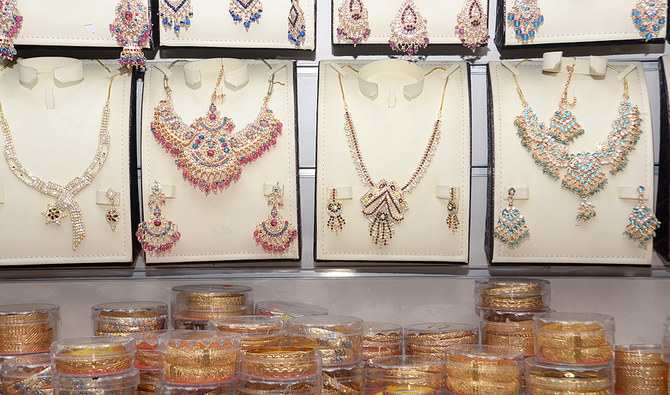
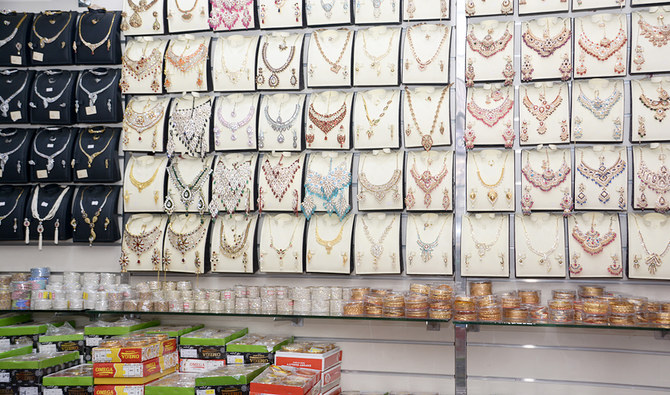
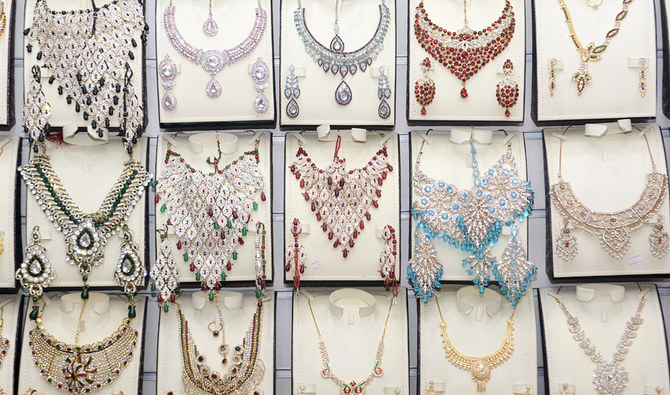
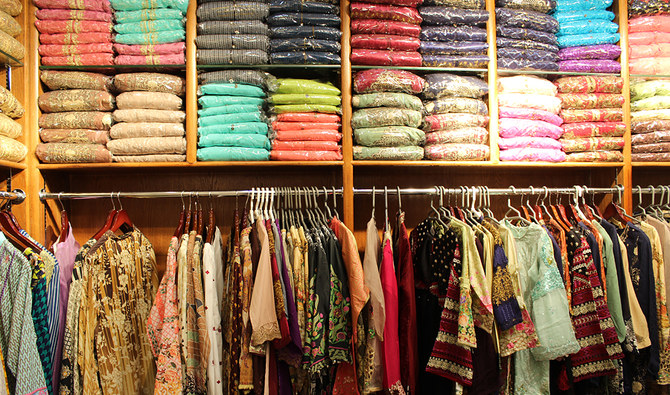
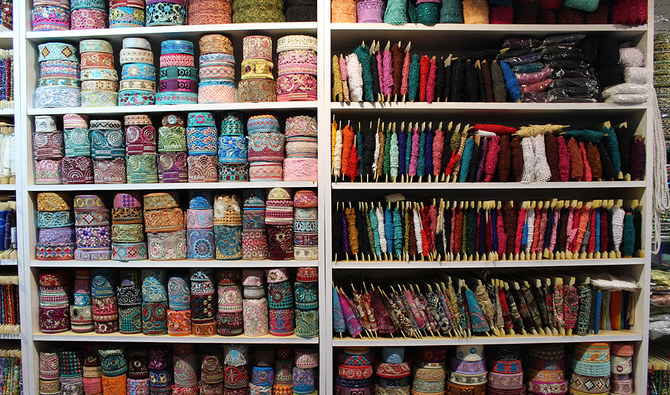
For the handful of clothes stores catering for South Asians, Eid brings business and new opportunities to shop owners, as people rush to buy their dresses and accessories as they would do at home.
According to Saudi Arabia’s General Authority for Statistics, there were more than 12.5 million expatriates living in Saudi Arabia in 2018. Many of these have founded age-old communities who cater to their community by providing support and goods.
Anas Mehmood, a Pakistani shopkeeper, told Arab News: “We have introduced more brands from Pakistan this Eid, focusing mostly on partywear. I have been so busy that I haven’t been able to shop for myself.”
Many of the fabrics and ready-made dresses are imported from the original countries, and businesses boom during such celebrations.
Ahtisham Shahzad, who has been working in Jeddah for eight years, told Arab News how excited he is to see his family, who are living in Makkah. He is reconnecting with his family and getting a taste of home, reminiscing about good times spent with friends and family at special occasions.
“My older brother and I live here in Jeddah as the rest of my family are in Makkah,” he said. “I can’t wait to spend my Eid with them.”


