

Lebanon receives Israeli response to border demarcation

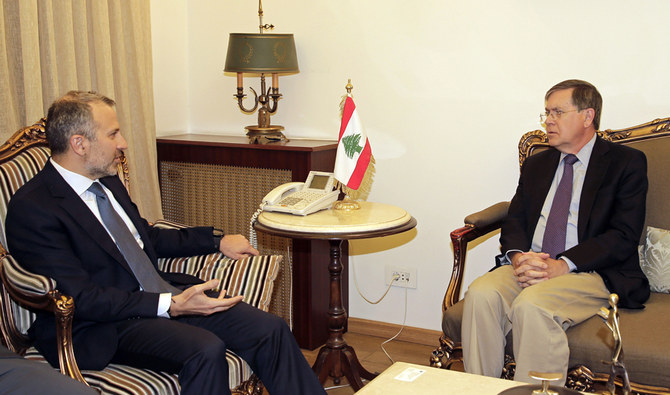
US Deputy Assistant Secretary of State David Satterfield, right, who is attempting to mediate a border dispute between Lebanon and Israel, meets with Lebanese Foreign Minister Gibran Bassil at the Lebanese foreign ministry in Beirut, Lebanon, Tuesday, May 28, 2019. (AP)
Updated 28 May 2019
Follow

Lebanon receives Israeli response to border demarcation

  • Lebanese Foreign Ministry sources said after Satterfield’s meeting with Foreign Minister Gebran Bassil that the atmosphere was “positive”

BEIRUT: David Satterfield, deputy US assistant secretary of state for Near Eastern affairs, conveyed Israel’s response to Lebanon regarding negotiations on border demarcation.

Sources at the Lebanese prime minister’s office said negotiations will focus on demarcating the maritime border, and will also tackle disputed points on the Blue Line, a border demarcation published by the UN in June 2000 to determine whether Israel had fully withdrawn from Lebanon. There are 13 disputed points on the Blue Line.

Lebanese Foreign Ministry sources said after Satterfield’s meeting with Foreign Minister Gebran Bassil that the atmosphere was “positive.”

They added that the final touches were being put on the form of negotiations and the role of concerned parties, including the UN, Lebanon, Israel and the US. Satterfield also met with Lebanese Parliament Speaker Nabih Berri.

Lebanon’s presidential media office said President Michel Aoun on Monday discussed with Jan Kubis, the UN special coordinator in Lebanon, the UN’s role “in helping to demarcate the southern Lebanese border.”

Lebanon delivered a proposal to Satterfield stressing its “determination to demarcate the maritime border through the tripartite commission originally formed in April 1996, as was done for the Blue Line after liberation in 2000, which is to be completed by a White Line in the sea.”

Beirut said it rejected “any direct Israeli-Lebanese negotiations,” and “demanded negotiations involving officers from Lebanon, Israel and the United Nations, with the participation of topographic and oil experts. The function of the tripartite committee is to demarcate the maritime line. There is no objection to the participation of American diplomats in the tripartite demarcation, provided that they are neutral.”

The head of the union of workers in the gas and exploration sector in Lebanon, Maroun Al-Khouli, said: “Solving this problem with Israel will establish a significant renaissance in Lebanon’s investment in its oil resources in the maritime economic zone, especially as Lebanon is preparing to begin drilling for oil and gas in blocks 4 and 9 in its territorial waters.”

He added: “This will also help large companies, including American companies, to enter the field of exploration in the second licensing cycle, which will be launched later.”


UN votes to end mission in Yemeni city of Hodeida

Updated 5 sec ago
Follow

UN votes to end mission in Yemeni city of Hodeida

  • The resolution approved Tuesday, which was sponsored by Britain, stipulates that the UN mission in Hodeida — known as UNMHA — must close as of March 31

UNITED NATIONS, United States: The UN Security Council voted Tuesday to terminate a mission that tried to enforce a ceasefire in war-torn Yemen’s port city of Hodeida.
“Houthi obstructionism has left the mission without a purpose, and it has to close,” said Tammy Bruce of the US delegation, one of 13 on the 15 member council to support ending the mission’s mandate.
The UN mission is now scheduled to conclude in two months.
Yemen’s internationally recognized government is a patchwork of groups held together by their opposition to the Iran-backed Houthis, who ousted them from the capital Sanaa in 2014 and now rule much of the country’s north. They also hold Hodeida.
The Houthis have been at war with the government, backed by a Saudi-led coalition since 2015, in a conflict that has killed hundreds of thousands of Yemenis and triggered a major humanitarian crisis.
Since 2021 the Houthis have periodically detained UN staffers and still hold some of them.
The resolution approved Tuesday, which was sponsored by Britain, stipulates that the UN mission in Hodeida — known as UNMHA — must close as of March 31. It has been there since 2019.
Russia and China abstained from the vote.
“For six years, UNMHA has served as a critical stabilizing presence” in the region and “actively deterred and prevented a return to full scale conflict,” said Danish representative Christina Markus Lassen.
“The dynamics of the conflict have evolved, and the operating environment has significantly narrowed as UN personnel have become the target of the Houthis’ arbitrary detentions,” Lassen said.
The war in the poorest country in the Arabian peninsula has triggered the worst humanitarian crisis anywhere in the world, the United Nations says.
It expects things to get worse in 2026 as hungry Yemenis find it even harder to get food and international aid drops off.