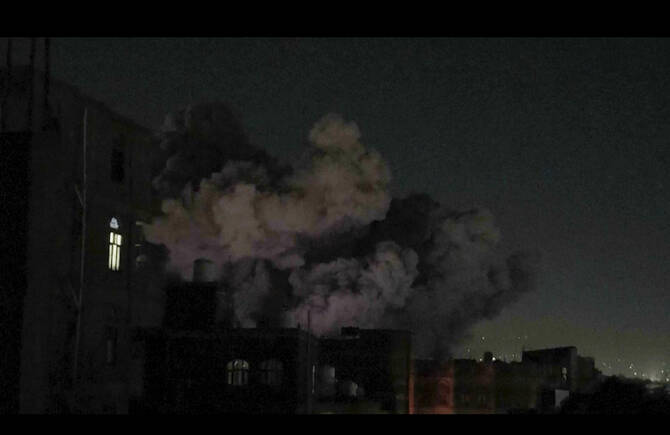
DUBAI: Suspected US airstrikes battered militant-controlled areas of Yemen into Wednesday, with the Houthis saying that one strike killed at least four people near the Red Sea port city of Hodeida.
Meanwhile, satellite images taken Wednesday and analyzed by The Associated Press show at least six stealth B-2 Spirit bombers now stationed at Diego Garcia in the Indian Ocean — a highly unusual deployment amid the Yemen campaign and tensions with Iran.
The intense campaign of airstrikes in Yemen under US President Donald Trump, targeting the militants over their attacks on shipping in Mideast waters stemming from the Israel-Hamas war, has killed at least 65 people, according to casualty figures released by the Houthis.
The campaign appears to show no signs of stopping as the Trump administration again linked their airstrikes on the Iranian-backed Houthis to an effort to pressure Iran over its rapidly advancing nuclear program. While so far giving no specifics about the campaign and its targets, White House press secretary Karoline Leavitt put the overall number of strikes on Tuesday at more than 200.
“Iran is incredibly weakened as a result of these attacks, and we have seen they have taken out Houthi leaders,” Leavitt said. “They’ve taken out critical members who were launching strikes on naval ships and on commercial vessels and this operation will not stop until the freedom of navigation in this region is restored.”
The Houthis haven’t acknowledged the loss of any of its leadership so far — and the US hasn’t identified any official by name. However, messages released by the leak of a Signal conversation between Trump administration officials and their public comments suggest a leader in the militants’ missile forces had been targeted.
Fatal strike reportedly targets Hodeida
Overnight, a likely US airstrike targeted what the Houthis described as a “water project” in Hodeida governorate’s Mansuriyah District, killing four people and wounding others. Other strikes into Wednesday targeted Hajjah, Saada and Sanaa governorates, the militants said.
The militants say they’ve continued to launch attacks against US warships in the Red Sea, namely the aircraft carrier USS Harry S. Truman, which is carrying out the majority of the strikes on the Houthis. No warship has been struck yet, but the US Navy has described the Houthi fire as the most intense combat its sailors have faced since World War II.
The aircraft carrier USS Carl Vinson, now in Asia, is on its way to the Middle East to back up the Truman. Early Wednesday, Pentagon spokesperson Sean Parnell said that “additional squadrons and other air assets” would be deployed to the region, without elaborating.
More B-2s seen at Diego Garcia
That likely includes the deployment of nuclear-capable B-2 bombers to Camp Thunder Bay on Diego Garcia in the Indian Ocean. Satellite photos taken Wednesday by Planet Labs PBC analyzed by the AP showed at least six B-2s at the base.
The deployment represents nearly a third of all the B-2 bombers in Washington’s arsenal. It’s also highly unusual to see that many at one base abroad. Typically, so-called show of force missions involving the B-2 have seen two or three of the aircraft conduct operations in foreign territory.
The nuclear-capable B-2, which first saw action in 1999 in the Kosovo War, is rarely used by the US military in combat, because each aircraft is worth around $1 billion. It has dropped bombs in Afghanistan, Iraq and Libya as well. The bombers are based at Whiteman Air Base in Missouri and typically conduct long-range strikes from there.
The US has used the B-2 in Yemen last year to attack underground Houthi bases. The B-2 likely would need to be used if Washington ever tried to target Iran’s underground nuclear sites as well.
The Houthis on Tuesday said that they shot down another American MQ-9 drone over the country.
Intense US bombings began on March 15
An AP review has found the new American operation against the Houthis under Trump appears more extensive than those under former US President Joe Biden, as Washington moves from solely targeting launch sites to firing at ranking personnel and dropping bombs on cities.
The new campaign of airstrikes started after the militants threatened to begin targeting “Israeli” ships again over Israel blocking aid entering the Gaza Strip. The militants have loosely defined what constitutes an Israeli ship, meaning many vessels could be targeted.
The Houthis targeted more than 100 merchant vessels with missiles and drones, sinking two of them and killing four sailors from November 2023 until January of this year. They also launched attacks targeting American warships without success.
The attacks greatly raised the Houthis’ profile as they faced economic problems and launched a crackdown targeting dissent and aid workers at home amid Yemen’s decadelong stalemated war, which has torn apart the Arab world’s poorest nation.

Suspected US airstrikes in Yemen kill at least 4 people near Hodeida, Houthi militants say
Short Url
https://arab.news/bbjyx
Suspected US airstrikes in Yemen kill at least 4 people near Hodeida, Houthi militants say
- The intense campaign of airstrikes in Yemen under US President Donald Trump has killed at least 65 people, according to casualty figures released by the Houthis
- “Iran is incredibly weakened as a result of these attacks, and we have seen they have taken out Houthi leaders,” Leavitt said
Israel orders Gaza families to move in first forced evacuation since ceasefire
CAIRO: Israeli forces have ordered dozens of Palestinian families in the southern Gaza Strip to leave their homes in the first forced evacuation since October’s ceasefire, as residents and Hamas said on Tuesday the military was expanding the area under its control.
Residents of Bani Suhaila, east of Khan Younis, said the leaflets were dropped on Monday on families living in tent encampments in the Al-Reqeb neighborhood.
“Urgent message. The area is under IDF control. You must evacuate immediately,” said the leaflets, written in Arabic, Hebrew, and English, which the army dropped over the Al-Reqeb neighborhood in the town of Bani Suhaila.
In the two-year war before the US brokered ceasefire was signed in October, Israel dropped leaflets over areas that were subsequently raided or bombarded, forcing some families to move several times.
Residents and a source from the Hamas militant group said this was the first time they had been dropped since then. The Israeli military did not immediately respond to a request for comment.
SIDES FAR APART ON NEXT PHASES
The ceasefire has not progressed beyond its first phase, under which major fighting has stopped, Israel withdrew from less than half of Gaza, and Hamas released hostages in return for Palestinian detainees and prisoners.
Virtually the entire population of more than 2 million people are confined to around a third of Gaza’s territory, mostly in makeshift tents and damaged buildings, where life has resumed under control of an administration led by Hamas.
Israel and Hamas have accused each other of major breaches of the ceasefire and remain far apart on the more difficult steps planned for the next phase.
Mahmoud, a resident from the Bani Suhaila area, who asked not to give his family name, said the evacuation orders impacted at least 70 families, living in tents and homes, some of which were partially damaged, in the area.
“We have fled the area and relocated westward. It is maybe the fourth or fifth time the occupation expanded the yellow line since last month,” he told Reuters by phone from Khan Younis, referring to the line behind which Israel has withdrawn.
“Each time they move it around 120 to 150 meters (yards) inside the Palestinian-controlled territory, swallowing more land,” the father-of-three said.
HAMAS CITES STATE OF HUMANITARIAN DISRUPTION
Ismail Al-Thawabta, director of the Hamas-run Gaza government media office, said the Israeli military had expanded the area under its control in eastern Khan Younis five times since the ceasefire, forcing the displacement of at least 9,000 people.
“On Monday, 19 January 2026, the Israeli occupation forces dropped warning leaflets demanding the forced evacuation of the Bani Suhaila area in eastern Khan Younis Governorate, in a measure that falls within a policy of intimidation and pressure on civilians,” Thawabta told Reuters.
He said the new evacuation orders affected approximately 3,000 people.
“The move created a state of humanitarian disruption, increased pressure on the already limited shelter areas, and further deepened the internal displacement crisis in the governorate,” Thawabta added.
Israel’s military has previously said it has opened fire after identifying what it called “terrorists” crossing the yellow line and approaching its troops, posing an immediate threat to them.
It has continued to conduct air strikes and targeted operations across Gaza. The Israeli military has said it views “with utmost severity” any attempts by militant groups in Gaza to attack Israel.
Under future phases of the ceasefire that have yet to be hammered out, US President Donald Trump’s plan envisages Hamas disarming, Israel pulling out further, and an internationally backed administration rebuilding Gaza.
More than 460 Palestinians and three Israeli soldiers have been reported killed since the ceasefire took effect.
Israel launched its operations in Gaza in the wake of an attack by Hamas-led fighters in October 2023 which killed 1,200 people, according to Israeli tallies. Israel’s assault has killed 71,000 people, according to health authorities in the enclave.
Residents of Bani Suhaila, east of Khan Younis, said the leaflets were dropped on Monday on families living in tent encampments in the Al-Reqeb neighborhood.
“Urgent message. The area is under IDF control. You must evacuate immediately,” said the leaflets, written in Arabic, Hebrew, and English, which the army dropped over the Al-Reqeb neighborhood in the town of Bani Suhaila.
In the two-year war before the US brokered ceasefire was signed in October, Israel dropped leaflets over areas that were subsequently raided or bombarded, forcing some families to move several times.
Residents and a source from the Hamas militant group said this was the first time they had been dropped since then. The Israeli military did not immediately respond to a request for comment.
SIDES FAR APART ON NEXT PHASES
The ceasefire has not progressed beyond its first phase, under which major fighting has stopped, Israel withdrew from less than half of Gaza, and Hamas released hostages in return for Palestinian detainees and prisoners.
Virtually the entire population of more than 2 million people are confined to around a third of Gaza’s territory, mostly in makeshift tents and damaged buildings, where life has resumed under control of an administration led by Hamas.
Israel and Hamas have accused each other of major breaches of the ceasefire and remain far apart on the more difficult steps planned for the next phase.
Mahmoud, a resident from the Bani Suhaila area, who asked not to give his family name, said the evacuation orders impacted at least 70 families, living in tents and homes, some of which were partially damaged, in the area.
“We have fled the area and relocated westward. It is maybe the fourth or fifth time the occupation expanded the yellow line since last month,” he told Reuters by phone from Khan Younis, referring to the line behind which Israel has withdrawn.
“Each time they move it around 120 to 150 meters (yards) inside the Palestinian-controlled territory, swallowing more land,” the father-of-three said.
HAMAS CITES STATE OF HUMANITARIAN DISRUPTION
Ismail Al-Thawabta, director of the Hamas-run Gaza government media office, said the Israeli military had expanded the area under its control in eastern Khan Younis five times since the ceasefire, forcing the displacement of at least 9,000 people.
“On Monday, 19 January 2026, the Israeli occupation forces dropped warning leaflets demanding the forced evacuation of the Bani Suhaila area in eastern Khan Younis Governorate, in a measure that falls within a policy of intimidation and pressure on civilians,” Thawabta told Reuters.
He said the new evacuation orders affected approximately 3,000 people.
“The move created a state of humanitarian disruption, increased pressure on the already limited shelter areas, and further deepened the internal displacement crisis in the governorate,” Thawabta added.
Israel’s military has previously said it has opened fire after identifying what it called “terrorists” crossing the yellow line and approaching its troops, posing an immediate threat to them.
It has continued to conduct air strikes and targeted operations across Gaza. The Israeli military has said it views “with utmost severity” any attempts by militant groups in Gaza to attack Israel.
Under future phases of the ceasefire that have yet to be hammered out, US President Donald Trump’s plan envisages Hamas disarming, Israel pulling out further, and an internationally backed administration rebuilding Gaza.
More than 460 Palestinians and three Israeli soldiers have been reported killed since the ceasefire took effect.
Israel launched its operations in Gaza in the wake of an attack by Hamas-led fighters in October 2023 which killed 1,200 people, according to Israeli tallies. Israel’s assault has killed 71,000 people, according to health authorities in the enclave.
© 2026 SAUDI RESEARCH & PUBLISHING COMPANY, All Rights Reserved And subject to Terms of Use Agreement.