



PESHAWAR: Nestled along the banks of the Budhni Pull river in the northwestern city of Peshawar, a small town of ethnic Pashtun settlers who fled wars, poverty and violence in Pakistan’s tribal areas of North and South Waziristan have carved out a special place for themselves, and a nickname for their town: Little Waziristan.
The volatile borderlands next to Afghanistan have been rocked by decades of war and instability since the late 70’s, when the Soviet war caused millions of Afghan refugees to pour into the tribal regions. Eventually, with increasing poverty and spikes in crime and violence, tribespeople began traveling deeper into Pakistan in search of better lives.
Some of them made their way to the town of Shero Jhangi, or Little Waziristan, where 700 tribal immigrants have over the years created a small but vibrant business community focused around timber, steel and brick work.
“We are able to have our businesses, and our children are getting a good education,” said Mirza Hakeem, a North Waziristani who settled in Shero Jhangi 25 years ago when he left his hometown to escape poverty. He now owns a timber shop filled with an assortment of knick-knacks and odd pieces of furniture.
“We know better than anyone else, the true value of peace,” he said. “We, who have left our homes to find prosperity.”
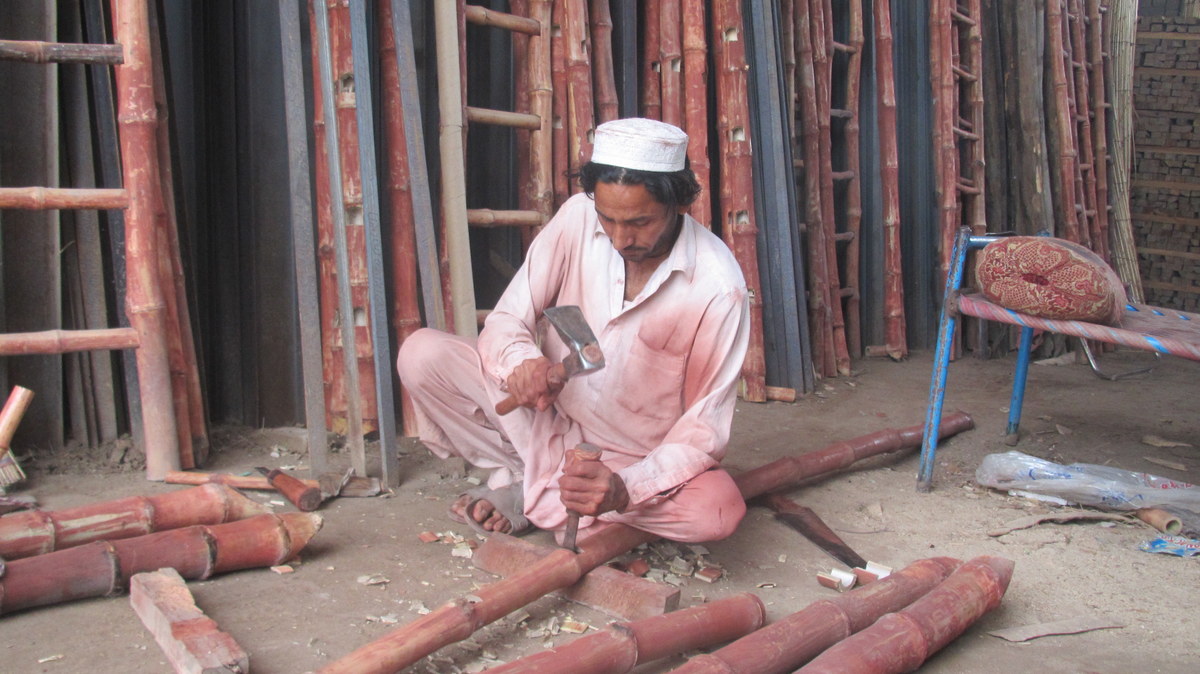
A labor makes ladders at the Shero Jhangi market, dubbed ‘Little Waziristan,’ in Pakistan’s Peshawar city on May 16, 2019. (AN photo)
Following the US war in Afghanistan, the tribal areas were once again marred by violence as Afghan Taliban began fleeing into Pakistan, creating large-scale militant hideouts and training camps. As a result, between 2009- 2014, almost two million people from North and South Waziristan were displaced when the Pakistan army launched a number of major anti-Taliban offensives in the area, and though most have since returned, there are still over 16,000 internally displaced persons (IDP’s) in Pakistan’s northwestern Khyber Pakhtunkhwa province alone.
“There are no drones and no trouble here,” said Abdur Rehman who fled to Peshawar with his wife and two children when the Pakistan army operation began in North Waziristan in 2014, eventually setting up a steel business in Shero Jhangi.
“The military operations destroyed almost all our infrastructure, and Waziristan was like living in the stone ages,” he said, adding that he chose to stay in Peshawar for its schools.
“I want my children to be doctors,” he said proudly. According to him, there are no higher education schools in North Waziristan, and the restoration of even basic infrastructure will still take years.
“I’m a (high school) graduate, but what will I do in Waziristan?” Muhammad Zahid said. He had moved to Shero Jhangi in 2010 from Shawal in South Waziristan after the military operation began there, and now works in the local brick and steel business.
Showing off his brick house in the center of the town, he said: “In Shawal, I used to live in a mud house,” and added: “Even if there is peace there, there are no jobs and no business opportunities.”
In Little Waziristan, there are no women to be seen in public. Rows of almost a hundred shops along main Charsadda Road are lined with wood and steel workshops manned by chattering Waziristani shopkeepers- all men- dressed in their traditional caps, and with the finest reputation for quality in the entire city.
“These people are soft-spoken and honest,” said Shoukat Ali, a Peshawar local who travels to Shehro Jhangi often for timber and brick supplies. “The quality of the material is better compared to other parts of Peshawar, and they don’t charge us extra the way others do.”
“When people in Peshawar want to shop here, they say, ‘Let’s go to Little Waziristan!” Hakeem shouted from his timber shop, and laughed.
But his happiness, and that of many others who come to work in the thriving market, belies a deep nostalgia for home.
“I still can’t forget the beauty and peace of Waziristan, now tarnished by militants,” Hakeem said.
For now, as the month of Ramadan enters its second half, many are excited for Eid- a time when they can lock up shop for a few days and head back to Waziristan to celebrate with the extended families they left behind.
“I cannot wait to meet my childhood friends and family, and to relive memories in our native land,” said Zubair Khan, who has lived in Shero Jhangi for almost two decades, and hasn’t been back in years. He has been collecting small Peshawari souvenirs, toys and gifts for family back home in South Waziristan.
“Here, it’s a happy life,” Abdur Rehman said, looking around his small steel shop. Then he fumbled with his hands and said: “But sometimes I miss the rain of home.”


