
WASHINGTON: International worries that the Trump administration is sliding toward war with Iran flared into the open amid skepticism about its claims that the Islamic republic poses a growing threat to the US and its allies in the Arabian Gulf and beyond.
The US military on Tuesday rebutted doubts expressed by a British general about such a threat. President Donald Trump denied a report that the administration has updated plans to send up to 120,000 troops to counter Iran if necessary. But Trump then stirred the controversy further by saying: “Would I do that? Absolutely.”
Underscoring what the US says is heightened risk to US personnel, the US Embassy in Baghdad on Wednesday ordered all non-essential, non-emergency government staff to leave Iraq immediately.
Still, the general’s remarks exposed international skepticism over the American military buildup in the Middle East, a legacy of the 2003 invasion of Iraq that was predicated on false intelligence. US officials have not publicly provided any evidence to back up claims of an increased Iranian threat amid other signs of allied unease.
As tensions in the region started to surge, British Foreign Secretary Jeremy Hunt said his nation was worried about the risk of accidental conflict “with an escalation that is unintended really on either side.”
On Tuesday, Spain temporarily pulled one of its frigates from the US-led combat fleet heading toward the Strait of Hormuz. That was followed by the unusual public challenge to the Trump administration by the general.
“No, there’s been no increased threat from Iranian-backed forces in Iraq and Syria,” said Maj. Gen. Chris Ghika, a senior officer in the US-backed coalition fighting Daesh.
Ghika, speaking in a video conference from coalition headquarters in Baghdad, told reporters at the Pentagon that the coalition monitors the presence of Iranian-backed forces “along with a whole range of others because that’s the environment we’re in.”
But he added: “There are a substantial number of militia groups in Iraq and Syria, and we don’t see any increased threat from any of them at this stage.”
Late in the day, in a rare public rebuttal of an allied military officer, US Central Command said Ghika’s remarks “run counter to the identified credible threats” from Iranian-backed forces in the Mideast.
In a statement, Central Command said the coalition in Baghdad has increased the alert level for all service members in Iraq and Syria.
“As a result, (the coalition) is now at a high level of alert as we continue to closely monitor credible and possibly imminent threats to US forces in Iraq,” the statement said.
Trump, who has repeatedly argued for avoiding long-term conflicts in the Mideast, discounted a New York Times report that the US has updated plans that could send up to 120,000 troops to counter Iran if it attacked American forces.
“Would I do that? Absolutely,” he told reporters Tuesday at the White House. “But we have not planned for that. Hopefully we’re not going to have to plan for that. If we did that, we’d send a hell of a lot more troops than that.”
Reinforcing Trump’s denial, Secretary of State Mike Pompeo said at a joint news conference in Sochi with Russian Foreign Minister Sergei Lavrov: “We fundamentally do not seek war with Iran.”
A Trump administration official said a recent small meeting of national security officials was not focused on a military response to Iran, but instead concentrated on a range of other policy options, including diplomacy and economic sanctions. The official spoke on condition of anonymity to discuss internal deliberations.
Lavrov said Pompeo told him that a potential deployment of 120,000 US troops to the Mideast was only a “rumor.”
Lavrov said the international community needs to focus on diplomacy with Iran, including on the potentially explosive issue of Iran’s nuclear program, which is constrained by a US-brokered deal in 2015 that Trump has abandoned.
US Iran envoy Brian Hook told reporters traveling with Pompeo in Brussels that the secretary of state shared intelligence on Iran with allies since “Europe shares our concerns about stability in the Gulf and the Middle East.” What the Europeans do not share, however, is Washington’s more aggressive approach to Iran.
“We are very worried about the risk of a conflict happening by accident, with an escalation that is unintended really on either side but ends with some kind of conflict,” British Foreign Secretary Jeremy Hunt told reporters in Brussels.
“What we need is a period of calm to make sure that everyone understands what the other side is thinking,” Hunt said.
Last week, US officials said they had detected signs of Iranian preparations for potential attacks on US forces and interests in the Mideast, but Washington has not spelled out that threat.
The US has about 5,000 troops in Iraq and about 2,000 in Syria as part of the coalition campaign to defeat the Daesh group there. It also has long had a variety of air and naval forces stationed in Bahrain, Qatar and elsewhere in the Gulf, partly to support military operations against IS and partly as a counter to Iranian influence.
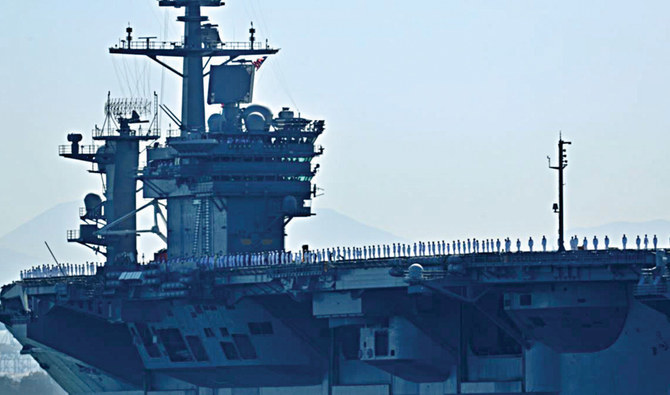
Gen. Ghika’s comments came amid dramatically heightened tensions in the Middle East. The US in recent days has ordered the USS Abraham Lincoln aircraft carrier strike group to the Gulf region, plus four B-52 bombers. It also is moving a Patriot air-defense missile battery to an undisclosed country in the area. As of Tuesday, the Lincoln and its strike group had passed through the Bab El-Mandeb Strait in the Red Sea, but officials would not disclose their exact location.
Tensions rose another notch with reports o Sunday that four commercial vessels anchored off the UAE had been damaged by sabotage.
A US military team was sent to the UAE to investigate, and one US official said the initial assessment is that each ship has a 5- to 10-foot hole in it, near or just below the water line. The official, who was not authorized to publicly discuss details of the investigation, said the early interpretation is that the holes were caused by explosive charges.
An initial assessment is that the damage was done by Iranian or Iranian-backed proxies, but they are still going through the evidence and have not yet reached a final conclusion, the official said.