ISLAMABAD: A vast Chinese-funded infrastructure project in Pakistan has become a major trigger for separatist insurgents, galvanizing their movement as they employ new tactics — including suicide attacks — in an escalation that could rattle Beijing, observers say.
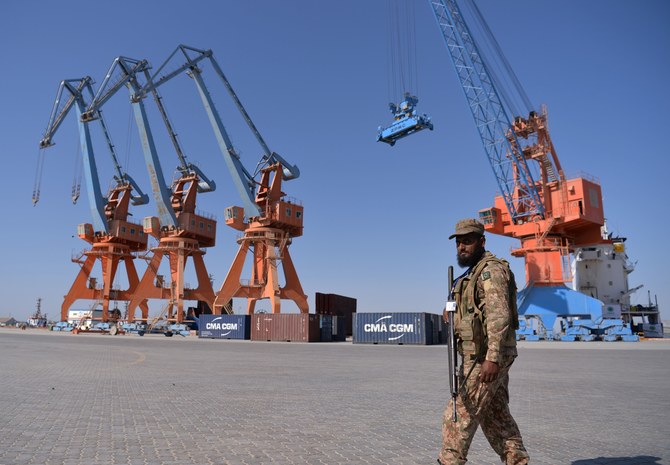
A deadly weekend attack by gunmen who stormed the luxury Pearl Continental hotel in Gwadar, a port on Pakistan’s southern coast, was the latest high-profile assault linked to the multi-billion dollar China-Pakistan Economic Corridor (CPEC).
CPEC — part of China’s massive Belt and Road initiative — seeks to link its western province Xinjiang with Gwadar, giving Beijing valuable access to the Arabian Sea and conferring new roads, ports, and airports on Pakistan.
Pakistani authorities routinely tout Gwadar, a former fishing village, as “the next Dubai.”
The problem is that Balochistan, Pakistan’s largest and poorest province through which much of CPEC runs, is a Pandora’s Box of Islamist, sectarian, and separatist insurgencies.
Saturday’s attack was claimed by the separatist Balochistan Liberation Army (BLA). Chinese and Pakistani investors visiting the hotel, isolated high on a ridge overlooking the port, were the target, a spokesman for the BLA said.
“We warn China to stop her exploitative projects in Balochistan and do not support Pakistan in the genocide of Baloch people, otherwise, we would respond with more attacks,” the English-language message to media read.
The BLA has attacked the Chinese in Pakistan before, said analyst Michael Kugelman of the Washington-based Wilson Center.
What’s new is the desire and capacity to attack highly visible, well-secured Chinese targets, he said, citing another deadly attack claimed by the group on Beijing’s consulate in Karachi last year.
“There’s good reason to believe that the Pearl Continental attack spooked (Beijing) in a big way, given that a major facility was struck in a city that houses one of the crown jewels of CPEC,” Kugelman said.
The project, he continued, “is a major trigger for Baloch insurgents.”
“CPEC represents everything the insurgents despise: A large infrastructure and development project undertaken by the Pakistani state and its Chinese ally.”
Separatist groups in Balochistan, whose proud population have a turbulent history, have long demanded autonomy and a fairer share of resources.
For years the Pakistani military maintained a crushing grip on the insurgency, while brushing off accusations of serious rights abuses.
However, analysts say Chinese investment appears to have imbued the nationalist movement with new energy, inflaming the long-running grievance over resources and giving sometimes-disparate groups a common focus.
At the same time, Pakistan’s determination to protect Chinese investment saw the military further intensify its stance, deepening resentment among the Baloch people.
With positions hardening on both sides, one result is the relatively new phenomenon for Baloch separatists of suicide attacks, such as in the Karachi consulate attack.
Nationalist politician Jan Mohammed Buledi described the development as previously “unimaginable and unthinkable” for a movement driven more by socialist principles than jihad.
“When locals resist they are kidnapped, tortured and their mutilated dead bodies appear,” he explained.
The state, he argued, has left young Baloch “no option but to blow themselves up.
“And now with the influx of Chinese, the Baloch separatists are getting international attention, so it seems the only way out.”
Anger against the Chinese, seen as usurpers, is real and powerful, said Buledi — but the true enemy for the separatists remains the Pakistani state, with analysts warning that unless genuine grievances are addressed, a low-level insurgency could continue indefinitely
“They blame the state for its long and relentless predatory behavior in Balochistan, and for the scorched earth policies used by the military,” agreed Kugelman.
Publicly at least, Beijing backs Pakistan’s crackdown, and while the Pearl Continental attack was widely reported in Chinese media the claim that Chinese investors were the target was largely downplayed.
What Beijing can do about the threats its faces remains to be seen.
One tantalising suggestion came from a Baloch leader based in the US, who told AFP that some Chinese officials have sought help from exiled Baloch nationalists in exchange for bringing them home.
AFP was unable to verify the claim.
“To the best of my knowledge they are still in contact with more than half a dozen nationalist leaders in US, UK and other European countries,” he said.


![]()

The Baloch vs Beijing - Pakistani militancy targets Chinese investment
The Baloch vs Beijing - Pakistani militancy targets Chinese investment
- Deadly weekend attack in Gwadar was latest high-profile assault linked to Chinese projects
- Gwadar is crown jewel of $62 billion corridor of energy and infrastructure projects China is building in Pakistan
Latest updates


Recommended


© 2026 SAUDI RESEARCH & PUBLISHING COMPANY, All Rights Reserved And subject to Terms of Use Agreement.