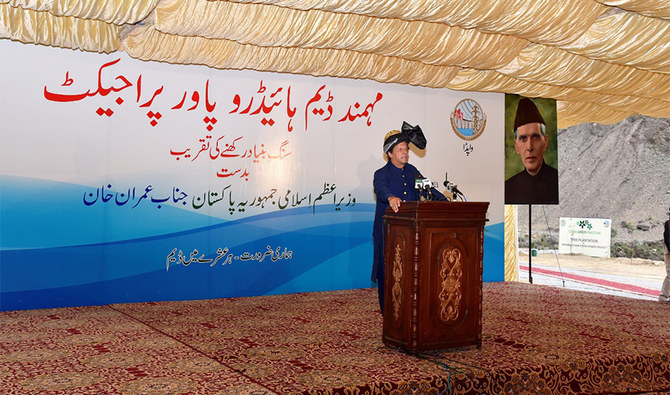
PESHAWAR: Prime Minister Imran Khan performed the ground-breaking of the Mohmand Hydropower Dam project in northwestern Pakistan on Thursday, as the country faces worsening water scarcity.
Pakistan needs to store at least 25 million acre feet (MAF) of water each year to help shore up water security, and that requires building a series of new large dams.
The Mohmand Dam is being constructed on the Swat River near Peshawar, the capital of the northwestern Khyber Pakhtunkhwa province, and will be completed at a cost of Rs183 billion by 2024. The dam has the capacity to store 300,000 cusecs of water and will generate some 800MW of electricity once completed. A sum of Rs2 billion has been allocated for the project in the Public Sector Development Program 2018-19.
“The water crisis is a nationwide issue that persists,” Khan said in a speech at the ground-breaking ceremony. “And this is linked to the construction of water reservoirs. Big dams were not built in the past.”
Last year, Mian Saqib Nisar, then the country’s chief supreme court judge, donated a million Pakistani rupees ($7,400) of his own money to start a fundraising drive for dams, calling water shortages a major national threat.
The drive aimed to raise as much as a staggering $14 billion toward the cost of installing water reservoirs and other equipment for two major dams.
Nisar retired in January but the current panel of top judges have taken over the push. According to December 2018 data available from the State Bank of Pakistan (SBP), a total of Rs8.46 billion was deposited in the dam fund.
“A chief justice has raised an issue which should have been done by the then government,” Khan said, referring to the past government of three time prime minister Nawaz Sharif. “I thank Justice Saqib Nisar for this.”
The prime minister said that the reason dams were not built in Pakistan was because they could not be completed within five years, the length of a Pakistani government’s term under the constitution, and therefore politicians did not focus on the issue because it was not considered politically expedient. He said that even though former president Ayub Khan was a military ruler, he should be commended for “thinking in the long term” and building dams at Warsak, Tarbela and Mangla.
The ground-breaking ceremony of the Mohmand project was attended by Pakistan army chief General Qamar Javed Bajwa, Nisar and other senior civil and military officials and tribal elders.
According to reports, the preliminary feasibility study for the dam was conducted by the Water and Power Development Authority back in 1969. Over 8,000 acres of land have been acquired for the project and its infrastructure, including 50 kilometers for a reservoir, regulation pond and irrigation network.
A JICA feasibility report in March 2000 claimed the project area for Mohmand dam was located in a highly active tectonic zone and in a region of high seismicity.
A 2015 IMF report put total annual availability of water at 191 million acre feet (MAF), which it said would become insufficient by 2025 when demand is expected to rise to 274 MAF.
Khan is widely considered to be an environmentalist who says he wants to fight climate change and pollution, mainly by planting trees on government land clawed back from politically connected landlords who have illegally profited from it for years.
This February, Khan inaugurated the first nature reserve and wildlife park on such reclaimed land at Balloki Headworks on the River Ravi in Nankana Sahib district, about an hour’s drive from the city of Lahore.
On Feb. 9, he planted the first of 652,500 saplings, mainly local species, to be put in by April on 1,500 acres (607 hectares) which had previously been turned into farm fields.
Khan has promised to plant 10 billion trees across the country over the next five years. He hopes to scale up the success of the “Billion Tree Tsunami” in Khyber Pakhtunkhwa, where his party has been protecting existing forests and planting new trees since 2013.


Pakistan’s green-leaning prime minister inaugurates 800MW Mohmand dam


Pakistan’s green-leaning prime minister inaugurates 800MW Mohmand dam

- Dam expected to be completed at a cost of Rs183 billion by 2024
- Pakistan needs to store at least 25 million acre feet of water each year to help shore up water security

Pakistani economists flag debt sustainability risks as foreign loans surge in FY26
- Pakistan received $2.98 billion from bilateral, global lenders from July to November this year, official data shows
- Economists urge government to take structural reforms to boost exports, cut energy costs, ensure rupee stability
KARACHI: Pakistani economists on Wednesday warned the government against debt sustainability risks as the country’s foreign loan receipts surged to nearly $3 billion in the first five months of the current fiscal year, data from the economic affairs ministry showed.
Pakistan received 16 percent more financing, which is $2.98 billion, from bilateral and multilateral lenders during the July to November period of the current fiscal year compared to last year, the economic affairs’ ministry data showed.
Pakistan, as per the data, seeks to raise $19.8 billion in loans this year through June, which include $16.7 billion non-project and $3.11 billion project loans from multilateral lenders such as the Asian Development Bank (ADB), Asian Infrastructure Investment Bank (AIIB), Islamic Development Bank (IsDB), European Union (EU), European Investment Bank (EIB), UNICEF and others.
Pakistan’s bilateral lenders include the countries of China, Saudi Arabia, Kuwait, Oman, the US, Denmark, France, Germany, Italy, Japan and South Korea
“As long as you are utilizing the loan for economic recovery and growth, it is understood,” Sana Tawfik, head of research at the Karachi-based brokerage firm Arif Habib Limited, told Arab News.
“But in the long term, it is not sustainable to rely only on loans. Foreign reserves should be built on FDI [foreign direct investment] and not on loans,” she added.
Pakistan’s finance adviser Khurram Schehzad and finance ministry spokesperson Qamar Sarwar Abbasi did not respond to requests for comment.
Cash-strapped Pakistan came close to a sovereign default in 2023 before a last-gasp financial bailout by the International Monetary Fund (IMF) averted the risk.
While Pakistan has lowered inflation and registered other economic gains, the country’s $15.9 billion foreign reserves mostly come from the IMF in budgetary support and bank deposits from countries such as Saudi Arabia and China.
The cash-strapped country will seek $13.5 billion in budgetary support, $700 million in short-term loans from the IsDB, $1.44 billion as program loans, $1 billion worth of oil on deferred payments and $3.11 billion as project loans by June, the data said.
Prime Minister Shehbaz Sharif’s government also plans to raise $400 million through issuing international bonds, $3.1 billion in loans from foreign commercial banks, $410 million from the IMF, $609 million through Naya Pakistan Certificates (NPCs) and $5 billion as time deposits from Saudi Arabia, and $4 billion as safe deposit from China.
“Long-term solution is not to take loans and this only adds up to the existing external account,” Tawfik said.
She, however, appreciated the government’s ability to reduce its current account deficit in recent months. The economist noted that Pakistan, in the short run, could manage its current account deficit if it remains in the $1.5 billion range throughout the year.
She urged the government to focus on increasing exports, noting its debt servicing requirement was $25.8 billion this year.
Tawfik called for long-term reforms such as reducing the cost of doing business, cutting energy costs, clearing Pakistan’s longstanding power sector debt and keeping the rupee stable to attract increased remittances from Pakistanis working abroad.
“In the long run, we must focus on increasing Pakistan’s exports, remittances, and FDI,” the economist said. “FDI is the most important.”
‘OBVIOUSLY A RISK FACTOR’
However, neither are Pakistan’s exports on the rise nor is FDI. Pakistan’s current account deficit widened by 37 percent to $16 billion from July to November this year. This was due to a 6.4 percent decline in exports to $12.8 billion and a 13 percent hike in imports to $28 billion, data from the Pakistan Bureau of Statistics (PBS) showed.
FDI dropped by more than 25 percent to $927 million during the same period and has never surged beyond $3 billion in nearly 20 years, data from Pakistan’s central bank shows.
“Our debt sustainability will be questioned at any point if we, going forward, are not able to match these debt flows or counter these debt flows with growth and remittances and exports,” Muhammad Saad Ali, head of research at Lucky Investments Ltd, told Arab News.
He noted that debt sustainability is “obviously a risk factor” as Pakistan has not increased its FDI nor exports during the period when its foreign debt has increased.
However, he said that there was a positive side to the 16 percent rise in foreign debt receipts as well, adding that recent macroeconomic improvements have enabled Islamabad to borrow more from global lenders.
But the risks remain.
“You (government) are increasing your debt and your debt sustainability will come into question again if global factors or global environment turn south,” he warned.


