

Attacks on Syrian health facilities condemned

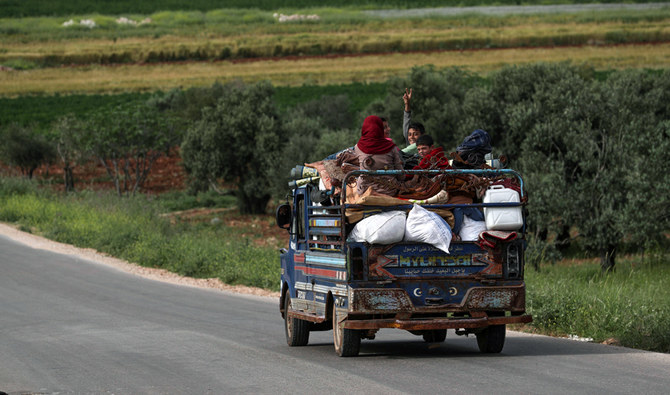
A Syrian boy, riding with his family in the back of a truck loaded with furniture and clothes, flashes the V sign as they flee from shelling on Hama and Idlib provinces on April 30, 2019. (AFP)
Updated 30 April 2019
Follow

Attacks on Syrian health facilities condemned

  • The UN is deeply disturbed by three separate reported attacks on hospitals and health facilities in northwestern Syria
  • The escalation has killed more than 200 civilians since February, the UN said last week

HBEIT: Shelling of areas in northwestern Syria in the past three days has damaged a medical center and put two hospitals out of service, the United Nations said on Tuesday.

“The UN is deeply disturbed by three separate reported attacks on hospitals and health facilities in northwestern Syria, depriving thousands of people of their basic right of health,” said David Swanson of the UN Office for the Coordination of Humanitarian Affairs.

“Such violence is completely unacceptable,” he told AFP.

The UN did not specify who was behind the attacks but the Britain-based Syrian Observatory for Human Rights blamed the Syrian regime and its ally Russia.

On Tuesday, a medical center in the town of Hbeit in the south of opposition-held Idlib province was “severely damaged” in artillery shelling, Swanson said.

Regime shelling blew a crater into the walls of the center, said an AFP correspondent who visited the facility. Its interior was littered with rubble, he said.

Earlier on Monday, an airstrike hit a hospital in the town of Latamna in neighboring Hama province, putting it out of service, Swanson said.

The hospital used to carry out 1,300 outpatient consultations and more than 300 operations a month before it was attacked, he said. A third facility — The Madiq Castle hospital in Hama — was also put out of service when it was hit by an air strike two days ago, causing heavy damage to its outpatient clinic, pharmacy and laboratory, Swanson said.

The hospital had served about 8,000 people a month, he added.

“All three incidents further limit civilians’ access to basic health care in northwest Syria,” he said.

“The UN continues to call on all the parties to the conflict to end the destruction of hospitals and other civilian infrastructure that is essential for the civilian population.”

Russia and Turkey in September inked a buffer zone deal to prevent a massive regime offensive on the Idlib region, near the Turkish border. But the region of some 3 million people has come under increasing bombardment since former Al-Qaeda affiliate Hayat Tahrir Al-Sham took full control of it in January.

The escalation has killed more than 200 civilians since February, the UN said last week.

The Observatory said two civilians were killed in Tuesday’s shelling on Idlib and neighboring Hama.


UN rights chief Shocked by ‘unbearable’ Darfur atrocities

Updated 18 January 2026
Follow

UN rights chief Shocked by ‘unbearable’ Darfur atrocities

  • Mediation efforts have failed to produce a ceasefire, even after international outrage intensified last year with reports of mass killings, rape, and abductions during the RSF’s takeover of El-Fasher in Darfur

PORT SUDAN: Nearly three years of war have put the Sudanese people through “hell,” the UN’s rights chief said on Sunday, blasting the vast sums spent on advanced weaponry at the expense of humanitarian aid and the recruitment of child soldiers.
Since April 2023, Sudan has been gripped by a conflict between the army and the paramilitary Rapid Support Forces that has left tens of thousands of people dead and around 11 million displaced.
Speaking in Port Sudan during his first wartime visit, UN Human Rights commissioner Volker Turk said the population had endured “horror and hell,” calling it “despicable” that funds that “should be used to alleviate the suffering of the population” are instead spent on advanced weapons, particularly drones.
More than 21 million people are facing acute food insecurity, and two-thirds of Sudan’s population is in urgent need of humanitarian aid, according to the UN.
In addition to the world’s largest hunger and displacement crisis, Sudan is also facing “the increasing militarization of society by all parties to the conflict, including through the arming of civilians and recruitment and use of children,” Turk added.
He said he had heard testimony of “unbearable” atrocities from survivors of attacks in Darfur, and warned of similar crimes unfolding in the Kordofan region — the current epicenter of the fighting.
Testimony of these atrocities must be heard by “the commanders of this conflict and those who are arming, funding and profiting from this war,” he said.
Mediation efforts have failed to produce a ceasefire, even after international outrage intensified last year with reports of mass killings, rape, and abductions during the RSF’s takeover of El-Fasher in Darfur.
“We must ensure that the perpetrators of these horrific violations face justice regardless of the affiliation,” Turk said on Sunday, adding that repeated attacks on civilian infrastructure could constitute “war crimes.”
He called on both sides to “cease intolerable attacks against civilian objects that are indispensable to the civilian population, including markets, health facilities, schools and shelters.”
Turk again warned on Sunday that crimes similar to those seen in El-Fasher could recur in volatile Kordofan, where the RSF has advanced, besieging and attacking several key cities.
Hundreds of thousands face starvation across the region, where more than 65,000 people have been displaced since October, according to the latest UN figures.