Beluga whale with Russian harness raises alarm in Norway

1 / 3
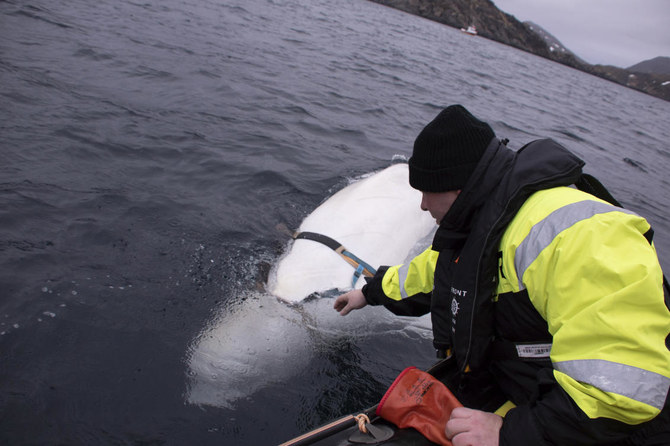
Norwegian fisherman Joar Hesten tries to attract a beluga whale swimming next to his boat before the Norwegian fishermen were able to removed the tight harness, off the northern Norwegian coast Friday, April 26, 2019. (AP)
2 / 3
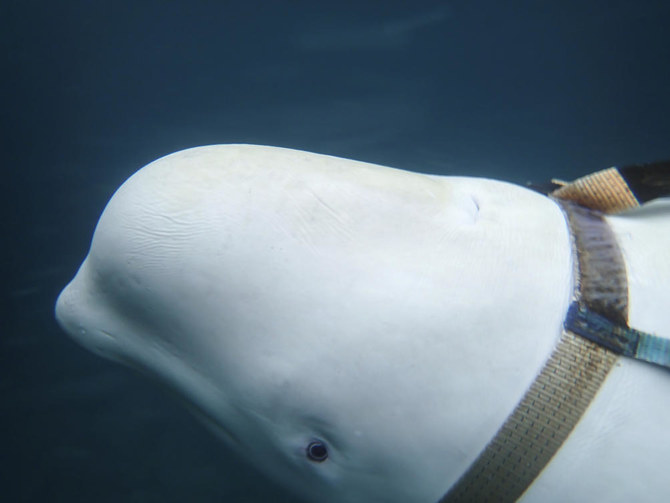
A beluga whale seen as it swims next to a fishing boat before Norwegian fishermen removed the tight harness, swimming off the northern Norwegian coast Friday, April 26, 2019. (AP)
3 / 3
Joergen Ree Wiig tries to reach the harness attached to a beluga whale before the Norwegian fishermen were able to removed the tight harness, off the northern Norwegian coast Friday, April 26, 2019. (AP)
Updated 29 April 2019
Follow

Beluga whale with Russian harness raises alarm in Norway

  • “Equipment St. Petersburg” is written on the harness strap, which features a mount for an action camera

COPENHAGEN: A beluga whale found with a tight harness that appeared to be Russian made has raised the alarm of Norwegian officials and prompted speculation that the animal may have come from a Russian military facility.
Joergen Ree Wiig of the Norwegian Directorate of Fisheries says “Equipment St. Petersburg” is written on the harness strap, which features a mount for an action camera.
He said Monday fishermen in Arctic Norway last week reported the tame white cetacean with a tight harness swimming around. On Friday, fisherman Joar Hesten, aided by the Ree Wiig, jumped into the frigid water to remove the harness.
Ree Wiig said “people in Norway’s military have shown great interest” in the harness.
Audun Rikardsen, a professor at the Department of Arctic and Marine Biology at the Arctic University of Norway in Tromsoe, northern Norway, believes “it is most likely that Russian Navy in Murmansk” is involved. Russia has major military facilities in and around Murmansk on the Kola Peninsula, in the far northwest of Russia.
It wasn’t immediately clear what the mammal was being trained for, or whether it was supposed to be part of any Russian military activity in the region.
Rikardsen said he had checked with scholars in Russia and Norway and said they have not reported any program or experiments using beluga whales.
“This is a tame animal that is used to get food served so that is why it has made contacts with the fishermen,” he said. “The question is now whether it can survive by finding food by itself. We have seen cases where other whales that have been in Russian captivity doing fine.”
Hesten told Norwegian broadcaster NRK that the whale began to rub itself again his boat when he first spotted it.
Russia does not have a history of using whales for military purposes but the Soviet Union had a full-fledged training program for dolphins.
The Soviet Union used a base in Sevastopol on the Crimean peninsula during the Cold War to train the mammals for military purposes such as searching for mines or other objects and planting explosives. The facility in Crimea was closed following the collapse of the Soviet Union, though unnamed reports shortly after the Russian annexation of Crimea indicated that it had reopened.
The Russian Defense Ministry published a public tender in 2016 to purchase five dolphins for a training program. The tender did not explain what tasks the dolphins were supposed to perform, but indicated they were supposed to have good teeth. It was taken offline shortly after publication.


Essex man takes on charity endurance challenge for children in Gaza

Updated 43 min 14 sec ago
Follow

Essex man takes on charity endurance challenge for children in Gaza

  • Mark Watson, 63, is undertaking a “virtual Sumud” journey from his Essex home town in Harlow to Gaza, covering 2,287 miles

LONDON: A man in England has launched a demanding charity challenge to raise funds for children affected by the war in Gaza.

Mark Watson, 63, is undertaking a “virtual sumud” journey from his Essex home town in Harlow to Gaza, covering 3,680 km running, walking, swimming, cycling and rowing.

He is raising money for Medical Aid for Palestinians, a UK-based humanitarian organization that provides healthcare to Palestinians in Gaza and the occupied territories.

“I have felt helpless day after day seeing images of countless children in Gaza with broken bodies and missing limbs and witnessing their unbearable suffering,” Watson said on his JustGiving page.

“I have been inspired by the courage of those who took part in the global sumud flotilla and all of the activists who have put their lives and freedom at risk supporting the Palestinian people and so I am raising funds for Medical Aid for Palestinians.

“My challenge is to complete a virtual sumud from Harlow, where I live, to Gaza. Running, walking, swimming, cycling and rowing I will cover the 2,287 miles as quickly as I can.

“I am an unfit, overweight 63-year-old, so I’m not going to break any records, but the Arabic word Sumud means steadfastness and perseverance, and I will give it my all.

Watson added: “I hope to be joined by people I love and admire along the way, so please support my fundraiser. Every donation, however small, will help save the lives of Palestinians.”

As of Jan. 3, his fundraising effort had reached 12 per cent of its £5,000 ($6,733) target.

The war in Gaza began after the Oct. 7, 2023, attack by Hamas on southern Israel, in which about 1,200 people were killed and more than 200 taken hostage, according to Israeli authorities.

Israel responded with a large-scale military campaign in Gaza, which local health authorities say has resulted in the deaths of more than 71,000 Palestinians, widespread destruction of civilian infrastructure and a severe humanitarian crisis.

International aid agencies have repeatedly said that children are among the most affected, facing injury, displacement, malnutrition and limited access to medical care.

Watson said he was inspired by activists and humanitarian efforts supporting Palestinians and hopes his challenge can make a small contribution to saving lives.