1 / 42
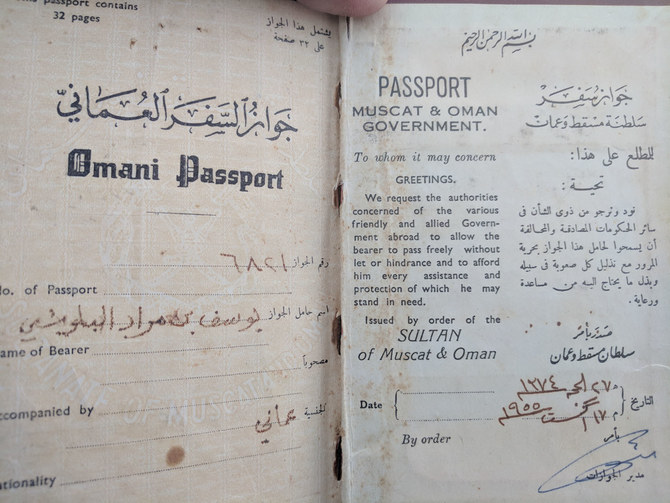
A passport issued to local fishermen Yousuf bin Murad Al-Baloshi in 1900. (AN Photo by Hassam Lashkari)
2 / 42
Many shopkeepers in Gwadar’s Shahi and other markets told Arab News on Tuesday, April 23, 2019 that they have displayed photos of the ruler of the Sultanate of Oman in their shops as a show of respect. (AN Photo by Hassam Lashkari)
3 / 42
Famous Gwadari Halwa has been attracting customers from Gwadar and adjacent districts since Omani era, manager Muhammad Ibrahim told Arab News on April 23, 2019. (AN photo by Hassam Lashkari)
4 / 42
This photo taken on April 23, 2019 provides a view of the Gwadar’s Shahi Bazaar. (AN Photo by Hassam Lashkari)
5 / 42
This photo taken on April 23, 2019 shows a fort of Oman, which was converted into Museum in 2001 and officially opened by former President Pervez Musharraf on March 20, 2007. (AN Photo by Hassam Lashkari)
6 / 42
Over a thousand people are associated with profession of boat making who work at the west bay of Gwadar, which has been a center for boat’s manufacturing for centuries, locals told Arab News on April 23, 2019. (AN Photo by Hassam Lashkari)
7 / 42
East Bay of Gwadar where the port has been constructed. The fishermen have been using this bay for fishing since centuries. They agitated when government started construction of expressway. However, after negotiations government agreed to provide three bridges and a breakwater for the passage of fishermen, locals told Arab News April 23, 2019. (AN Photo by Hassam Lashkari)
8 / 42
This photo taken on Tuesday April 23, 2019 shows a necklaces of Omani era displayed in Gwadar’s fort museum. (AN Photo by Hassam Lashkari)
9 / 42
This cannon displayed outside the old municipal office of Gwadar is one the two cannons which would fire explosives to announce the beginning of the religious festival of Eid before Pakistan purchased Gwadar from Oman in 1958, locals told Arab News on Tuesday, April 23, 2019. (AN Photo by Hassam Lashkari)
10 / 42
This photo taken on Tuesday April 23, 2019 shows an Omani fort in Thana Ward in Gwadar, which has now been converted into museum. (AN Photo by Hassam Lashkari)
11 / 42
This photo taken on April 23, 2019 shows an old Pan Shop of Omani period at Shahi Bazaar of Gwadar. (AN Photo by Hassam Lashkari)
12 / 42
Several shops in Pakistan's coastal town of Gwadar are named Oman, which locals told Arab News on Tuesday, April 23, 2019 is a manifestation of the strong bond between the people of Gwadar and their old Arab rulers. (AN Photo by Hassam Lashkari)
13 / 42
This photo taken on April 23, 2019 provides a view of the city from fort’s top. (AN Photo by Hassam Lashkari)
14 / 42
This Khuda Bux Halwai in Gwadar’s Shahi Bazaar has been selling special Gwadari Halwa since the Omani period, manager Muhammad Ibrahim told Arab News on April 23, 2019. (AN Photo by Hassam Lashkari)
15 / 42
This photo taken on April 23, 2019 provides a view of the Gwadar’s Shahi Bazaar (AN Photo by Hassam Lashkari)
16 / 42
Muhammad Ismail, an old staff at Kareemuk teashop, told Arab News on April 23, 2019 that he has been instructed to not allow anyone touch the Omani era pots and papers. (AN Photo by Hassam Lashkari)
17 / 42
Arab soldiers of Oman seen in a photo handout by Gwadar resident Nasir Raheem.
18 / 42
This photo taken on Tuesday April 23, 2019 shows one of three Omani forts in Gwadar, which was part of the Sultanate of Oman until September 1958. (AN Photo by Hassam Lashkari)
19 / 42
Photos and portraits of Sultan Qaboos Bin Said, the ruler of Oman, can be seen in many shops in Gwadar, a port city which remained a suzerainty of Oman till September 1958, locals told Arab News on April 23, 2019. (AN Photo by Hassam Lashkari)
20 / 42
Photos and portraits of Sultan Qaboos Bin Said, the ruler of Oman, can be seen in many shops in Gwadar, a port city which remained a suzerainty of Oman till September 1958, locals told Arab News on April 23, 2019. (AN Photo by Hassam Lashkari)
21 / 42
This photo taken on April 23, 2019 provides a view of the city from fort’s top. (AN Photo by Hassam Lashkari)
22 / 42
Gwadar under the Omani rule had rich culture. Different dramas, including Akbar Azam, would be staged on weddings. These old recorders at historic Kareemuk teashop shows the love of people for music and arts, locals told Arab News on April 23, 2019. (AN Photo)
23 / 42
In this photograph taken on April 23, 2019, an Omani fort used for keeping inmates can be seen near Shahi Bazaar in Gwadar city. (AN Photo by Hassam Lashkari)
24 / 42
Different products of Oman may be found in Gwadar port city of Pakistan, locals told Arab News on April 23, 2019. (AN Photo by Hassam Lashkari)
25 / 42
There are several shops named after Oman in Pakistan’s Gwadar city, which the locals told Arab News on April 23, 2019 is manifestation of strong bond of people with their previous Arab rulers. (AN Photo by Hassam Lashkari)
26 / 42
Several shops in Pakistan's coastal town of Gwadar are named Oman, which locals told Arab News on Tuesday, April 23, 2019 is a manifestation of the strong bond between the people of Gwadar and their old Arab rulers. (AN Photo by Hassam Lashkari)
27 / 42
Dad Kareem, a fisherman who has kept the old Omani passport of his father, told Arab News on Tuesday, April 23, 2019 that the people of Gwadar have a special love for Arabs. (AN Photo by Hassam Lashkari)
28 / 42
This photo taken on April 23, 2019 shows a basket of Omani era in Gwadar’s fort museum. (AN Photo by Hassam Lashkari)
29 / 42
Dad Kareem, a fisherman who has kept the old Omani passport of his father, told Arab News on Tuesday, April 23, 2019 that the people of Gwadar have a special love for Arabs. (AN Photo by Hassam Lashkari)
30 / 42
Muhammad Ismail, an old staff at Kareemuk teashop, told Arab News on April 23, 2019 that he has been instructed to not allow anyone touch the Omani era pots and papers. (AN Photo by Hassam Lashkari)
31 / 42
Almost every second fishermen from Gwadar has kept his passports and identity cards safe, fisherman Dad Karim told Arab News on April 2019. (AN Photo by Hassam Lashkari)
32 / 42
This photo taken on April 23, 2019 shows historic Kareemuk Hotel, formerly a bakery owned by an Arab businessman who gifted it to a local who has since converted it into a tea shop. (AN Photo Hassam Lashkari)
33 / 42
This well inside the Omani fort turned museum would be used to punish the hardened criminals, locals and district officials told Arab News on April 23, 2019. (AN Photo by Hassam Lashkari)
34 / 42
On April 23, 2019, Sakeena Bibi, 80, recalled "the golden days" of Gwadar before Pakistan purchased the town from the rulers of Oman in 1958. (AN Photo by Hassam Lashkari)
35 / 42
This photo taken on April 23, 2019 shows a grinding stone of Omani era in Gwadar’s fort museum. (AN Photo by Hassam Lashkari)
36 / 42
Muhammad Akbar, 78, sharing his childhood memories of Omani area with Arab News on April 23, 2019. (AN Photo by Hassam Lashkari)
37 / 42
Gwadar has always been facing the issue of water scarcity. This man, called Aappi, would pitch water from a well in Koh-e-Batil and sell in to the city, Nasir Raheem, a social activist told Arab News on April 23, 2019. (Photo courtesy: Nasir Raheem)
38 / 42
Top of the Omani fort, which has been designed to defend the attack on city, although local told Arab News on April 23, 2019 that the Omani era had been the most peaceful one. (AN Photo by Hassam Lashkari)
39 / 42
This photo taken on April 23, 2019 shows a pair of Sandals in Gwadar’s fort museum. (AN Photo by Hassam Lashkari)
40 / 42
In this letter wrote by Haji Muhammad Iqbal Baloch, former father of Karachi and a leading figure from Pasni, now part of Gwadar district, on April 23, 1950 has reasoned as why Gwadar should be part of Pakistan. Several locals, who formed Anjuman-e-Islah Balochan, have been rigorously campaigning for Gwadar’s accession with Pakistan. (Photo courtesy: Muhammad Iqbal Baloch)
41 / 42
In this letter wrote by Haji Muhammad Iqbal Baloch, former father of Karachi and a leading figure from Pasni, now part of Gwadar district, on April 23, 1950 has reasoned as why Gwadar should be part of Pakistan. Several locals, who formed Anjuman-e-Islah Balochan, have been rigorously campaigning for Gwadar’s accession with Pakistan. (Photo courtesy: Muhammad Iqbal Baloch)
42 / 42
In this letter wrote by Haji Muhammad Iqbal Baloch, former father of Karachi and a leading figure from Pasni, now part of Gwadar district, on April 23, 1950 has reasoned as why Gwadar should be part of Pakistan. Several locals, who formed Anjuman-e-Islah Balochan, have been rigorously campaigning for Gwadar’s accession with Pakistan. (Photo courtesy: Muhammad Iqbal Baloch)