


RIYADH: Arab coalition airstrikes in 2015 that killed 20 civilians in Yemen were targeting a compound used by Houthi commanders, investigators have found.
The airstrikes destroyed four houses in the Al-Hasba neighborhood in the north of the capital Sanaa, which is held by Houthi militants.
The Arab Coalition’s Joint Incident Assessment Team (JIAT) said on Wednesday that the site was a legitimate military target but a technical fault meant two of the four bombs hit buildings 80 and 150 meters away.
A Human Rights Watch report alleged that of the 20 people killed in the airstrikes on Sept. 21, 2015, 18 were from the same family, including 11 children and six women.
The JIAT, which was set up by the coalition to investigate allegations of human rights violations in Yemen, said intelligence had confirmed that the targeted compound had been seized by the Houthis from a tribal elder and was being used by militant commanders for meetings.
“Furthermore, ground intelligence confirmed that there were Houthi commanders meeting late at that night in the seized building,” the JIAT report said.
It added that the coalition should “review and rectify” the technical fault and provide assistance for the human losses and material damage that took place at the two buildings incorrectly hit.
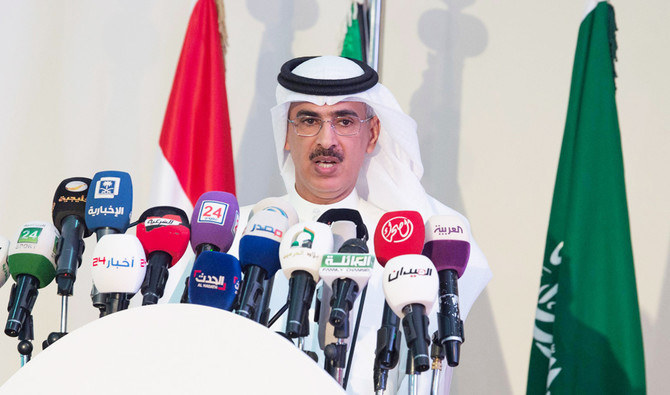
The report was one of several published by the JIAT on Wednesday. They were announced by JIAT spokesman Mansour Ahmed Al-Mansour in Riyadh.
In another alleged incident in May of the same year, the National Committee to Investigate Human Rights Violations in Yemen, reported that 14 people were killed when the coalition aircraft fired four missiles in a neigborhood in Al-Mudhaffar, Taiz governorate. The committee alleged that one missile fell on a house and the second missile fell beside a mosque.
The JIAT report, however, said the allegations were inaccurate and that the guided bombs had hit their targets and not the houses claimed by the committee, the nearest of which was 240 meters away.
The report found “highly reliable” intelligence had shown a gathering of Houthi militants and military equipment, including air-defense missiles.
Reports into five other incidents were also published by the JIAT.
The Arab Coalition launched a military campaign in 2015 to support forces loyal to Yemen’s internationally recognized government. The operation came after the Iran-backed Houthi militia seized the capital Sanaa in 2014 and, allied with forces of the former president Ali Abdullah Saleh, launched an offensive to seize swathes of territory.


