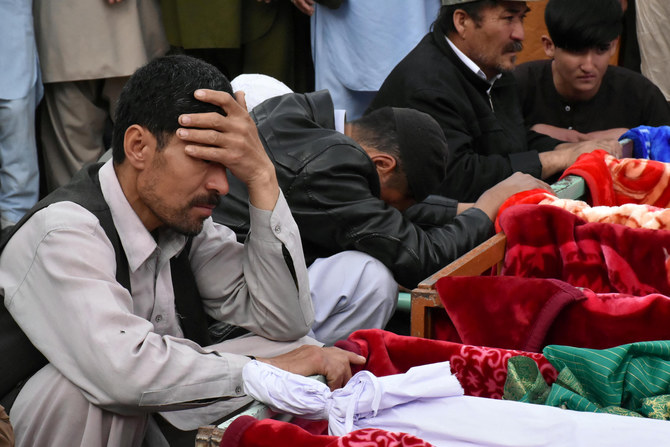
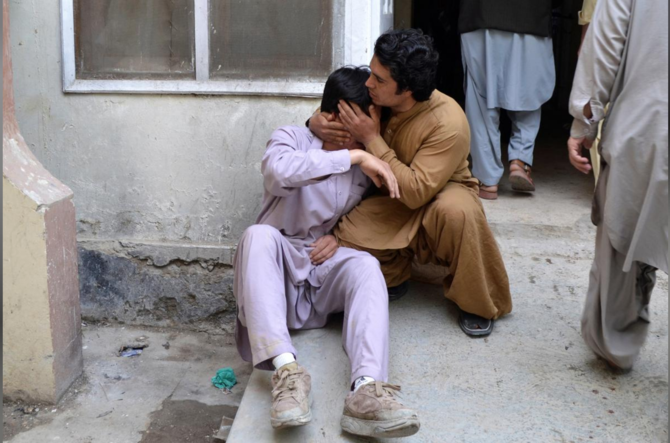
KARACHI: The Middle-Eastern Daesh militant organization said it was behind a suicide bombing that killed at least 20 people in an openair market in southwestern Pakistan on Friday, the group’s Amaq news agency said on Saturday.
The group provided no further detail or evidence for its claim.
On Friday, a bomb ripped through an outdoor market in Quetta, the capital of Balochistan province, in an attack police said had aimed to target the ethnic Hazara Shia minority.
Militants linked to the Taliban, Al-Qaeda and Daesh have been operating in the province, which borders Iran as well as Afghanistan. It also has an indigenous ethnic Baloch insurgency fighting the central government.
Last year, Daesh claimed responsibility for an attack on an election rally in Balochistan in which at least 128 people were killed. In 2017, Daesh said it had killed two Chinese teachers it had previously kidnapped in Balochistan province.
Beijing has pledged $62 billion for its “Belt and Road” plan in Pakistan and many of the flagship projects, including a commercial port, are housed in Balouchistan.
Police initially said Friday’s blast was caused by a bomb placed in a potato sack but Balochistan Home Minister Mir Zia Ullah Langau clarified that it was carried out by a suicide bomber.
On Saturday, Deputy police Chief Abdul Razzaq Cheema said police had found the body parts of the attacker and sent them for forensic examination.
“An investigation team comprising officials of the counter terrorism department has been setup,” he told Arab News, declining further comment until the investigation was completed.
On Friday, Cheema said of those killed in the attack, eight were members of the Hazara community, which regularly comes under attack in both Pakistan and Afghanistan from Taliban and Daesh militants and other sectarian outfits.
At least 48 people were also injured in the attack, according to Bolan Medical Complex and Quetta Trauma Center.
On Friday evening, an IED [improvised explosive device] blast aimed at paramilitary troops left two dead and seven wounded in Chaman, city police chief Attaullah Shah said.
According to a 2018 report released by the National Commission for Human Rights, 509 ethnic Hazaras were killed and 627 wounded in a spate of attacks against the community between January 2012 and Dec 2017.
The deadliest attacks took place in 2013 when three separate bombings killed more than 200 members of the community in Balochistan province. After those attacks, it became standard practice for security officials to escort Hazara buses out of the two protected enclaves where they mostly live and work, including to markets like the one where Friday’s attack occurred.
On Friday, too, 55 Hazaras were escorted to the market by security officials in 11 vehicles, Cheema said. The blast took place inside the market.
Prime Minister Imran Khan said in a post on Twitter that he called an “immediate inquiry” into the attack.
“Prayers go to the families of the victims & for early recovery of the injured,” he said.
“Prime Minister Imran Khan’s government has made important commitments to protect all religious groups in the country. Those commitments must translate now into policies to effectively protect the Hazaras of Quetta, ending more than a decade of bloodshed that has scarred their community,” Amnesty International’s Deputy South Asia Director, Omar Waraich, said.
“This horrific loss of life is a painful reminder of the threats that Quetta’s Hazara community continues to face. Targeted for their religion by sectarian armed groups, they have suffered many such tragedies over several years. Each time, there are promises that more will be done to protect them, and each time those promises have failed to materialize.”


![]()
![]()

Daesh says behind Pakistan market suicide bombing that killed 20
Daesh says behind Pakistan market suicide bombing that killed 20
- Eight of the deceased are Shia Muslims from the Hazara community
- Second blast targeting paramilitary troops in Chaman kills two
Latest updates


© 2026 SAUDI RESEARCH & PUBLISHING COMPANY, All Rights Reserved And subject to Terms of Use Agreement.