


BRUSSELS: European Union leaders gave Theresa May a new Brexit deadline of Oct. 31, four months longer than the prime minister asked for, in a move the EU summit chair said would let Britain resolve its domestic deadlock on the issue.
“EU27/UK have agreed a flexible extension until 31 October,” European Council President Donald Tusk tweeted after eight hours of talks that went into the early hours of Thursday.
“This means (an) additional six months for the UK to find the best possible solution,” Tusk added on the eve of what would otherwise have been the day Britain crashed out of the bloc with no deal to smooth the departure for businesses and citizens.
Britain, he stressed, could still leave earlier if May secures parliamentary backing for her Brexit treaty, or it could amend what it wants from a future trade pact. “Until the end of this period, the UK will also have the possibility to... cancel Brexit altogether,” Tusk added.
The agreement gives May more than the three months to June 30 that she asked for to build a parliamentary majority behind the withdrawal treaty she negotiated with the EU last year.
But she insisted Britain could still secure a deal and leave before Britons would have to vote in a May 23-26 election to the European Parliament — a condition for the country to remain a member of the bloc beyond June 1 under the EU’s accord.
Many leaders had wanted a much longer extension, to the end of the year or even next March, but French President Emmanuel Macron mounted stiff resistance throughout the evening, eventually forcing the compromise.
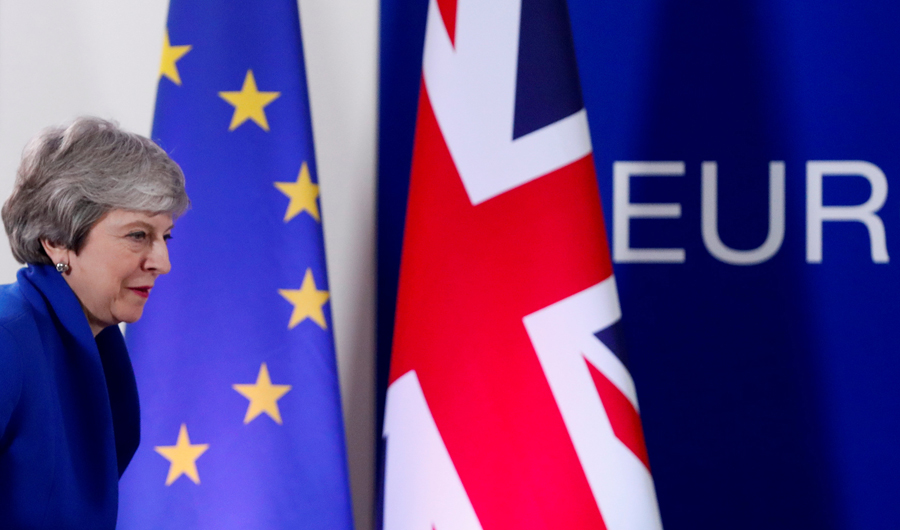
British Prime Minister Theresa May leaves after holding a news conference in Brussels, Belgium, on April 11, 2019 following an extraordinary European Union leaders summit to discuss Brexit. (REUTERS/Susana Vera)
Macron questioned May’s ability to persuade parliament to her treaty, EU officials said, and said that a tighter deadline would focus British minds. Others argued that an even longer extension could spook May’s pro-Brexit critics into backing her deal for fear Brexit might stall.
Leaving at midnight on Oct. 31 — Halloween, as social media commentators were quick to note — would correspond with the end of the mandate of the present EU executive Commission.
Leaders would assess the situation again when they meet for a regular summit on June 20-21. Britain could have left by then if May succeeds in building a coalition for her deal with the Labour opposition — though there is no sign of agreement yet.
In order to continue as an EU member beyond June, May has agreed to organize British elections to the European Parliament, though it is still unclear if that vote will go ahead and how far it might turn into a virtual second referendum on EU membership that some hope could mean Britain canceling Brexit.
The other 27 had all but ruled out pitching Britain, and parts of the EU economy, into chaos on Friday. But a drive by Macron to keep London on a tight leash saw the emergency summit bogged down in late-night wrangling as German Chancellor Angela Merkel and others argued the merits of a longer lag.
As at a summit last month, which put back Brexit for two weeks, several EU diplomats said May failed to persuade her peers that she could definitely break the paralysis of repeated failures to ratify the treaty within the coming months.
French officials said the EU faced “blackmail” by hard-line pro-Brexit potential successors to May, such as Boris Johnson. They might try to sabotage decision-making, they said.
Laughter with Merkel
However, Merkel has urged the bloc to do all it can to avoid such disruption. She said before leaving Berlin that she favored a delay of “several months” for May, who has pledged to quit if hardcore Brexit supporters in her own Conservative Party drop objections to her “soft Brexit” and help ratify the deal.
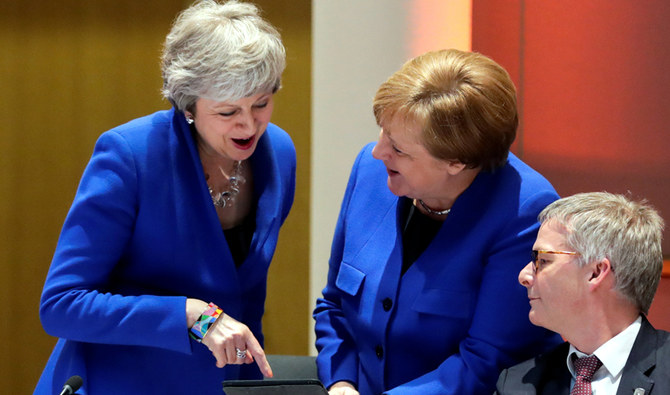
Keen to ease tension, Merkel had broken the ice as talks began by showing May a photomontage on a tablet of both wearing similar jackets when addressing their parliaments earlier in the day. It provoked mutual laughter as other leaders joined in.
As talks wore on beyond midnight, with May patiently waiting elsewhere in the building for word on her nation’s fate, Macron rallied support for his concerns about a long extension.
May said on arrival that she did not want a long delay: “I want us to be able to leave the European Union in a smooth and orderly way as soon as possible,” she told reporters.
Her EU peers, however, are skeptical about her ability to break the deadlock soon. They are exasperated with May’s handling of a tortuous and costly divorce that is a distraction from ensuring the bloc can hold its own against global economic challenges.
Across from the summit venue, the EU executive celebrated its part in funding a global project that produced the first picture of a black hole, prompting no shortage of ironic comments on social media about the juxtaposition.
Blogger Eliot Higgins tweeted: “We’re now more certain about what black holes look like than what Brexit looks like.”


