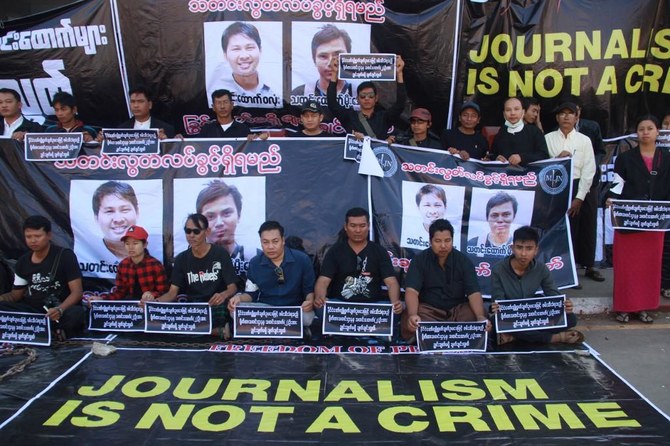
PARIS: The United Nations’ cultural agency said Wednesday that it had awarded its annual press freedom prize to two Reuters reporters jailed in Myanmar over their reporting on the killings of Rohingya Muslims in the country.
Wa Lone and Kyaw Soe Oo have been behind bars since December 2017, detained on claims of violating state secrets.
“They were arrested because they documented a taboo topic regarding crimes committed against Rohingyas,” said Wojciech Tochman, a Polish reporter who headed the jury for the UNESCO prize.
The Guillermo Cano prize, named for a Colombian journalist gunned down in Bogota in 1986, will be awarded on May 2 at a ceremony in Ethiopia on the eve of World Press Freedom Day.
Rights groups have denounced the jailing of the two Myanmar nationals as an attempt to muzzle criticism of the government’s treatment of the Rohingya minority.
At the time of their arrest the reporters were probing the extrajudicial killing of 10 Rohingya men at Inn Din village in northern Rakhine state.
They were convicted of possessing classified information regarding security operations in Rakhine, from where an estimated 740,000 Rohingya fled during an army-led crackdown the United Nations has described as “ethnic cleansing.”
They were sentenced to seven years in prison. In February, lawyers lodged an appeal with Myanmar’s Supreme Court.
“Wa Lone and Kyaw Soe Oo symbolize their country’s emergence after decades of isolation,” beginning with landmark elections in 2015 which ended decades of military rule, said Tochman.
Myanmar’s civilian leader Aung San Suu Kyi, who was awarded a Nobel prize over her push for democracy, has refused to use her influence to secure a pardon for the reporters.

Jailed Reuters journalists in Myanmar win UN press freedom prize
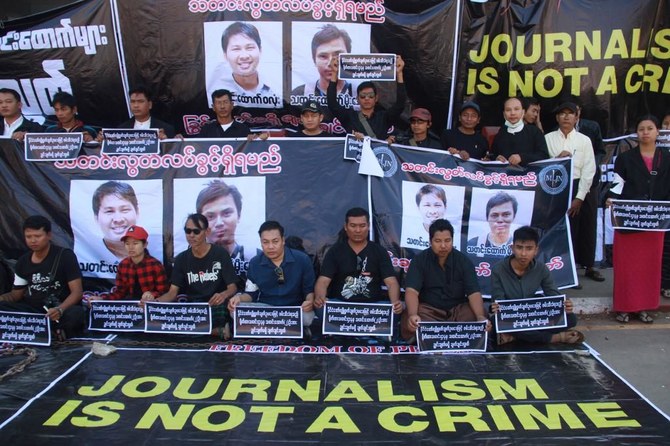
- Reuters journalists Wa Lone and Kyaw Soe Oo have been behind bars since December 2017
- The Guillermo Cano prize will be awarded on May 2 in Ethiopia on the eve of World Press Freedom Day
Israel says ban on Gaza media access should stay: court document
- Israeli authorities have told the Supreme Court that a ban on international media access to Gaza should remain in place, arguing it is necessary for security reasons
JERUSALEM: Israeli authorities have told the Supreme Court that a ban on international media access to Gaza should remain in place, arguing it is necessary for security reasons, according to a government submission filed by the public prosecutor.
Since the outbreak of the Gaza war in October 2023, Israeli authorities have barred foreign journalists from independently entering the devastated territory.
Instead, Israel has allowed only a limited number of reporters to enter Gaza on a case-by-case basis, embedded with its military forces inside the blockaded territory.
The Foreign Press Association (FPA), which represents hundreds of foreign journalists working in Israel and the Palestinian territories, filed a petition with the Supreme Court in 2024 seeking immediate and unrestricted access for international media to the Gaza Strip.
Since then the court has given several extensions to the Israeli authorities to come up with a plan, but at a hearing last month it set January 4 as a final deadline.
Late on Sunday, the Israeli authorities filed their response with the court, a copy of which was obtained by AFP.
In the submission, the government said the ban on media access to Gaza should continue, citing security risks in the territory.
“Even at this time, entry of journalists into the Gaza Strip without escort, as requested in the petition, should not be permitted,” said the government submission.
“This is for security reasons, based on the position of the defense establishment, which maintains that a security risk associated with such entry still exists.”
The Israeli authorities said the ceasefire in Gaza, which came into effect on October 10, continues to face regular threats.
At least 420 Palestinians have been killed in Gaza by Israeli forces since the ceasefire took effect, according to Gaza’s health ministry.
The Israeli military said three of its soldiers have also been killed by militants during the same period.
The Israeli authorities said in their submission that the search for the remains of the last hostage held in Gaza is ongoing, suggesting that allowing journalists into the territory at this stage could hinder the operation.
The remains of Ran Gvili, whose body was taken to Gaza after he was killed during the Hamas attack on October 7, 2023, have still not been recovered despite the ceasefire.
All other 250 hostages seized on that day — both the living and the deceased — have been returned to Israel.
The Supreme Court is expected to issue a ruling on the matter, though it is unclear when a decision will be handed down.
An AFP journalist sits on the board of the FPA.