ROME: Italy on Tuesday confirmed that it would keep its military missions in Tripoli and Misrata despite the advance of strongman Khalifa Haftar's forces on the Libyan capital.
Miasit, launched in January 2018, will "continue in order to make assistance activities in Libya more incisive and efficient", the Italian defence ministry said in a statement.
UN chief Antonio Guterres has appealed for an immediate halt to fighting in Libya after Haftar's forces claimed an airstrike on Tripoli's only functioning airport.
Thousands have fled violence in the capital city, according to the United Nations, since Haftar launched a surprise assault last week which has left dozens dead.
Italy's Bilateral Mission of Assistance and Support in Libya "supports Libyan authorities in their pacification and stabilisation activities in the country and against human trafficking, smuggling and threats to security."
No figures were provided for the current deployment but the mission has previously included around 100 troops in Tripoli and 300 in Misrata, about 200 kilometres (130 miles) to the east.
Troops from former colonial power Italy are involved in "training and technical and infrastructure assistance for Libyan security forces," in Tripoli, the statement said.
In Misrata, the troops provide security and assistance to a hospital within a military academy for the UN-backed Government of National Accord.
The oil-rich northern African country has been rocked by violent power struggles between an array of armed groups since the NATO-backed overthrow of dictator Moamer Kadhafi in 2011.
The UN-backed Government of National Accord (GNA) controls the capital, but its authority is not recognised by a parallel administration in the east of the country, backed by Haftar.


Italy keeps troops in Libya despite Khalifa advance
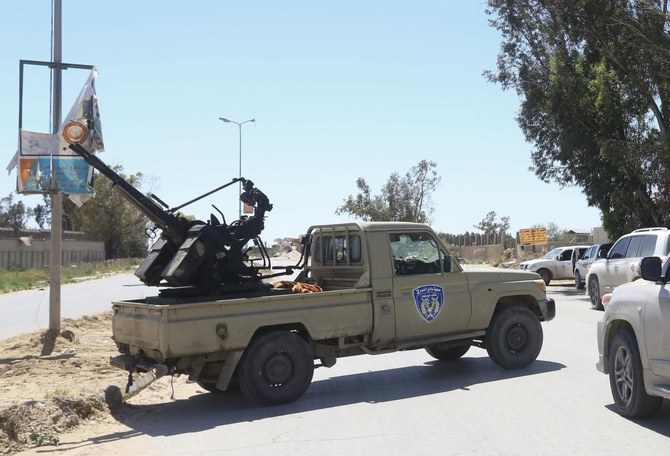
Italy keeps troops in Libya despite Khalifa advance

- Guterres has appealed for an immediate halt to fighting in Libya after Haftar's forces claimed an airstrike on Tripoli's airport

Saudi intervention ends Socotra power crisis
- Sudden shutdown of the power plants after the operating company withdrew and disabled control systems
- Saudi engineering and technical teams moved immediately after receiving an appeal from local authorities
ADEN: Electricity has returned to Yemen’s Socotra archipelago after urgent Saudi intervention ended days of outages that disrupted daily life and crippled vital institutions, including the general hospital, the university and the technical institute.
The breakthrough followed a sudden shutdown of the power plants after the operating company withdrew and disabled control systems, triggering widespread blackouts and deepening hardship for residents.
The Saudi Development and Reconstruction Program for Yemen said that its engineering and technical teams moved immediately after receiving an appeal from local authorities. Specialists were dispatched to reactivate operating systems that had been encrypted before the company left the island.
Generators were brought back online in stages, restoring electricity across most of the governorate within a short time.
The restart eased intense pressure on the grid, which had faced rising demand in recent weeks after a complete halt in generation.
Health and education facilities were among the worst affected. Some medical departments scaled back services, while parts of the education sector were partially suspended as classrooms and laboratories were left without power.
Socotra’s electricity authority said that the crisis began when the former operator installed shutdown timers and password protections on control systems, preventing local teams from restarting the stations. Officials noted that the archipelago faced a similar situation in 2018, which was resolved through official intervention.
Local sources said that the return of electricity quickly stabilized basic services. Water networks resumed regular operations, telecommunications improved, and commercial activity began to recover after a period of economic disruption linked to the outages.
In the health sector, stable power, combined with operational support, secured the functioning of Socotra General Hospital, the archipelago’s main medical facility.
Funding helped to provide fuel and medical supplies and support healthcare staff, strengthening the hospital’s ability to receive patients and reducing the need to transfer cases outside the governorate, a burden that had weighed heavily on residents.
Medical sources said that critical departments, including intensive care units and operating rooms, resumed normal operations after relying on limited emergency measures.
In education, classes and academic activities resumed at Socotra University and the technical institute after weeks of disruption.
A support initiative covered operational costs, including academic staff salaries and essential expenses, helping to curb absenteeism and restore the academic schedule.
Local authorities announced that studies at the technical institute would officially restart on Monday, a move seen as a sign of gradual stabilization in public services.
Observers say that sustained technical and operational support will be key to safeguarding electricity supply and preventing a repeat of the crisis in a region that depends almost entirely on power to run its vital sectors.


