Thriving Saudi startup scene to produce top-30 companies, WEF hears

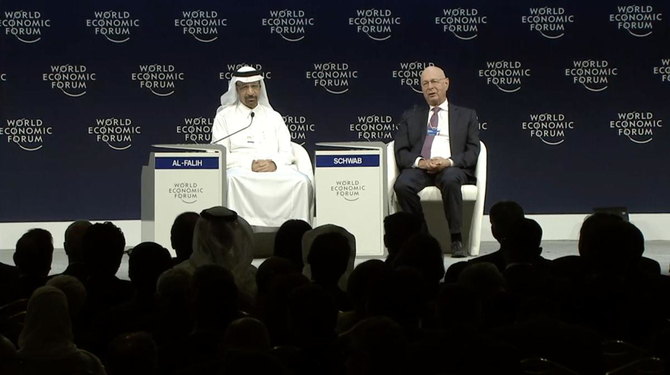
audi Arabia’s Energy Minister Khalid Al-Falih (L) told the forum that he expects the startups of today to be among the Kingdom’s biggest companies in a decade’s time. (Screenshot)
Updated 08 April 2019
Follow

Thriving Saudi startup scene to produce top-30 companies, WEF hears

  • Agile new businesses of today will be among Kingdom’s largest by 2030, World Economic Forum hears
  • Khalid Al-Falih told the forum that he expects the startups of today to be among the Kingdom’s biggest companies

DEAD SEA, Jordan: Saudi Arabia’s startup scene is “moving faster than anyone can imagine” and is set to create hundreds of thousands of jobs over the coming years, the World Economic Forum in Jordan heard on Saturday.
The region’s most successful tech ventures — like ride-hailing service Careem, which Uber recently agreed to buy for $3.1 billion, and web portal Maktoob, which was acquired by Yahoo in 2009 — have emerged from more established startup hubs of Dubai and Amman.
But the next wave is seen emerging from Saudi Arabia, panelists said at the regional meeting of the World Economic Forum (WEF) at the Dead Sea.
Saudi Arabia’s Energy Minister Khalid Al-Falih told the forum that he expects the startups of today to be among the Kingdom’s biggest companies in a decade’s time.
“Our enterprises will multiply in size,” he said. “I predict that by 2030, companies that we don’t know today will be among the top 20, 30 companies in Saudi Arabia. They will be driven by innovation, they will be driven by young people, they will be driven by women.”
The government has a role to play in encouraging more Saudi startups, along with a culture where young people experiment in business, the minister added.
“(It’s about) creating an environment where failure is not encouraged, but certainly dealt with in a positive way — and that young people are given the opportunity to fail, fail, fail, and succeed ultimately, and not only create opportunities for themselves … but also employment and opportunities for hundreds of thousands of people.”
Al-Falih pointed to the venture capital funds and startup incubators that are already active in the Kingdom.
“We hope to see hundreds of these startups coming up with innovations that are not only going to change our countries in the region, but indeed in due course will be part of the global movement where young, innovative enterprises are creating the economies and the solutions of the future,” he said.
Ten Saudi companies made it to the WEF’s 100 most promising startups for 2019, with entrepreneurs from the Kingdom in attendance at the event.
Fadi Ghandour, the founder of courier service Aramex and executive chairman of venture capital firm Wamda Capital, said that the Kingdom’s startup scene has virtually transformed overnight.
“I am extremely impressed. Suddenly you thought nothing is happening, and then you wake up in the morning and you say ‘what happened here?’,” he told a panel at the event.
“Saudi Arabia is a country that is changing, it is moving faster than anybody can image … It’s an exciting time, it is where the region is going to scale its businesses.”
Ghandour was joined on the panel by Ayman Alsanad, co-founder and CEO Mrsool, the Saudi delivery app that recently received multi-million dollar investments from Saudi Technology Ventures and others.
Audrey Nakad, co-founder of the education platform Synkers, which is based in Lebanon, told the panel that her company is preparing to expand into Saudi Arabia. Synkers provides a link between tutors and students looking for additional help.


RLC Global Forum helping retail experts exchange knowledge around new tech, industry leaders say

Updated 6 sec ago
Follow

RLC Global Forum helping retail experts exchange knowledge around new tech, industry leaders say

RIYADH: New technologies used to improve customer experience and day-to-day operations are driving Saudi Arabia’s retail transformation, industry leaders have told Arab News during a high-profile gathering in Riyadh.

On the sidelines of the RLC Global Forum, key players in the sector spoke to Arab News about how artificial intelligence is playing an increasingly important role as tech-savvy consumers look for integration between the virtual and physical worlds.

They also praised the role of the forum in bringing stakeholders together to exchange knowledge and ideas, which is driving forward retail offerings in the Kingdom and beyond.

The two-day RLC Global Forum started on Feb. 3 under the strategic theme “Growth Crossroads,” and brought together more than 2,000 global leaders, policymakers, and innovators from over 40 countries to define the next chapter of growth across retail, consumer, and lifestyle industries.

Speaking to Arab News, Majid Al-Gothmi, acting CEO of shopping centre management company Red Malls, said: “The Saudi retail sector is changing under Vision 2030. The transformation has helped our growth.”

He agreed that digital tools, AI, and new technologies are being used to improve customer experience and day-to-day operations.

“It’s helping us a lot in actually profiling our customers, understanding them, and providing better services to the younger generation,” said Al-Gothmi.

“Gen Z constitutes a major component of the retail market. We can see that 70 percent of the consumers are Gen-Z — they do most of their shopping online, over 60 percent of them,” he added, going on to say that his company’s focus is on “future proofing” shopping malls by integrating technology along with physical space that allows people to mingle comfortably and seamlessly.

Al-Gothmi described the RLC Global Forum as “an excellent platform gathering all the developers, retailers, brands, and most importantly, policymakers.”

He added: “This is a first, I think, where they share their insights, challenges, and exchange solutions, which helps the whole industry to move faster.”

Stefania Lazzaroni, CEO of Italian luxury brands association Altagamma Foundation, told Arab News that she expects steady growth for high-end products and experiences in the Kingdom.

She said: “There’s a new trend about hospitality, fine dining, longevity, and health spa beauty. These are the key factors that are growing. And we believe fine dining, hospitality and spa health as well will be a new trend even in this area. Honestly, they have been doing well for a couple of years.”

Stefania Lazzaroni, CEO of Altagamma Foundation. AN

Lazzaroni asserted that digital tools, AI and new technologies are being used to improve customer experience, as “the luxury client is very specific about what they want.”

She added: “Artificial intelligence is really perfect for us. We have a lot of counterfeiting all around the world, so technology can really support luxury brands in protecting their brands.

“So we are very pro artificial intelligence, which is changing the game and giving more strength and potential for luxury brands.”

The CEO explained that AI is also useful for talking to Gen Z, “which will be the clients of the future.”

She added: “So today with social media, TikTok, and so forth, there is an explosion of beauty, Gen Z is very much active on this.”

Abdel-Salam Bdeir, CEO at the Saudi Co. for Hardware, agreed that the retail sector is changing under Vision 2030 transformation.

He told Arab News: “We are building new technologies for AI to be used and demand planning and inventory optimization, marketing, and pricing optimization, margin, maximization.

“Even in security cameras, communication with customers, shopping behavior targeting certain sectors of customers, we are building all that as we speak.”

Bdeir believes technological progress brings both opportunities and challenges, among them the risk of fewer jobs.

He said: “With major international platforms entering the market, not only the jobs, but money goes to other markets. That’s why the United States, UK, France, Italy, Spain, and Germany put strict regulations on international platforms first to meet safety standards for the consumer and environmental standards, and second to secure jobs for locals.

“They also put higher tariffs, customs duties, on developing markets like India, Egypt, Turkiye, Brazil, Mexico, Vietnam, Indonesia, and Malaysia.”

Bdeir added: “So what is in my opinion, necessary is for the regulators to do what European countries and developing markets did to protect jobs, consumers and the economy.”