France, Germany and UK say Iran missiles can deliver nukes

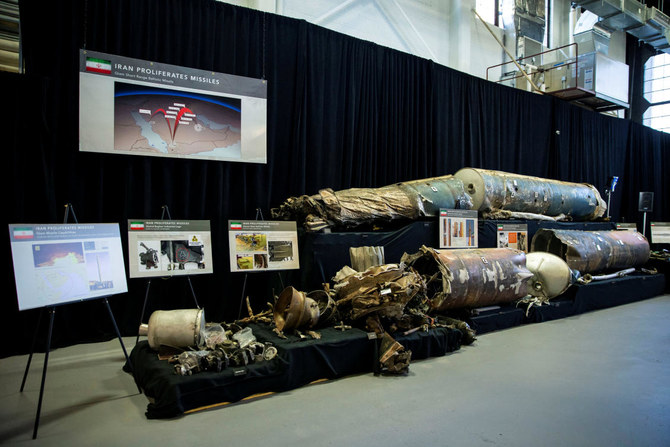
A U.S. Department of Defense exhibit shows a "Qiam" ballistic missile manufactured in Iran, at a military base in Washington, U.S., November 29, 2018. (Reuters)
Updated 02 April 2019
Follow

France, Germany and UK say Iran missiles can deliver nukes

  • Ambassadors from the three countries said Iran’s ballistic missiles are destabilizing the Middle East

UNITED NATIONS: France, Germany and Britain expressed concern in a letter released Tuesday that Iran’s latest ballistic missile activities are part of increasing actions to develop missiles capable of delivering a nuclear weapon.
Ambassadors from the three UN Security Council nations said in a letter to Secretary-General Antonio Guterres that Iran’s latest development and launching of ballistic missiles is having a destabilizing effect in the Middle East and increasing existing tensions. The Western allies also said Iran’s activities are “inconsistent” with a 2015 UN resolution calling on Iran not to undertake any activity involving such missiles.
The resolution was adopted unanimously to support the 2015 deal between Iran and six major powers including the United States to rein in Tehran’s nuclear program. Last year, President Donald Trump announced the US withdrawal from the pact but France, Germany and Britain, also signatories, still support the nuclear agreement.
In their letter, the three European allies pointed to the Feb. 6 launch of a Dousti satellite, saying its Safir space launch vehicle is capable of delivering nuclear weapons.
They also cited Iran’s unveiling of a Dezful surface-to-surface ballistic missile on Feb. 7 saying it is “highly likely” to meet the criteria to deliver a nuclear weapon, and Tehran’s public display on Feb. 4 of a variation of the Khorramshahr ballistic missile, calling it “potentially” a nuclear-capable intermediate-range ballistic missile.
France’s UN Ambassador Francois Delattre, Germany’s UN Ambassador Christoph Heusgen and Britain’s UN Ambassador Karen Pierce asked Guterres to report “fully and thoroughly on Iranian ballistic missile activity inconsistent” with the 2015 resolution in his next report to the Security Council.
The ambassadors’ latest letter is a follow-up to previous letters in November, December and February on Iranian missile activity “inconsistent” with the resolution.
In early March, the United States urged the Security Council to impose new sanctions on Iran, saying its recent missile-related launches could be capable of delivering nuclear weapons and risk a regional arms race.
Acting US ambassador Jonathan Cohen condemned “Iran’s destabilizing activities” in a letter to Guterres and called on Tehran “to cease immediately all activities related to ballistic missiles designed to be capable of delivering nuclear weapons.”
The Trump administration re-imposed US sanctions on Iran in November, including those targeting its vital oil sector, after it pulled the United States out of the nuclear deal.
On March 22, the US hit Iran with additional sanctions, targeting 31 Iranian scientists, technicians and companies which had been at the forefront of the country’s former nuclear weapons program.
The European ambassadors’ letter made no mention of sanctions.
Under the nuclear agreement, many UN sanctions on Iran were lifted.


Culture being strangled by Kosovo’s political crisis

Updated 58 min 33 sec ago
Follow

Culture being strangled by Kosovo’s political crisis

  • Cultural institutions have been among the hardest-hit sectors, as international funding dried up and local decisions were stalled by the parliamentary crisis

PRIZREN: Kosovo’s oldest cinema has been dark and silent for years as the famous theater slowly disintegrates under a leaky roof.
Signs warn passers-by in the historic city of Prizren that parts of the Lumbardhi’s crumbling facade could fall while it waits for its long-promised refurbishment.
“The city deserves to have the cinema renovated and preserved. Only junkies gathering there benefit from it now,” nextdoor neighbor butcher Arsim Futko, 62, told AFP.
For seven years, it waited for a European Union-funded revamp, only for the money to be suddenly withdrawn with little explanation.
Now it awaits similar repairs promised by the national government that has since been paralyzed by inconclusive elections in February.
And it is anyone’s guess whether the new government that will come out of Sunday’s snap election will keep the promise.

- ‘Collateral damage’ -

Cinema director Ares Shporta said the cinema has become “collateral damage” in a broader geopolitical game after the EU hit his country with sanctions in 2023.
The delayed repairs “affected our morale, it affected our lives, it affected the trust of the community in us,” Shporta said.
Brussels slapped Kosovo with sanctions over heightened tensions between the government and the ethnic Serb minority that live in parts of the country as Pristina pushed to exert more control over areas still tightly linked to Belgrade.
Cultural institutions have been among the hardest-hit sectors, as international funding dried up and local decisions were stalled by the parliamentary crisis.
According to an analysis by the Kosovo think tank, the GAP Institute for Advanced Studies, sanctions have resulted in around 613 million euros ($719 million) being suspended or paused, with the cultural sector taking a hit of 15-million-euro hit.

- ‘Ground zero’ -

With political stalemate threatening to drag on into another year, there are warnings that further funding from abroad could also be in jeopardy.
Since February’s election when outgoing premier Albin Kurti topped the polls but failed to win a majority, his caretaker government has been deadlocked with opposition lawmakers.
Months of delays, spent mostly without a parliament, meant little legislative work could be done.
Ahead of the snap election on Sunday, the government said that more than 200 million euros ($235 million) will be lost forever due to a failure to ratify international agreements.
Once the top beneficiary of the EU Growth Plan in the Balkans, Europe’s youngest country now trails most of its neighbors, the NGO Group for Legal and Political Studies’ executive director Njomza Arifi told AFP.
“While some of the countries in the region have already received the second tranches, Kosovo still remains at ground zero.”
Although there have been some enthusiastic signs of easing a half of EU sanctions by January, Kurti’s continued push against Serbian institutions and influence in the country’s north continues to draw criticism from both Washington and Brussels.

- ‘On the edge’ -

Across the river from the Lumbardhi, the funding cuts have also been felt at Dokufest, a documentary and short film festival that draws people to the region.
“The festival has had to make staff cuts. Unfortunately, there is a risk of further cuts if things don’t change,” Dokufest artistic director Veton Nurkollari said.
“Fortunately, we don’t depend on just one source because we could end up in a situation where, when the tap is turned off, everything is turned off.”
He said that many in the cultural sector were desperate for the upcoming government to get the sanctions lifted by ratification of the agreements that would allow EU funds to flow again.
“Kosovo is the only one left on the edge and without these funds.”