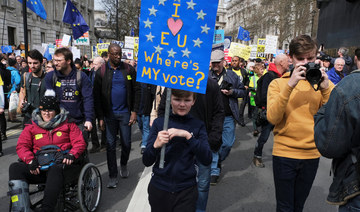
LONDON: British MPs have voted to play a bigger role in Brexit, giving themselves the power to express their preference for different options in an unprecedented move that the government called “dangerous.”
On Monday evening MPs won a vote that will allow them to seize control of parliamentary business on Wednesday by 329 to 302, with three junior ministers quitting after voting against the government.
British pro-Brexit tabloid The Sun said Tuesday that May had “lost control of the Brexit process to MPs in a humiliating defeat.”
The Times also said the prime minister had been “humiliated by Tory rebellion” as the cabinet “prepares for (a) snap election.”
Foreign Office minister Alistair Burt and health minister Steve Brine resigned, a government source said, while business minister Richard Harrington announced his decision to leave government on Twitter.
In his resignation letter, Harrington said the government’s approach was “playing roulette with the lives and livelihoods of the vast majority of people in this country.”
But the Brexit ministry said in a statement it was “disappointed” by the vote, adding that it “upends the balance between our democratic institutions and sets a dangerous, unpredictable precedent.”
Three years after Britain voted to leave the European Union, Monday’s vote sets up a potentially crucial clash between government and parliament on the best way to end a bitter political crisis.
MPs will now have the chance to vote on various options, such as revoking Article 50 and canceling Brexit, holding another referendum, a deal including a customs union and single market membership or leaving the EU without a deal.
But even if MPs decide a majority course of action, the government is not legally bound to follow their instructions.
“The government will continue to call for realism — any options considered must be deliverable in negotiations with the EU,” the Brexit ministry said.
The prime minister said she was “skeptical” about the process and that similar efforts in the past “produced contradictory outcomes or no outcomes at all.”
May admitted Monday she had still not secured the votes needed to get her own, twice-rejected Brexit deal through parliament, raising again the prospect that Britain could crash out of the European Union in just over two weeks’ time.
Anxious at the deepening crisis in London, EU leaders last week agreed to postpone Brexit to avoid a potentially catastrophic “no deal” divorce on March 29, when 46 years of ties were formally scheduled to end.
But they warned that unless May can persuade MPs this week to support her withdrawal deal, Britain must come up with a new plan by April 12 — or leave its closest trading partner with no deal at all.
Opposition Labour leader Jeremy Corbyn said the government was a “national embarrassment,” adding: “We will still face the prospect of a disastrous no-deal Brexit.”
The EU had earlier ramped up the pressure by announcing its full readiness to deal with the “increasingly likely” event of a no-deal Brexit in three weeks’ time.
Parliament remains deeply divided over Brexit, reflecting the sharp divisions in the country.
MPs have already voted against a “no deal” Brexit but this remains the default legal position unless they agree an alternative.
May went over her own Brexit scenarios at an emergency cabinet meeting earlier Monday.
It followed a weekend of media reports that her own ministers were trying to oust her.
Most of the alleged plotters are Brexit backers who fear the terms of Britain’s departure will be watered down or even reversed.
“Theresa May is the chicken who bottled Brexit,” former foreign minister Boris Johnson wrote in The Telegraph.
“It is time for the PM to channel the spirit of Moses in Exodus, and say to Pharaoh in Brussels — LET MY PEOPLE GO,” he wrote, leaving some room however for possibly supporting her deal.
What happens to her premiership if parliament favors a more EU-friendly Brexit that contradicts her policies is unclear.
Parliament is thought most likely to rally around the idea of keeping Britain in a customs union with the EU or its single market.
Both of those policies contradict May’s position.
A customs union would keep Britain from striking its own trade agreements with non-EU countries.
A single market would require the government to go back on May’s promise to regain control of Britain’s borders and migration policy.

British MPs vote for bigger role in Brexit process
- Monday’s vote sets up a potentially crucial clash between government and parliament on the best way to end a bitter political crisis
- But even if MPs decide a majority course of action, the government is not legally bound to follow their instructions
Ukrainians defy cold, Russian strikes at sub-zero street party
KYIV: Music blasts from speakers and lights strobe in the dark as revellers, clad in puffer jackets and bobble hats, brave Kyiv’s freezing cold at an outdoor party despite blackouts triggered by Russian strikes.
Moscow has been pummelling Ukraine’s power grid with drones and missiles, plunging millions into darkness and cold as temperatures dip as low as -20C.
“People are tired of sitting without power, feeling sad... It’s a psychological burden on everyone’s mental health,” Olena Shvydka, who threw the street party with the support of her neighbors, told AFP.
“Now we’re letting off some steam, so to speak.”
Across the country, around 58,000 workers were racing to restore power, with additional crews deployed to the capital where, according to Ukrainian President Volodymyr Zelensky, the situation was “extremely tough.”
A massive Russian strike on Kyiv cut off heating to half the city’s apartment buildings earlier this month.
The ongoing hours-long power outages are the worst yet of the war, which will hit the four-year mark next month.
In Shvydka’s building, equipped with a generator, heating is “almost always” there but the blackouts have been dragging on for hours.
“We didn’t have electricity for 18 hours two days ago, then for 17 hours three days ago,” she said. This was when the idea for the street party was born.
- ‘Civilized resistance’ -
“In our community chat, we decided to do something to support the general spirit of our residential complex,” Yevgeniy, Shvydka’s neighbor, told AFP.
“Despite the very difficult situation, people want to hold on and celebrate. And they are waiting for victory no matter what,” said Yevgeniy, a retired military officer who did not give his full name.
When neighbors started setting up generators, mixers and lights, “the temperature was about -10C. Now it’s probably -15C or more,” Shvydka said.
Clutching hot drinks in paper cups, warming around braziers or bopping to the thudding music, the crowd was undeterred, refusing to cave in despite the ongoing Russian invasion.
“What the Russians are trying to do to us is instil fear, anxiety, and hatred,” Olga Pankratova, a mother of three and a former army officer, told AFP.
“These kinds of gatherings provide some kind of civilized resistance to the force that is being directed at us — rockets, explosions, flashes. It unites us,” Pankratova said.
The loudspeakers started blasting Bon Jovi’s “It’s My Life.”
Hands in the air, the revellers belted out the rock anthem’s lyrics.
“It is impossible to defeat these people,” Yevgeniy said, looking around the party.
“The situation is very difficult — but the people are invincible.”
Moscow has been pummelling Ukraine’s power grid with drones and missiles, plunging millions into darkness and cold as temperatures dip as low as -20C.
“People are tired of sitting without power, feeling sad... It’s a psychological burden on everyone’s mental health,” Olena Shvydka, who threw the street party with the support of her neighbors, told AFP.
“Now we’re letting off some steam, so to speak.”
Across the country, around 58,000 workers were racing to restore power, with additional crews deployed to the capital where, according to Ukrainian President Volodymyr Zelensky, the situation was “extremely tough.”
A massive Russian strike on Kyiv cut off heating to half the city’s apartment buildings earlier this month.
The ongoing hours-long power outages are the worst yet of the war, which will hit the four-year mark next month.
In Shvydka’s building, equipped with a generator, heating is “almost always” there but the blackouts have been dragging on for hours.
“We didn’t have electricity for 18 hours two days ago, then for 17 hours three days ago,” she said. This was when the idea for the street party was born.
- ‘Civilized resistance’ -
“In our community chat, we decided to do something to support the general spirit of our residential complex,” Yevgeniy, Shvydka’s neighbor, told AFP.
“Despite the very difficult situation, people want to hold on and celebrate. And they are waiting for victory no matter what,” said Yevgeniy, a retired military officer who did not give his full name.
When neighbors started setting up generators, mixers and lights, “the temperature was about -10C. Now it’s probably -15C or more,” Shvydka said.
Clutching hot drinks in paper cups, warming around braziers or bopping to the thudding music, the crowd was undeterred, refusing to cave in despite the ongoing Russian invasion.
“What the Russians are trying to do to us is instil fear, anxiety, and hatred,” Olga Pankratova, a mother of three and a former army officer, told AFP.
“These kinds of gatherings provide some kind of civilized resistance to the force that is being directed at us — rockets, explosions, flashes. It unites us,” Pankratova said.
The loudspeakers started blasting Bon Jovi’s “It’s My Life.”
Hands in the air, the revellers belted out the rock anthem’s lyrics.
“It is impossible to defeat these people,” Yevgeniy said, looking around the party.
“The situation is very difficult — but the people are invincible.”
© 2026 SAUDI RESEARCH & PUBLISHING COMPANY, All Rights Reserved And subject to Terms of Use Agreement.