Indonesians get first chance to ride subway in traffic-clogged capital

1 / 2
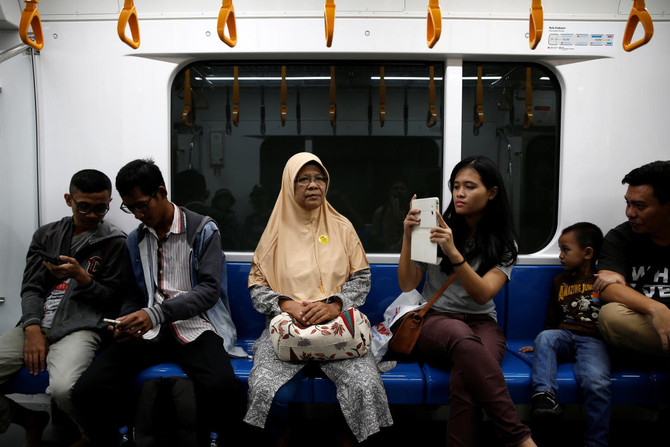
The $3 billion Mass Rapid Transit, which is officially due to open on March 26, was developed with Japanese expertise and funding. (Reuters)
2 / 2
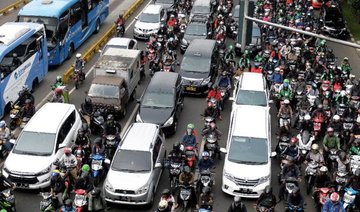
Ticket prices have been set at an initial 10,000 rupiah (70 cents) and the trains can carry more than 28,000 passengers a day. (Reuters)
Updated 12 March 2019
Follow

Indonesians get first chance to ride subway in traffic-clogged capital

  • The MRT, which is officially due to open on March 26, was developed with Japanese expertise and funding
  • But some passengers complained that facilities in some stations and feeder lines had not been finished

JAKARTA: Indonesia’s capital, Jakarta, held on Tuesday the first public trial run of its $3 billion mass rapid transit (MRT) system aimed at improving transport conditions in a city suffering some of the worst traffic jams in the world.
The MRT, which is officially due to open on March 26, was developed with Japanese expertise and funding, and is a center-piece of an infrastructure boom under President Joko Widodo, who is seeking re-election in April.
Dozens of excited residents, many of them students, rode in the shiny, air-conditioned carriages, tested the ticketing machines, and wandered through the stations.
“I’m impressed that it’s like any foreign country, like Singapore!” said Mika, a 23-year-old student, who registered weeks ago for the trial run.
But some passengers complained that facilities in some stations and feeder lines had not been finished.
“Some of the supporting infrastructure ... for pedestrians and passengers is very incomplete,” said Irfan, 40, who had brought his son along for the subway ride.
Construction workers in hard hats were racing to finish up walkways and other facilities in some stations.
The first phase is a 16-km stretch that runs partially underground from south to central Jakarta along one of the city’s main thoroughfares. The train takes about 30 minutes, compared with more than an hour by car in regular traffic.
Construction of the second line — an 8-km stretch that ends in north Jakarta — is underway and it should be operational by 2025.
Ticket prices have been set at an initial 10,000 rupiah (70 cents) and the trains can carry more than 28,000 passengers a day.
Delayed for more than 20 years, the project was finally launched in 2013, with the first line originally scheduled to open in 2018.
As well as its awful traffic jams, Jakarta regularly suffers from floods and earthquakes and the MRT was built to withstand such disasters, said Silvia Halim, construction director of PT MRT, the Indonesian-Japanese consortium that is developing the network.
“We have used the reference of standards from Japan,” Halim said. “The structure of the tunnel and the viaduct can hold up against a magnitude of 8 or equivalent.”
Flood barriers have been installed to protect the underground stations from inundation, she said.


Israeli firm loses British Army contract bid

Updated 9 sec ago
Follow

Israeli firm loses British Army contract bid

  • Subsidiary Elbit Systems UK’s campaign for $2.6bn program was marred by controversy
  • Senior govt civil servant overseeing contract was dined, handed free Israel tour

LONDON: A UK subsidiary of Israeli weapons giant Elbit Systems has lost its bid to win a prominent British Army contract, The Times reported.

The loss followed high-profile reporting on controversy surrounding Elbit Systems UK’s handling of the bid.

The subsidiary led one of two major arms consortiums attempting to secure the $2.6 billion bid to prepare British soldiers for war and overhaul army standards.

Rivaling Elbit, the other consortium led by Raytheon UK, a British subsidiary of the US defense giant, ultimately won the contract, a Ministry of Defence insider told The Times.

It had been decided following an intricate process that Raytheon was a “better candidate,” the source said.

Elbit Systems UK’s controversial handling of its contract campaign was revealed in reports by The Times.

A whistleblower had compiled a dossier surrounding the bid that was shown to the MoD last August, though the report was privately revealed to the ministry months earlier.

It alleged that Elbit UK had breached business appointment rules when Philip Kimber, a former British Army brigadier, had reportedly shared information with the firm after leaving the military.

Kimber attending critical meetings at the firm to discuss the training contract that he had once overseen at the ministry, the report alleged.

In one case, Kimber was present in an Elbit meeting and sitting out of view of a camera. He reportedly said he “should not be there,” according to the whistleblower’s report.

In response to a freedom of information request, the MoD later admitted that it had held the dossier for seven months without investigating its claims. Insiders at the ministry blamed the investigative delay on “administrative oversight.”

A month after being pushed on the allegations by The Times, a senior civil servant completed an “assurance review” in September and found that business appointment rules had not been breached.

Other allegations concerned lunches and dinners hosted by Elbit UK in which civil servants at the heart of the contract decision process were invited.

One senior civil servant was dined by the British subsidiary seven times, while rival Raytheon did not host events.

Mike Cooper, the senior responsible owner at army headquarters for the army training program, also traveled to Jerusalem with two senior British military officers.

He took part in a sightseeing tour funded by Elbit Systems, the British subsidiary’s parent company.

In response to the allegations, an MoD spokesperson said in a statement: “The collective training transformation programme will modernise training for soldiers to ensure the British Army can face down the threats of the future.

“We will not comment further until a preferred tenderer announcement is made public in due course.”

Amid mounting criticism of Israel within the British military establishment, four former senior army officers, in a letter to Prime Minister Keir Starmer, recently urged the government to end involvement with Israeli-owned or Israeli-supported weapons companies.

“Now is not the time to return to business as usual with the Israeli government,” they wrote, urging harsher sanctions.