

ANKARA: The US plans to demand that allies hosting American troops cover the full cost of their deployment and pay an additional amount, Bloomberg reported on Friday.
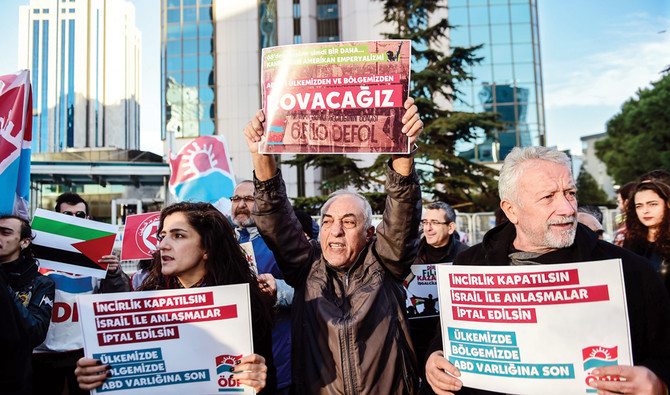
The idea, which US President Donald Trump has floated for months, has raised concerns in fellow NATO member Turkey, where American troops are stationed in the Incirlik air base, 250 miles southeast of Ankara.
Analysts say the plan may cause a further deterioration in US-Turkish relations, and may trigger a debate in Turkey about whether the presence of American troops is desirable.
In a separate move, the Pentagon recently warned Turkey that it could be banned from buying the US F-35 and Patriot defense systems if it goes through with plans to buy Russia’s S-400 air defense system.
Ziya Meral, senior resident fellow at the British Army’s Center for Historical Analysis and Conflict Research, said Turkey’s Incirlik is used by the US for its own purposes, not to defend Turkey.
If Washington implements its plan regarding deployment costs, “it would add fuel to the fire of voices in Turkey asking Ankara to put an end to the US presence in Incirlik,” Meral told Arab News.
Combined with the crisis over the S-400s, and strained US-Turkish relations, he said it may trigger a strategic rift that would be the final nail in the coffin of bilateral ties.
“This would not only harm US military operations and reach in the region … but would also be a major win for Russia and a blow to NATO’s integrity,” he added.
Incirlik has been in use since December 1954, when Turkey and the US signed a joint-use agreement. It was also used by coalition forces during the first Gulf War for combat missions over Iraq.
The base is currently home to the 39th Air Base Wing of the US Air Force, and holds B61-type hydrogen bombs.
In 2015, Turkey authorized the use of the strategically important base as a launching pad for aerial operations by the US-led anti-Daesh coalition in Syria. The base is believed to host about 2,000 American service members.
Calls to close it, especially by Turkish nationalists, have increased recently as relations between Ankara and Washington have deteriorated.
Ankara has warned several times that it would consider denying the US access to the base, which has also been used as leverage against Germany.
After Turkey refused to permit German MPs to visit the base, Berlin decided to relocate its military planes from Incirlik to Jordan in 2017.
Prof. Serhat Guvenc, from Istanbul’s Kadir Has University, said Jordan’s Al-Asrak air base has always been seen by the US as an alternative to Incirlik.
“It wouldn’t provide similar advantages like the Incirlik air base, but the US may renounce its presence in Turkey considering the increased political burdens,” he told Arab News.
Asking Turkey for a premium for the presence of US troops on its soil is a non-starter, he said.
“In that case, Ankara may either request that the US leave its soil completely, or decrease its military presence to a minimum,” he added.
But Oubai Shahbandar, a defense analyst and fellow at the New America think tank’s International Security Program, said US military cooperation with Turkey in Syria will be as crucial ever with Daesh’s defeat.
“Iran-backed militias in Iraq want to close down the US Al-Asad air base in the Iraqi desert, which could make Incirlik as important as ever to support kinetic strikes against Daesh terror remnants,” he told Arab News. A satisfactory deal will eventually be reached between Washington and Ankara, he said.


