In Gaza, women walk thin line between hope and despair

1 / 6
Palestinian high school student Wessal Abu Amra, 17, takes a selfie with a person wearing a costume at a public park in Gaza City, February 14, 2019. Abu Amra loves to go around Gaza with her friends, shopping and eating fast food. “We have things that look like famous brands but they are not the same,” she said. “Despite wars and the bad economy, we are trying to find some joy. We know the reality we live in so we do things we love to get out of a bad mood.” (Reuters/Samar Abo Elouf)
2 / 6
Palestinian midwife Sara Abu Taqea (L), 23, who works in the maternity ward at Gaza’s Al-Ahli hospital, speaks with her colleague at the hospital in Gaza City, February 10, 2019. Abu Taqea said she found temporary work in a Gaza hospital after finishing a bachelor’s degree in midwifery, but that many of her colleagues were not so lucky. “It is a six-month contract, with no guarantee of further employment,” she said. (Reuters/Samar Abo Elouf)
3 / 6
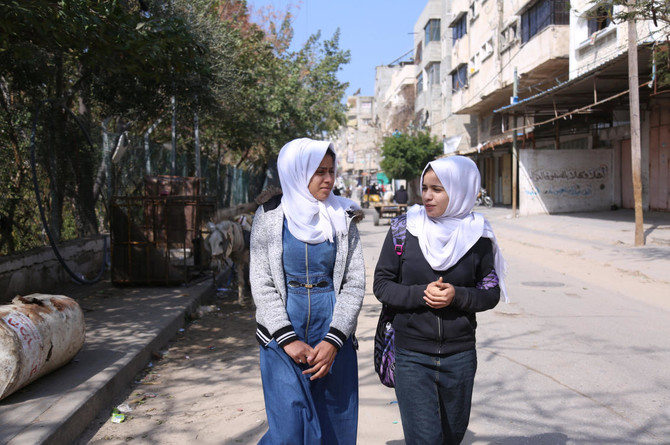
Palestinian high school student Wessal Abu Amra (R), 17, walks home from school with her colleague, in Gaza City, February 14, 2019. Abu Amra loves to go around Gaza with her friends, shopping and eating fast food. “We have things that look like famous brands but they are not the same,” she said. “Despite wars and the bad economy, we are trying to find some joy. We know the reality we live in so we do things we love to get out of a bad mood.” (Reuters/Samar Abo Elouf)
4 / 6
Palestinian Suad Dawood, 24, rides a horse on a beach in Gaza City, February 16, 2019. Dawood holds a diploma as a medical secretary, but has failed to secure a job for four years. “There are no jobs in Gaza. Whenever I get fed up, I go with my friends to sit on the beach or visit areas with greenery,” she said. (Reuters/Samar Abo Elouf)
5 / 6
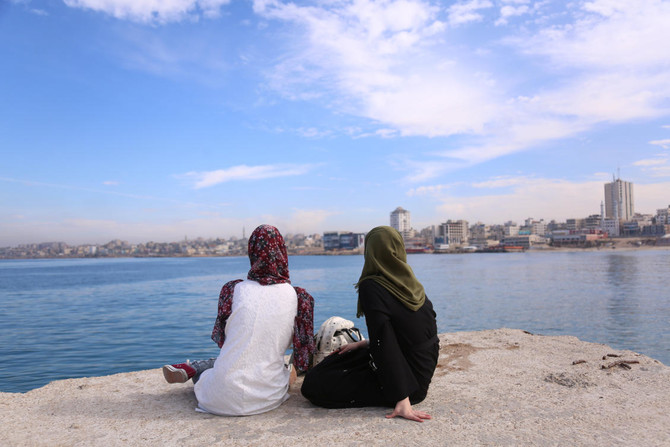
Palestinian Sara Abu Taqea (R), 23, who works in the maternity ward at Gaza’s Al-Ahli hospital, and her friend spend time at the seaport in Gaza City, November 27, 2018. Abu Taqea said she found temporary work in a Gaza hospital after finishing a bachelor’s degree in midwifery, but that many of her colleagues were not so lucky. “It is a six-month contract, with no guarantee of further employment,” she said. (Reuters/Samar Abo Elouf)
6 / 6
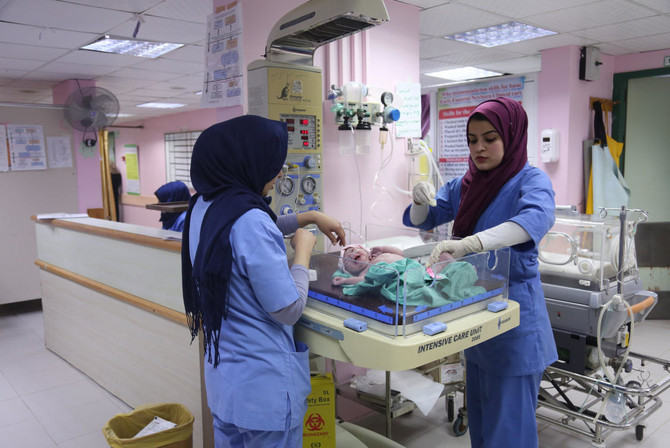
Palestinian midwife Sara Abu Taqea (R), 23, who works in the maternity ward at Gaza’s Al-Ahli hospital, weighs a newborn at the hospital in Gaza City, February 10, 2019. Abu Taqea said she found temporary work in a Gaza hospital after finishing a bachelor’s degree in midwifery, but that many of her colleagues were not so lucky. “It is a six-month contract, with no guarantee of further employment,” she said. (Reuters/Samar Abo Elouf)
Updated 08 March 2019
Follow

In Gaza, women walk thin line between hope and despair

  • Other Gaza women say community pressures weigh on them as they seek to bypass Gaza’s economic struggles by working jobs which some see as non-traditional
  • Those restrictions have devastated Gaza’s economy and left many of its women struggling to find work after graduating from college

GAZA: Amid the poverty and deprivation of the Gaza Strip, Palestinian women struggle to find a taste of normality that is taken for granted in much of the rest of the world.
Nada Rudwan used to work in digital marketing, but as her work slowed — unemployment in Gaza stands at nearly 50 percent — she decided to put her tech skills toward one of her passions: cooking.
“It was difficult to find a job, so I thought of doing something I like and that will make me money at the same time,” said Rudwan, 27, who posts cooking tutorials to social media platforms under the name “Nada Kitchen.”
Rudwan said she earns income from YouTube proceeds and that several companies in Saudi Arabia recently purchased her videos.
“It is an attempt to beat the physical blockade of Gaza by finding a job that just needs some talent, a camera and Internet connection,” she said.
More than 2 million Palestinians — mostly descendants of people who were driven out or fled from territory that is now Israel at its founding in 1948 — are packed into the narrow Gaza Strip, which shares borders with Israel and Egypt.
Israel maintains tight control of Gaza’s land and sea borders, citing security concerns emanating from Hamas, the Islamist group which controls the coastal territory. Egypt also restricts movement in and out of Gaza on its border.
Those restrictions have devastated Gaza’s economy and left many of its women, like Rudwan’s younger sister, struggling to find work after graduating from college.
“It is hard to find a job that will allow you take care of your needs,” said Lama Rudwan, 22, a media and communications graduate who joined her sister’s cooking project after an unsuccessful job search.
Disapproving community
Some young women in Gaza speak of struggles in their personal lives, as well. They say shopping and even getting married is made more difficult by the restrictions of Israel, which has fought three wars with Hamas over the past decade.
Hana Abu El-Roos, 18, said she plans to get married this summer but can’t find items she needs for her wedding in any of Gaza’s shops. “I haven’t picked my wedding dress yet,” said El-Roos, who is also busy preparing for her final high school exams. “I am confused. My sisters are helping me.”
Other Gaza women say community pressures weigh on them as they seek to bypass Gaza’s economic struggles by working jobs which some see as non-traditional.
Sahar Yaghi took up work as a wedding planner soon after dropping out of university to earn income for her family.
Yaghi’s party-planning requires her to stay up late at night. She said she sometimes hears some of her neighbors, who view her work as inappropriate, making comments about her.
“I hate some comments. But I love my job and hope to have my own business,” Yaghi, 28, said, adding she wants to become the “first female party planner” in Gaza.
For those Gaza women who do have work, the constant fear of losing their job heightens their sense of insecurity.
Sara Abu Taqea said she found temporary work in a Gaza hospital after finishing a bachelor’s degree in midwifery, but that many of her colleagues were not so lucky.
“It is a six-month contract, with no guarantee of further employment,” said Abu Taqea, 23, who works in the maternity ward at Gaza’s Al-Ahli hospital.
Abu Taqea said she finds a sense of solace in the Mediterranean Sea, whose waves crash along Gaza’s coast.
“We are lucky to have the sea. The beach is a place for relief, and for meditation, so we can forget about the wars and poverty,” Abu Taqea said.


Lebanon approves financial gap draft law despite opposition from Hezbollah and Lebanese Forces

Lebanon's Prime Minister Nawaf Salam speaking during a press conference after a cabinet session in Beirut on December 26, 2025.
Updated 21 min 28 sec ago
Follow

Lebanon approves financial gap draft law despite opposition from Hezbollah and Lebanese Forces

  • Legislation aims to address the fate of billions of dollars in deposits that have been inaccessible to Lebanese citizens during the country’s financial meltdown

BEIRUT: Lebanon’s Cabinet on Friday approved a controversial draft law to regulate financial recovery and return frozen bank deposits to citizens. The move is seen as a key step in long-delayed economic reforms demanded by the International Monetary Fund.

The decision, which passed with 13 ministers voting in favor and nine against, came after marathon discussions over the so-called “financial gap” or deposit recovery bill, stalled for years since the banking crisis erupted in 2019. The ministers of culture and foreign affairs were absent from the session.

The legislation aims to address the fate of billions of dollars in deposits that have been inaccessible to Lebanese citizens during the country’s financial meltdown.

The vote was opposed by three ministers from the Lebanese Forces Party, three ministers from Hezbollah and the Amal Movement, as well as the minister of youth and sports, Nora Bayrakdarian, the minister of communications, Charles Al-Hajj, and the minister of justice, Adel Nassar.

Finance Minister Yassin Jaber broke ranks with his Hezbollah and Amal allies, voting in favor of the bill. He described his decision as being in line with “Lebanon’s supreme financial interest and its obligations to the IMF and the international community.”

The draft law triggered fierce backlash from depositors who reject any suggestion they shoulder responsibility for the financial collapse. It has also drawn strong criticism from the Association of Banks and parliamentary blocs, fueling fears the law will face intense political wrangling in Parliament ahead of elections scheduled in six months.

Prime Minister Nawaf Salam confirmed the Cabinet had approved the bill and referred it to Parliament for debate and amendments before final ratification. Addressing public concerns, he emphasized that the law includes provisions for forensic auditing and accountability.

“Depositors with accounts under $100,000 will be repaid in full with interest and without any deductions,” Salam said. “Large depositors will also receive their first $100,000 in full, and the remainder will be issued as negotiable bonds backed by the assets of the Central Bank, valued at around $50 billion.”

He said further that bondholders will receive an initial 2 percent payout after the first tranche of repayments is completed.

The law also includes a clause requiring criminal accountability. “Anyone who smuggled funds abroad or benefited from unjustified profits will be fined 30 percent,” Salam said.

He emphasized that Lebanon’s gold reserves will remain untouched. “A clear provision reaffirms the 1986 law barring the sale or mortgaging of gold without parliamentary approval,” he said, dismissing speculation about using the reserves to cover financial losses.

Salam admitted that the law was not perfect but called it “a fair step toward restoring rights.”

“The banking sector’s credibility has been severely damaged. This law aims to revive it by valuing assets, recapitalizing banks, and ending Lebanon’s dangerous reliance on a cash economy,” he said. “Each day of delay further erodes people’s rights.”

While the Association of Banks did not release an immediate response after the vote, it previously argued during discussions that the law would destroy remaining deposits. Bank representatives said lenders would struggle to secure more than $20 billion to cover the initial repayment tier and accused the state of absolving itself of responsibility while effectively granting amnesty for decades of financial mismanagement and corruption.

The law’s fate now rests with Parliament, where political competition ahead of the 2025 elections could complicate or delay its passage.

Lebanon’s banking sector has been at the heart of the country’s economic collapse, with informal capital controls locking depositors out of their savings and trust in state institutions plunging. International donors, including the IMF, have made reforms to the sector a key condition for any financial assistance.