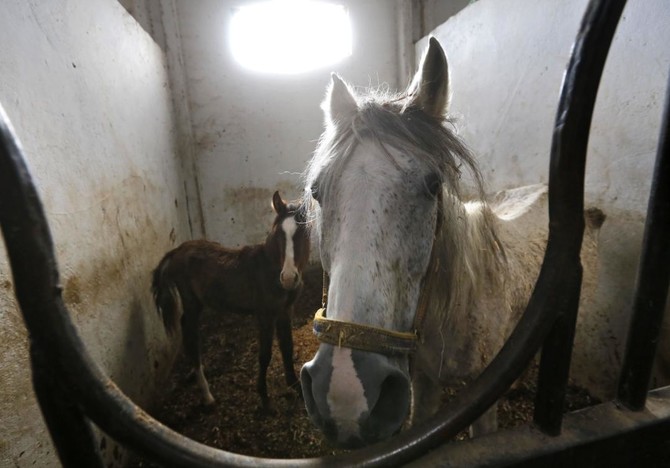
DAMASCUS: A shadow of her former self after years of war, 11-year-old Arabian mare Karen stands quietly as a Syrian vet gently pushes a syringe into her pale grey neck.
“Karen used to be the beauty queen of all horses,” says the vet, Ahmad Sharida.
But inside her stable near Damascus today, her hips jut out viciously from her overgrown speckled coat.
Weak and withdrawn, Karen is unable to even whinny.
After almost eight years of war, she is one of dozens of Arabian horses from all over Syria recovering from the physical and psychological trauma of the fighting.
Prized for their beauty, endurance and speed, Arabian purebreds are one of the oldest horse breeds in the world.
In Syria, Bedouins have bred them in the north of the country for centuries, seeking to maintain the purity of the local bloodlines.
Before the conflict, Sharida had proudly watched Karen grow from a long-legged foal into a graceful equine beauty.
“I know her very well. I was the one who brought her out of her mother’s belly,” says the vet, a stethoscope hanging around his neck.
But he lost sight of Karen after she was stolen from her stable in Eastern Ghouta in 2012, the same year rebels overran the region northeast of Damascus.
The area suffered five years of regime bombardment, as well as food and medicine shortages under a crippling siege, before Russia-backed government forces took it back last year.
Sharida had long fled his home region but returned to search for missing Arabian horses and immediately recognized Karen when he found her in October.
“I was so shocked,” says the 51-year-old vet.
“She was all skin and bones, and could barely stand up.”
Like all other horses he found, she was frail and sick after years of being surrounded by fighting, not enough food, and no medical attention.
Syria’s war has killed more than 360,000 people and displaced millions since it started in 2011 with the brutal repression of anti-government protests.
And it has taken a toll on the country’s equine population too.
“Horses have greatly suffered, just like us all,” says Mohammed Ghaith Al-Shaib, head of the state’s Arabian Horse Office.
“They’ve also been displaced, kidnapped and killed.”
Of the 8,500 horses that Syria registered with the World Arabian Horse Organization (WAHO) in 2011, it has lost 3,000 in the war, he says.
But the conflict in Syria has turned around in recent years, and after a series of victories against rebels and jihadists, President Bashar Assad’s regime is now in control of almost two-thirds of the country.
Having returned to one region after another, the Damascus authorities are now trying to protect the country’s Arabian purebreds.
Since 2014, WAHO has recognized 2,400 new Syrian foals as Arabian, after samples from their manes were sent off for DNA testing in Germany, Shaib says.
Horses rescued from retaken areas are being looked after at a state-run stables west of the capital, Damascus.
At the stables in Dimas, staff are paying special attention to Karen’s recovery.
She hails from the Hadbaa strain of Arabian purebreds, so called after their long eyelashes and mane.
But after years of war, she is the only known female survivor of a rare Syrian branch of that family.
“The Hadbaa Enzahi Fawaeira were already at risk of dying out before the war,” says Shaib.
But “today, it’s only Karen.”
Arabian mares are often seen as more precious than their male counterparts, as they carry the bloodline from one generation to the next.
Once Karen has regained her health, her carers hope to artificially inseminate her so that she can give birth to a daughter.
To maintain her bloodline, a Syrian purebred should father that female foal — but he does not need to come from the same strain.
Karen is just one of many Arabian horses all over Syria recovering from conflict.
In the adjacent hippodrome, trainer Jihad Ghazal watches a student trot around the red-earth arena on a horse with a shiny brown coat.
Nejm — “star” in Arabic — spent the war in Damascus, a city which has remained relatively sheltered from the conflict.
But the mare was one of the luckier ones, says Ghazal, who is full of anecdotes about the suffering of her kind.
“Horses are very sensitive, and the sounds they hear greatly affect them,” says the 40 year-old, wearing jeans and trainers.
During the war, an alleged Israeli strike hit Dimas, traumatising pregnant mares, for example.
“For a year afterwards, foals were born paralyzed or dead because their mother had been so terrified,” he says.
In 2016, a horse was so shocked by a blast that, within hours, he had killed himself.
“He banged his head against metal until he died.”


War horses: Syria’s Arabian beauties plod way to recovery


War horses: Syria’s Arabian beauties plod way to recovery
- After almost eight years of war, Karen is one of dozens of Arabian horses from all over Syria recovering from the physical and psychological trauma of the fighting

Trump says ‘hopefully’ no need for military action against Iran
- US president said he is speaking with Iran and left open the possibility of avoiding a military operation
- An Iranian military spokesman warned Tehran’s response to any US action would not be limited
PARIS: US President Donald Trump said on Thursday he hoped to avoid military action against Iran, which has threatened to strike American bases and aircraft carriers in response to any attack.
Trump said he is speaking with Iran and left open the possibility of avoiding a military operation after earlier warning time was “running out” for Tehran as the United States sends a large naval fleet to the region.
When asked if he would have talks with Iran, Trump told reporters: “I have had and I am planning on it.”
“We have a group headed out to a place called Iran, and hopefully we won’t have to use it,” the US president added, while speaking to media at the premiere of a documentary about his wife Melania.
As Brussels and Washington dialed up their rhetoric and Iran issued stark threats this week, UN chief Antonio Guterres has called for nuclear negotiations to “avoid a crisis that could have devastating consequences in the region.”
An Iranian military spokesman warned Tehran’s response to any US action would not be limited — as it was in June last year when American planes and missiles briefly joined Israel’s short air war against Iran — but would be a decisive response “delivered instantly.”
Brig. Gen. Mohammad Akraminia told state television US aircraft carriers have “serious vulnerabilities” and that numerous American bases in the Gulf region are “within the range of our medium-range missiles.”
“If such a miscalculation is made by the Americans, it will certainly not unfold the way Trump imagines — carrying out a quick operation and then, two hours later, tweeting that the operation is over,” he said.
An official in the Gulf, where states host US military sites, said that fears of a US strike on Iran are “very clear.”
“It would bring the region into chaos, it would hurt the economy not just in the region but in the US and cause oil and gas prices to skyrocket,” the official added.
‘Protests crushed in blood’
Qatar’s leader Sheikh Tamim bin Hamad Al-Thani and Iran’s President Masoud Pezeshkian held a call to discuss “efforts being made to de-escalate tensions and establish stability,” the Qatar News Agency (QNA) reported.
The European Union, meanwhile, piled on the pressure by designating the Islamic Revolutionary Guard Corps (IRGC) a “terrorist organization” over a deadly crackdown on recent mass protests.
“’Terrorist’ is indeed how you call a regime that crushes its own people’s protests in blood,” said EU chief Ursula von der Leyen, welcoming the “overdue” decision.
Though largely symbolic, the EU decision has already drawn a warning from Tehran.
Iran’s military slammed “the illogical, irresponsible and spite-driven action of the European Union,” alleging the bloc was acting out of “obedience” to Tehran’s arch-foes the United States and Israel.
Iranian officials have blamed the recent protest wave on the two countries, claiming their agents spurred “riots” and a “terrorist operation” that hijacked peaceful rallies sparked over economic grievances.
Rights groups have said thousands of people were killed during the protests by security forces, including the IRGC — the ideological arm of Tehran’s military.
In Tehran on Thursday, citizens expressed grim resignation.
“I think the war is inevitable and a change must happen. It can be for worse, or better. I am not sure,” said a 29-year-old waitress, speaking on condition of anonymity for fear of reprisals.
“I am not in favor of war. I just want something to happen that would result in something better.”
Another 29-year-old woman, an unemployed resident of an upscale neighborhood in northern Tehran, said: “I believe that life has highs and lows and we are now at the lowest point.”
Trump had threatened military action if protesters were killed in the anti-government demonstrations that erupted in late December and peaked on January 8 and 9.
But his more recent statements have turned to Iran’s nuclear program, which the West believes is aimed at making an atomic bomb.
On Wednesday, he said “time is running out” for Tehran to make a deal, warning the US naval strike group that arrived in Middle East waters on Monday was “ready, willing and able” to hit Iran.
Conflicting tolls
The US-based Human Rights Activists News Agency (HRANA) said it has confirmed 6,479 people were killed in the protests, as Internet restrictions imposed on January 8 continue to slow verification.
But rights groups warn the toll is likely far higher, with estimates in the tens of thousands.
Iranian authorities acknowledge that thousands were killed during the protests, giving a toll of more than 3,000 deaths, but say the majority were members of the security forces or bystanders killed by “rioters.”
Billboards and banners have gone up in the capital Tehran to bolster the authorities’ messages. One massive poster appears to show an American aircraft carrier being destroyed.


