

‘Hope my next film Heer Maan Ja premiers in Riyadh’

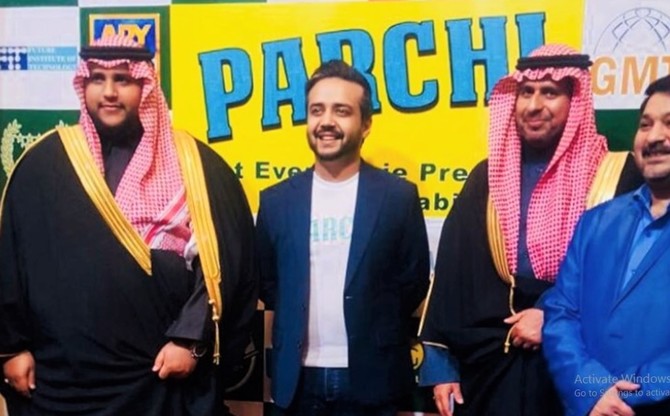
Imran Raza Kazmi pictured at the premiere of 'Parchi' in Riyadh alongside Prince Abdul Aziz (Social Media)
Updated 18 February 2019
Follow

‘Hope my next film Heer Maan Ja premiers in Riyadh’

  • Pakistani director speaks to Arab News one year after Parchi premier in Saudi Arabia
  • Parachi producer Kazmi teams up with Saudi company to distribute Pakistani movies

ISLAMABAD: Pakistani film director Azfar Jafri said he hoped his next film, Heer Maan Ja, would premier in Saudi Arabia to packed crowds just as his last film Parchi had exactly one year ago.

In January 2018, Parchi became the first Pakistani film ever to release in Saudi Arabia and one of the first international films to release in the Kingdom after it ended a nearly 40-year ban on cinemas under a push by the crown prince to modernize the deeply conservative Muslim kingdom.

“I hope that my fourth film Heer Maan Ja has a premiere in Riyadh as its predecessor Parchi did and I hope the response is bigger than it was before,” Jafri told Arab News.

Last year’s cinema opening and film premiers in Saudi Arabia mark another milestone for reforms spearheaded by Crown Prince Mohammed bin Salman to open the country culturally, including by easing restrictions on public concerts, women driving and gender mixing. The kingdom also held its first-ever fashion show last year with a women-only audience.

“To say it was the best experience is an understatement,” said Parchi producer and CEO of IRK films Imran Raza Kazmi, describing the film premier in Riyadh. “I was completely overwhelmed with the amazing response we received. We weren’t expecting a crowd of that intensity to come. They had to increase the number of shows and seats because of the overwhelming response.”

He said the release of Parchi had paved the path for future filmmakers from Pakistan to go to the Kingdom and showcase their work. Recently, Kazmi has joined hands with a Saudi production and distribution company to distribute Pakistani movies in the Kingdom.

“We have some interesting projects lined up and we will recruit talent from there as well, so that should be interesting,” Kazmi said.

The Kingdom shutdown cinemas in the early 1980s under pressure from Islamists but its citizens have remained avid consumers of Western media and culture and Hollywood films and television series are widely watched at home and private film screenings.

In 2017, the government said it would lift the ban and set up around 350 cinemas with over 2,500 screens by 2030, which it hopes will attract nearly $1 billion in annual ticket sales.

“It is matter of pride to be the torch bearer of sharing entertainment, culture and our unique voice with audience in the Kingdom of Saudi Arabia,” Jafri said.

The Parchi premiere at the Pakistani embassy in Riyadh was attended by senior officials including Prince Abdul Aziz Bin Matab Bin Thenayan Bin Mohamed Al Saud.

“We had a great discussion on the Pakistani film and drama industry and it was great to know that he was a big fan of Pakistani dramas and movies,” Jafri said.

“Pakistani talent must spread out and work in other countries as well,” Jafri said. “I believe it’s a good time for the Pakistani film industry and who knows one day we would have Saudi Arabia holding film festivals for all Muslim countries! Wouldn’t that be great?”


Pakistan vaccinates over 44.6 million in final anti-polio drive of 2025

Updated 5 sec ago
Follow

Pakistan vaccinates over 44.6 million in final anti-polio drive of 2025

  • Pakistan has reported 30 polio cases so far this year, underscoring fragile progress against virus
  • Pakistan and Afghanistan are the only two countries in the world where polio remains endemic

ISLAMABAD: Pakistan has vaccinated 44.6 million children against poliovirus in the last nationwide immunization campaign of the year, health authorities said on Monday.

The seven-day anti-polio campaign was launched on Dec. 15, targeting children under the age of five. It was conducted simultaneously in Pakistan and Afghanistan, according to Pakistan’s National Emergency Operations Center (NEOC), which oversees eradication efforts.

Pakistan and neighboring Afghanistan are the only two countries where transmission of the wild poliovirus has never been interrupted, posing a risk to global eradication efforts. The virus, which can cause irreversible paralysis, has no cure and can only be prevented through repeated oral vaccination.

“The final National Polio Eradication Campaign of 2025 has been successfully concluded,” the EOC said in a statement. “During the national polio campaign, vaccination of more than 44.6 million children was successfully completed.”

Giving a breakdown of the numbers, the EOC said approximately 22.9 million children have received polio drops in Pakistan’s eastern Punjab province, around 10.6 million in Sindh, more than 7.1 million in the northwestern Khyber Pakhtunkhwa (KP) province and more than 2.54 million children in Balochistan. 

In Pakistan’s capital Islamabad, over 450,000 children received polio drops while in the northern Gilgit-Baltistan region, approximately 274,000 children have been vaccinated, the NEOC said. 

In Azad Jammu & Kashmir, over 714,000 children received polio drops.

Pakistan has reported 30 polio cases so far in 2025, underscoring the fragility of progress against the virus. The country recorded 74 cases in 2024, a sharp increase from six cases in 2023, reflecting setbacks linked to vaccine hesitancy, misinformation and access challenges in high-risk areas.

Health officials say insecurity remains a major obstacle. Polio workers and their security escorts have repeatedly been targeted in militant attacks, particularly in parts of Khyber Pakhtunkhwa and Balochistan, complicating efforts to reach every child.

A gun attack targeting a polio vaccination team in Pakistan’s northwestern Bajaur district on Dec. 16 left one police constableand a civilian dead. 

Natural disasters, including flooding, have also disrupted vaccination campaigns in recent years.

“Polio workers and security personnel who served during the national campaign are the true heroes of the nation,” the EOC said.