

Jordan to host new talks on Yemen prisoner swap

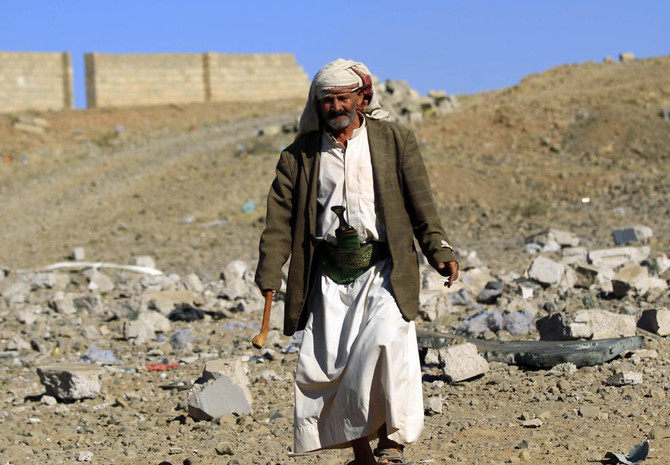
A Yemeni man walks above debris of a building destroyed in Saudi-led air strikes in Yemen's capital Sanaa on February 1, 2019. (AFP)
Updated 04 February 2019
Follow

Jordan to host new talks on Yemen prisoner swap

  • The swap, which could involve up to 15,000 detainees from each side, was agreed in principle as a confidence-building measure ahead of peace talks in Sweden in December

AMMAN: Yemeni government delegates and Houthi militia leaders will reconvene in Jordan from Tuesday for a new round of talks to thrash out a deal on a prisoner exchange, the UN said.

The swap, which could involve up to 15,000 detainees from each side, was agreed in principle as a confidence-building measure ahead of peace talks in Sweden in December.

In mid-January, representatives of Yemen’s warring parties held two days of talks in Amman during which they submitted lists of prisoners they wanted to see released to UN mediators.

Those talks were also attended by representatives of the United Nations, which brokered the swap agreement, and the International Committee of the Red Cross, which will supervise its implementation.

On Wednesday government and rebel representatives would meet again in Amman for “technical” talks to “discuss the steps taken... (by both sides) to finalize the list of prisoners,” a UN statement said.

UN envoy Martin Griffiths and ICRC president Peter Maurer “are scheduled to take part in the first day” of the talks, the statement said without specifying how many days the meetings would last.

It also described the Jordan talks as “important,” and thanked the government in Amman for hosting them.

At the end of January, the Iran-linked Houthis released a Saudi soldier under the deal while the Arab coalition supporting the internationally recognized government set free seven Houthi prisoners.

That prisoner swap was the first to take place since Yemen’s warring sides agreed in Sweden a deal that involved a cease-fire in the lifeline port city of Hodeida.

For nearly four years, the Houthis have been locked in a war with the regional pro-government military coalition, which includes Saudi Arabia.

Some 10,000 people have been killed, according to the World Health Organization.


Turkey's Erdogan hails 2.6bn euro jet deal with Spain

Updated 56 min 56 sec ago
Follow

Turkey's Erdogan hails 2.6bn euro jet deal with Spain

  • Under the deal, Spain will procure Turkish-made HURJET training aircraft

ISTANBUL: President Recep Tayyip Erdogan on Saturday welcomed an agreement under which Spain will procure Turkish-made HURJET training aircraft, describing it as evidence of Turkey's "pioneering role" in defence and aviation industry.
Under the deal, signed this week, the Spanish Air Force will acquire 30 HURJET aircraft from Turkey in a contract valued at around 2.6 billion euros, according to Turkish officials.
Speaking at an event in Istanbul, Erdogan said Turkey had become a globally recognised player in the defence and aviation sectors.
"Most recently, the agreement we concluded with Spain has confirmed our country's pioneering role in this field," Erdogan said.
He added that the inclusion of HURJET in the inventory of a European Union and NATO member state would further expand Turkey's opportunities in the coming years.
On Tuesday, Haluk Gorgun, head of Turkey's defence industry agency, described the agreement as more than a simple aircraft sale.
"This is not merely a training aircraft deal," Gorgun said. "It is a comprehensive package that includes ground systems, simulation systems, maintenance and sustainment services, as well as a cooperation model."
He added that the agreement underscored the deepening of defence industry and high-technology cooperation between Turkey and Spain, noting that the aircraft configuration would be updated over time to meet Spain's specific operational requirements.
Turkey has steadily expanded its defence exports in recent years, including drones that have been sold to multiple countries.
Erdogan said Turkey's defence exports, which stood at $248 million in 2002, had increased nearly 40 fold to reach $9.8 billion in 2025.