‘Lone Ranger,’ ‘Superman’ register for Thailand’s first election since 2014 coup

1 / 3
Noppajun Woratitwuttikul, a representative of Palang Prachatipatai Party, arrives for registration with the election commission wearing a Lone Ranger costume in Bangkok. (AFP)
2 / 3
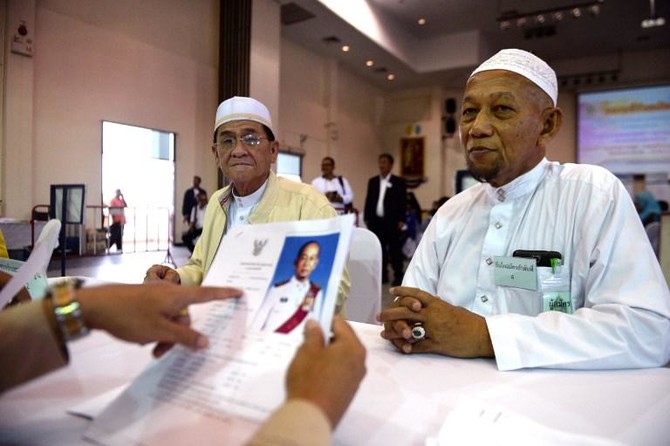
Muslim candidates for members of parliament for Narathiwat province register before the election commission on Monday, February 4. (AFP)
3 / 3
A supporter displays a placard of Action Coalition for Thailand party candidate Man Charoenwan, depicted as ‘Superman,’ during registration with the election commission in Bangkok. (AFP)
Updated 04 February 2019
Follow

‘Lone Ranger,’ ‘Superman’ register for Thailand’s first election since 2014 coup

  • Since the coup, the military has rewritten the constitution, clamped down on dissent and appointed allies across the bureaucracy
  • ‘On March 24, the Thai people must raise their voice to stop the military regime’

BANGKOK: Hundreds of aspiring politicians, including a masked costumed hero, registered on Monday for Thailand’s first election since the 2014 coup, promising a colorful cast of candidates stumping for political parties both old and new.
Since the coup, the military has rewritten the constitution, clamped down on dissent and appointed allies across the bureaucracy.
But recent days have seen echoes of Thailand’s formerly rambunctious politics, with outdoor political announcements, campaign posters and loudspeakers on vans touting political slogans as the country gears up for the much-anticipated election after more than four years of junta rule.
Monday’s registration was marked by a festive atmosphere, with supporters of dozens of groups waving neon banners and party flags as they entered a stadium in central Bangkok.
While familiar faces abound, such as leaders from political powerhouse Pheu Thai and the army-aligned Phalang Pracharat, there were also quirky entrants, including a member of an obscure new party Phalang Prachatipatai — or “Power of Democracy” — who dressed as American pop culture icon the “Lone Ranger.”
Another hopeful for the Action Coalition for Thailand party carried posters of himself dressed as Superman.
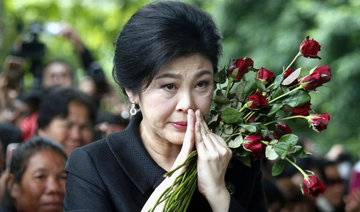
But the levity displayed by some belied an underlying resolve to restore a democratically elected government after former premier Yingluck Shinawatra was ousted by the military.
“We stand firm with our principle to stop the continuing power of the (military government),” said Thanathorn Juangroongruangkit, head of upstart party Future Forward which advocates for the military to be divorced from politics.
“On March 24, the Thai people must raise their voice to stop the military regime.”
Pheu Thai, Thailand’s biggest political party, also wants a “free and fair (election) without any interference from the government,” said party stalwart Sudarat Keyuraphan.
In the last election, the party backed ousted premier Yingluck Shinawatra, and it remains to be seen if it will be able to capitalize on previous electoral successes without the star power of Yingluck and her older brother Thaksin, who was himself pushed out in a military takeover in 2006.
Both live in self-exile to avoid what they say are politically motivated court charges.
But their names will still be on the ballot: Thaksin-aligned Pheu Chart Party currently has over a dozen registered candidates who legally changed their first names to mimic the siblings.
“Right now, there are 15 members who changed their names ... 10 men who changed to Thaksin and five women to Yingluck,” party spokeswoman Ketpreeya Kaewsanmuang said, adding the party was surprised to hear of the name changes.
“It’s their personal choice ... you can call it a gimmick as well.”
The move is likely to attract votes from hardcore Thaksin supporters in certain parts of the country, where the billionaire is still revered for the populist policies he enacted as premier, such as universal health care and debt relief for farmers.
Less than ten weeks from the election, it remains unclear if junta leader Prayut Chan-O-Cha will stand as a candidate for prime minister.
Even if the junta’s rivals are successful in the polls, any new civilian government is expected to be hamstrung by the military-scripted constitution.
Meanwhile, the pro-army Phalang Pracharat on Monday branded itself as “the best choice for Thais who want to move past conflicts,” said leader Uttama Savanayana, who recently resigned as industry minister.
Phalang Pracharat last week formally invited junta leader Prayut to stand as its candidate for prime minister.
The gruff general must formally submit his interest to the Election Commission by Friday.


Starmer arrives in China to defend ‘pragmatic’ partnership

Updated 4 sec ago
Follow

Starmer arrives in China to defend ‘pragmatic’ partnership

  • British Prime Minister Keir Starmer arrived in Beijing on Wednesday to meet with Chinese leader Xi Jinping, hoping to restore long fraught relations

BEIJING: British Prime Minister Keir Starmer arrived in Beijing on Wednesday to meet with Chinese leader Xi Jinping, hoping to restore long fraught relations.
It is the first visit to China by a UK prime minister since 2018 and follows a string of Western leaders courting Beijing in recent weeks, pivoting from a mercurial United States.
Starmer, who is also expected to visit Shanghai on Friday, will later make a brief stop in Japan to meet with Prime Minister Sanae Takaichi.
For Xi, the trip is an opportunity to show Beijing can be a reliable partner at a time when President Donald Trump’s policies have rattled historic ties between Washington and its Western allies.
Starmer is battling record low popularity polls and hopes the visit can boost Britain’s beleaguered economy.
The trip has been lauded by Downing Street as a chance to boost trade and investment ties while raising thorny issues such as national security and human rights.
Starmer will meet with Xi for lunch on Thursday, followed by a meeting with Premier Li Qiang.
The British leader said on Wednesday this visit to China was “going to be a really important trip for us,” vowing to make “some real progress.”
There are “opportunities” to deepen bilateral relations, Starmer told reporters traveling with him on the plane to China.
“It doesn’t make sense to stick our head in the ground and bury in the sand when it comes to China, it’s in our interests to engage and not compromise on national security,” he added.
China, for its part, “is willing to take this visit as an opportunity to enhance political mutual trust,” foreign ministry spokesman Guo Jiakun reiterated Wednesday during a news briefing.
Starmer is the latest Western leader to be hosted by Beijing in recent months, following visits by Canadian Prime Minister Mark Carney and French President Emmanuel Macron.
Faced with Trump’s threats to impose tariffs on Canada for signing a trade agreement with China, and the US president’s attempts to create a new international institution with his “Board of Peace,” Beijing has been affirming its support for the United Nations to visiting leaders.
Reset ties 
UK-China relations plummeted in 2020 after Beijing imposed a sweeping national security law on Hong Kong, which severely curtailed freedoms in the former British colony.
They soured further since with both powers exchanging accusations of spying.
Starmer, however, was quick to deny fresh claims of Chinese spying after the Telegraph newspaper reported Monday that China had hacked the mobile phones of senior officials in Downing Street for several years.
“There’s no evidence of that. We’ve got robust schemes, security measures in place as you’d expect,” he told reporters on Wednesday.
Since taking the helm in 2024, Starmer has been at pains to reset ties with the world’s second-largest economy and Britain’s third-biggest trade partner.
In China, he will be accompanied by around 60 business leaders from the finance, pharmaceutical, automobile and other sectors, and cultural representatives as he tries to balance attracting vital investment and appearing firm on national security concerns.
The Labour leader also spoke to Xi on the sidelines of the G20 summit in Brazil in November 2024.
Jimmy Lai
The prime minister is also expected to raise the case of Hong Kong media mogul and democracy supporter Jimmy Lai, 78, a British national facing years in prison after being found guilty of collusion charges in December.
When asked by reporters about his plans to discuss Lai’s case, Starmer avoided specifics, but said engaging with Beijing was to ensure that “issues where we disagree can be discussed.”
“You know my practice, which is to raise issues that need to be raised,” added Starmer, who has been accused by the Conservative opposition of being too soft in his approach to Beijing.
Reporters Without Borders urged Starmer in a letter to secure Lai’s release during his visit.
The British government has also faced fierce domestic opposition after it approved this month contentious plans for a new Chinese mega-embassy in London, which critics say could be used to spy on and harass dissidents.
At the end of last year, Starmer acknowledged that China posed a “national security threat” to the UK, drawing flak from Chinese officials.
The countries also disagree on key issues including China’s close ties with Russian President Vladimir Putin amid the war in Ukraine, and accusations of human rights abuses in China.