Philippine ‘jeepney’ artists stalked by extinction

1 / 4
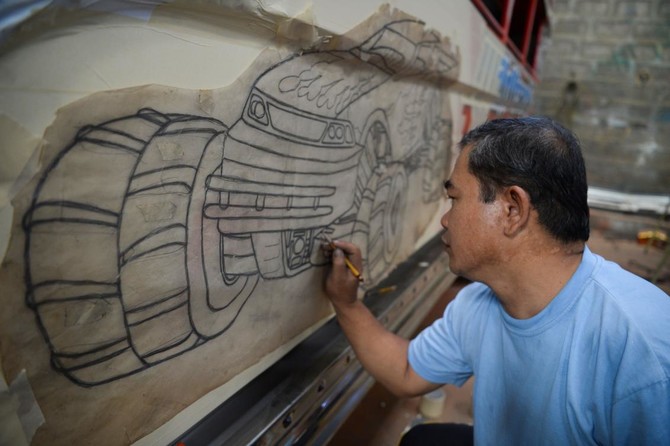
Jeepney artist Vic Capuno, based in San Pablo town south of Manila, now paint just three of four of the public transport vehicles a month after demand has fallen. (AFP)
2 / 4
Jeepney artist Vic Capuno, based in San Pablo town south of Manila, now paint just three of four of the public transport vehicles a month after demand has fallen. (AFP)
3 / 4
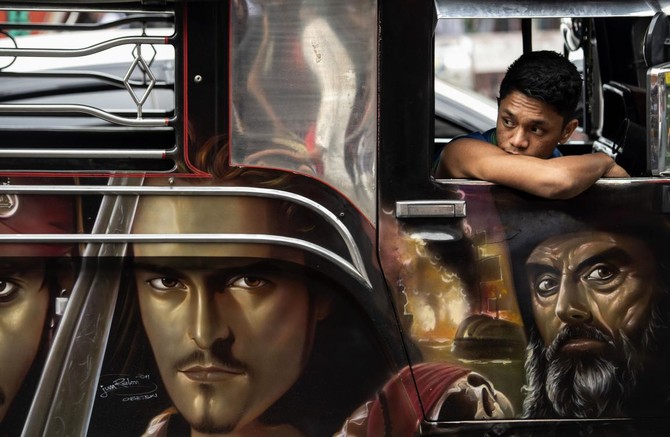
Jeepneys, hand-painted with custom images of everything from Batman to babies, as well as disco lights and chrome wheels, have for decades provided cheap transport for millions. (AFP)
4 / 4
Jeepneys, hand-painted with custom images of everything from Batman to babies, as well as disco lights and chrome wheels, have for decades provided cheap transport for millions. (AFP)
Updated 28 January 2019
Follow

Philippine ‘jeepney’ artists stalked by extinction

  • ‘This is an act of treachery against fellow Filipinos’
  • Jeepneys are highly polluting, and the Philippines is desperate to improve air quality in its traffic-clogged cities

MANILA: Bernardo de la Cruz casts his eyes around the nearly silent workshop where he used to toil overtime hand-painting custom decor on jeepneys, the singularly Philippine minibuses facing the scrapheap.
These rolling art galleries adorned with images of everything from Batman to babies, as well as disco lights and chrome wheels, have for decades provided cheap transport for millions.
But pollution and safety concerns have led to a modernization program, with jeepneys 15 years or older to be taken off the streets by 2020.
“This is an act of treachery against fellow Filipinos,” said de la Cruz. “This is a uniquely Filipino product. We were born with it.”
When he began 45 years ago, there were hundreds of artists giving the vehicles their famously boisterous paint jobs. Now there are estimated to be fewer than a dozen left.
He has seen orders decline from a high of up to 80 a month in the 1980s to just one or two now.
His canvas is being replaced by eco-jeepneys, powered by electricity or lower-polluting diesel motors.
Riders of old jeepneys currently have to climb in through a hatch in the rear, cramming into the benches inside with no respite from the heat and roadside pollution.
The jeepney’s successor is being billed as a big improvement.
It has doors, individual seats, air-conditioning, and enough height to stand up.
But it will be mass-produced and look just like a public bus.
Skipping over the jeepney’s bespoke production process in small workshops means a loss of the individual style and flair that made them global symbols of the Philippines.
“It’s one of the most genuine forms of modern folk art that we have,” Bernie Sim, a Manila-based graphic designer and co-author of a 2014 book on jeepney art, said.
French fashion designer Christian Louboutin launched a jeepney-themed handbag collection last year, while Swedish furniture giant Ikea painted a jeepney in its signature blue and yellow to announce plans to open a Philippine store.

But the vehicles, which were first made from leftover US jeeps after World War II, have been on borrowed time for years.
Jeepneys are highly polluting, and the Philippines is desperate to improve air quality in its traffic-clogged cities.
Their drivers are also notorious for ignoring traffic rules, and the vehicles have few safety features.
On top of that, Manila ushered in Internet-based ride-sharing services in 2014, and three years later President Rodrigo Duterte said the jeepney must evolve or disappear.
“They have all but stopped making jeepneys,” said 52-year-old jeepney artist Vic Capuno, based in San Pablo town south of Manila.
As a result, he and a colleague at Armak Motors now paint just three of four jeepneys a month.
De la Cruz worked on nine in the last year. He’s the only painter left at Manila’s Sarao Motors, once the country’s biggest producer.
Two of his siblings were also jeepney artists, but they died from diseases he believes were caused by years inhaling fumes from the paint.
Yet he is still passionate about the vehicle’s importance in Philippine history.
“When the jeepney disappears a piece of Filipino culture will also die,” de la Cruz warned.
A self-taught painter, he was inspired by the work of renowned local artists such Carlos Francisco and Fernando Amorsolo.
His jeepney designs, still seen on the streets for now, chronicle the rapidly changing landscape of his home — Las Pinas — from a farming and salt-making backwater into a highly urbanized area.
“It’s a pleasing sight. It brings us back to a time and place that is no more,” said de la Cruz.
After raising four children on the pay earned painting, he now also creates canvases and makes storefront signs as a sideline.
He conceded he could have a decent life without the jeepneys, but was heartbroken by the government’s decision.
“I would like to appeal to the authorities not to outlaw it,” de la Cruz said. “At times I cry quietly when I think about what is happening.”
Some Warren Buffett wisdom on his last day leading Berkshire Hathaway

Updated 31 December 2025
Follow

Some Warren Buffett wisdom on his last day leading Berkshire Hathaway

OMAHA, Nebraska: The advice that legendary investor Warren Buffett offered on investing and life over the years helped earn him legions of followers who eagerly read his annual letters and filled an arena in Omaha every year to listen to him at Berkshire Hathaway’s annual meetings.
Buffett’s last day as CEO is Wednesday after six decades of building up the Berkshire conglomerate. He’ll remain chairman, but Greg Abel will take over leadership.
Here’s a collection of some of Buffett’s most famous quotes from over the years:
___
“Be fearful when others are greedy, and greedy when others are fearful.”
That’s how Buffett summed up his investing approach of buying out-of-favor stocks and companies when they were selling for less than he estimated they were worth.
He also urged investors to stick with industries they understand that fall within their “circle of competence” and offered this classic maxim: “Rule No. 1: Never lose money. Rule No. 2: Never forget Rule No. 1.”
___
“After they first obey all rules, I then want employees to ask themselves whether they are willing to have any contemplated act appear the next day on the front page of their local paper to be read by their spouses, children and friends with the reporting done by an informed and critical reporter.
“If they follow this test, they need not fear my other message to them: Lose money for the firm and I will be understanding; lose a shred of reputation for the firm and I will be ruthless.”
That’s the ethical standard Buffett explained to a Congressional committee in 1991 that he would apply as he cleaned up the Wall Street investment firm Salomon Brothers. He has reiterated the newspaper test many times since over the years.
___
“You only find out who is swimming naked when the tide goes out.”
Many companies might do well when times are good and the economy is growing, but Buffett told investors that a crisis always reveals whether businesses are making sound decisions.
___
“Who you associate with is just enormously important. Don’t expect that you’ll make every decision right on that. But you are going to have your life progress in the general direction of the people you work with, that you admire, that become your friends.”
Buffett always told young people that they should try to hang out with people who they feel are better than them because that will help improve their lives. He said that’s especially true when choosing a spouse, which might be the most important decision in life.
___
“Our unwavering conclusion: never bet against America.”
Buffett has always remained steadfast in his belief in the American capitalist system. He wrote in 2021 that “there has been no incubator for unleashing human potential like America. Despite some severe interruptions, our country’s economic progress has been breathtaking.”