

End of the road: Philippines to phase out its beloved cheap but rickety jeepneys

1 / 2
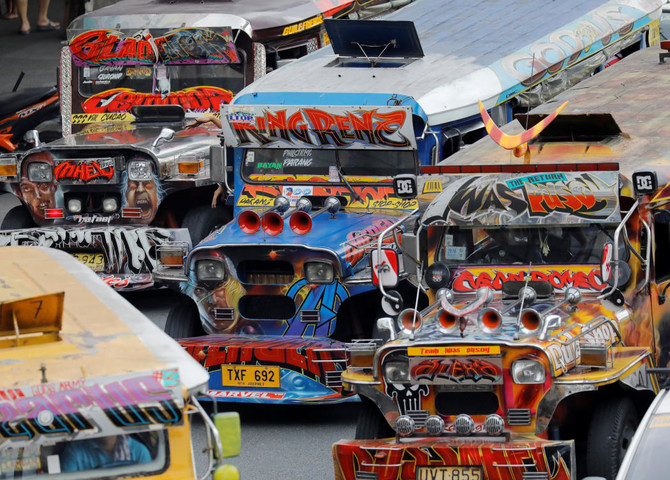
A typical jeepney packs in 10 to 16 commuters, sitting knee-to-knee on twin benches, and lacks air-conditioning or windows to shield occupants from the heat, rain and choking fumes. (Reuters)
2 / 2
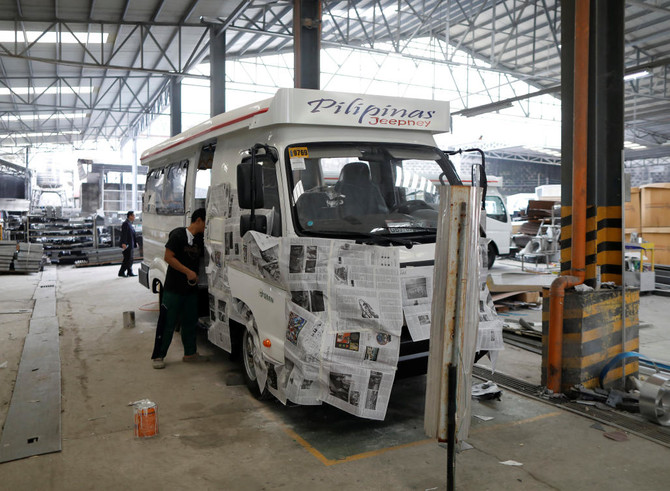
The Philippine government wants bigger, cleaner, safer and more modern replacements for the jepneeys, some electric, others using cleaner fuel. Above, a modern jeepney prototype is painted by a worker at an assembly plant in Valenzuela City. (Reuters)
Updated 29 January 2018
Follow

End of the road: Philippines to phase out its beloved cheap but rickety jeepneys

MANILA: Jeepneys, the flamboyant passenger trucks of the Philippines, are nearing the end of their reign as the “Kings of the Road,” but they’re not going down without a fight.
Government moves to overhaul outdated public transport, making it safer and more environment friendly, will put the brakes on a mode of travel that has long been the surest and cheapest option in a country of 105 million people.
But the operators and drivers of the 200,000 jeepneys that have plied the nation’s roads and highways for decades are defiant, denouncing moves to oust them as “anti-poor” and a threat to their livelihoods.
“It is a big hassle to us poor people since we are the ones suffering,” said one jeepney driver, upset after traffic police pulled him over because his vehicle was belching black smoke.
Jeepneys have evolved from surplus army jeeps left behind by the US military after World War Two to become brightly-painted vehicles festooned with religious slogans, horoscope signs or family names.
At a cost of 8 pesos ($0.59) for a journey of 4 kilometers in Manila, the capital, they are easily affordable, but the ride is far from comfortable.
A typical jeepney packs in 10 to 16 commuters, sitting knee-to-knee on twin benches, and lacks air-conditioning or windows to shield occupants from the heat, rain and choking fumes.
In Metro Manila, one of Asia’s most gridlocked mega-cities, passengers can sit there for hours.
There are no seatbelts and commuters have only ceiling bars to keep from being thrown off their seats as drivers race to beat traffic lights or edge out competitors for waiting passengers.
The government wants to force unsound and shabby jeepneys off the streets in favor of bigger, cleaner, safer and more modern replacements, some electric, others using cleaner fuel.
But drivers complain that the newer units, priced around 1.8 million pesos, are prohibitively expensive, and government subsidies are paltry.
Some fear vested interests are at play.
“They only want to kick out the operators so they could let corporations take over,” said George San Mateo, head of transport group PISTON, as he led a protest last week outside the transport regulator’s office.
“The government is using this crackdown on dilapidated and smoke-belching jeepneys to force poor operators to buy new ones they cannot afford.”
Regulators have said the plan, backed by President Rodrigo Duterte, aims simply to modernize public transport.
“There’s a lot of public utility jeepneys which are old and dirty, so we have to address it,” Martin Delgra, chairman of the Land Transportation Franchising and Regulatory Board, told reporters.
“We cannot compromise safety when it comes to roadworthiness.”

Related

Healthier ‘King of the Road’ Makes Debut in Manila

Author: 
Julie Javellana-Santos, Arab News
Publication Date: 
Thu, 2007-07-05 03:00

MANILA, 5 July 2007 — If tests go well, the Philippines’ “king of the road” known as “jeepneys” would soon become environment-friendly and a regional model.

Tests on the electric-powered minibuses began yesterday in Manila’s financial capital, Makati, and were welcomed with great enthusiasm by a public tired of heavy pollution in the national capital.

“If the project is successful, our hope is that the project will be replicated in other cities in the country and possibly other Asian capitals,” Athena Ronquillo, a Greenpeace energy campaigner and founder of the Green Renewable Independent Power Producer (GRIPP).

Makati Mayor Jejomay Binay, who was present at the launch of the passenger vehicles, said he believed that the project willd not only address the problem of pollution, but will also provide public transport drivers with cheaper fuel alternative.

Binay himself drove one of the two e-jeepneys being tested during the launching ceremonies.

Ronquillo said the e-jeepneys are expected not only to drastically reduce pollution but would also cost less to run.

According to GRIPP, an e-jeepney can run 140 kilometers after eight hours of battery charging at an estimated cost of only 120 pesos or $3, as against the regular jeepneys that guzzle at least 300 pesos ($6.5) of diesel a day.

Introduced after World War II, the usually brightly painted jeepney is the most ubiquitous passenger vehicle in the country.

The early jeepneys used to run on engines taken from US Army weapons carriers and later from knocked-down Japanese-made diesel trucks, which cause a lot of noise and air pollution.

Ronquillo said the iconic jeepney’s colorful design remains “but without wasteful and carbon emitting diesel, while providing increased incomes to the vehicles’ drivers.”

The 14-seater e-jeepneys were designed by Philippine renewable energy firm Solar Electric Company and the engines are made in China.

An e-jeepney costs 550,000 pesos ($11,982), has a 5-horsepower engine powered by batteries that can run up to 120 kilometers per day on a maximum speed of 40 kilometers per hour.

The two vehicles would be plying Makati in the next six months to test their viability.

“The pilot test in Makati is meant to ensure the technical, commercial, environmental and social feasibility of the project,” said Ronquillo. (With input from Agencies)

Main category: 
Old Categories: 

‘King of the Road’ on Display in Jeddah

Author: 
Francis R. Salud, Arab News
Publication Date: 
Tue, 2004-11-02 03:00

JEDDAH, 2 November 2004 — The Philippine’s most popular jeepney, a rugged-looking but an economical means of public transport, is now on display at the Jeddah’s Corniche Commercial Center in Balad.

The Filipino workers and their family will now have the chance for a glimpse of this trendy looking passenger jeepney, popularly known among Filipinos as Manila’s ‘king of the road’.

Ambassador Bahnarim Guinomla was invited to cut the ceremonial ribbon, in a simple ceremony attended by sport’s organizer Mohammad Bayoumi and Qatar Airways executives headed by their area manager Ahmed Al Idrissi.

“This is the great way to promote Philippine tourism by showing our popular and decorated public transport jeepney,” said Guinomla.

“Since 9/11, tourists from the Middle East are shifting their travel destinations to the Far East, including Indonesia, Malaysia and the Philippines. That is why this effort of Qatar Airways is of great help to generate more revenues for tourism in our country,” he added.

Guinomla is looking forward to the possibility of exporting these jeepneys in the Middle East as it has already been exported to South African countries, Bangladesh and Papua New Guinea.

“Qatar Airways has been transporting Filipinos and tourists to the Philippines and having said that, we are sincere and committed to give what the Filipino needs. We want the passengers complete travel satisfaction, especially this Christmas,” said the area manager Ahmed Al Idrissi.

After a month’s the display in Balad, the jeepney will be transferred and be displayed at Sarawat International Market and Hera Mall where large concentration of OFWs are known to converge.

The jeepney’s next destination will be Kuwait and Lebanon.

Qatar Airways has been instrumental in transporting the jeepney to the Kingdom, as part of their promotional campaign to attract the traveling Filipino customers.

The airline executives are happy to announce that Qatar Airways now fly direct either to Manila or Cebu.

Aside from competitive rates, passengers are also given SR900 in savings by joining their frequent flyer club. For reservations, call 667-9911 ext. 121 or fax 667-5916.

Main category: 
Old Categories: 

Trump set to expand immigration crackdown in 2026 despite brewing backlash

Updated 7 sec ago
Follow

Trump set to expand immigration crackdown in 2026 despite brewing backlash

  • Trump plans to increase workplace raids despite political risks
  • ICE and Border Patrol to receive $170 billion funding boost
WASHINGTON: US President Donald Trump is preparing for a more aggressive immigration crackdown in 2026 with billions in new funding, including by raiding more workplaces — even as backlash builds ahead of next year’s midterm elections. Trump has already surged immigration agents into major US cities, where they swept through neighborhoods and clashed ​with residents. While federal agents this year conducted some high-profile raids on businesses, they largely avoided raiding farms, factories and other businesses that are economically important but known to employ immigrants without legal status. ICE and Border Patrol will get $170 billion in additional funds through September 2029 — a huge surge of funding over their existing annual budgets of about $19 billion after the Republican-controlled Congress passed a massive spending package in July. Administration officials say they plan to hire thousands more agents, open new detention centers, pick up more immigrants in local jails and partner with outside companies to track down people without legal status.
The expanded deportation plans come despite growing signs of political backlash ahead of next year’s midterm elections.
Miami, one of the cities most affected by Trump’s crackdown because of its large immigrant population, elected its first Democratic mayor in nearly three decades last week in what the mayor-elect said was, in part, a reaction to the president. Other local elections and polling ‌have suggested rising concern among ‌voters wary of aggressive immigration tactics. “People are beginning to see this not as an immigration question anymore ‌as ⁠much ​as it ‌is a violation of rights, a violation of due process and militarizing neighborhoods extraconstitutionally,” said Mike Madrid, a moderate Republican political strategist. “There is no question that is a problem for the president and Republicans.” Trump’s overall approval rating on immigration policy fell from 50 percent in March, before he launched crackdowns in several major US cities, to 41 percent in mid-December, for what had been his strongest issue. Rising public unease has focused on masked federal agents using aggressive tactics such as deploying tear gas in residential neighborhoods and detaining US citizens.

’NUMBERS WILL EXPLODE’
In addition to expanding enforcement actions, Trump has stripped hundreds of thousands of Haitian, Venezuelan and Afghan immigrants of temporary legal status, expanding the pool of people who could be deported as the president promises to remove 1 million immigrants each year – a goal he almost certainly will miss this year. So far, some 622,000 immigrants ⁠have been deported since Trump took office in January.
White House border czar Tom Homan told Reuters Trump had delivered on his promise of a historic deportation operation and removing criminals while shutting down illegal immigration across ‌the US-Mexico border. Homan said the number of arrests will increase sharply as ICE hires more ‍officers and expands detention capacity with the new funding.
“I think you’re going to ‍see the numbers explode greatly next year,” Homan said.
Homan said the plans “absolutely” include more enforcement actions at workplaces.
Sarah Pierce, director of social policy at the ‍center-left group Third Way, said US businesses have been reluctant to push back on Trump’s immigration crackdown in the past year but could be prompted to speak up if the focus turns to employers.
Pierce said it will be interesting to see “whether or not businesses finally stand up to this administration.”
Trump, a Republican, recaptured the White House promising record levels of deportations, saying it was needed after years of high levels of illegal immigration under his Democratic predecessor, Joe Biden. He kicked off a campaign that dispatched federal agents to ​US cities in search of possible immigration offenders, sparking protests and lawsuits over racial profiling and violent tactics.
Some businesses shut down to avoid raids or because of a lack of customers. Parents vulnerable to arrest kept their children home from school or had neighbors ⁠walk them. Some US citizens started carrying passports. Despite the focus on criminals in its public statements, government data shows that the Trump administration has been arresting more people who have not been charged with any crimes beyond their alleged immigration violations than previous administrations.
Some 41 percent of the roughly 54,000 people arrested by ICE and detained by late November had no criminal record beyond a suspected immigration violation, agency figures show. In the first few weeks in January, before Trump took office, just 6 percent of those arrested and detained by ICE were not facing charges for other crimes or previously convicted. The Trump administration has taken aim at legal immigrants as well. Agents have arrested spouses of US citizens at their green card interviews, pulled people from certain countries out of their naturalization ceremonies, moments before they were to become citizens, and revoked thousands of student visas.
PLANS TO TARGET EMPLOYERS
The administration’s planned focus on job sites in the coming year could generate many more arrests and affect the US economy and Republican-leaning business owners.
Replacing immigrants arrested during workplace raids could lead to higher labor costs, undermining Trump’s fight against inflation, which analysts expect to be a major issue in the closely watched November elections, determining control of Congress. Administration officials earlier this year exempted such businesses from enforcement on Trump’s orders, then quickly reversed, Reuters reported at the time.
Some immigration hard-liners have ‌called for more workplace enforcement.
“Eventually you’re going to have to go after these employers,” said Jessica Vaughan, policy director for the Center for Immigration Studies, which backs lower levels of immigration. “When that starts happening the employers will start cleaning up their acts on their own.”